
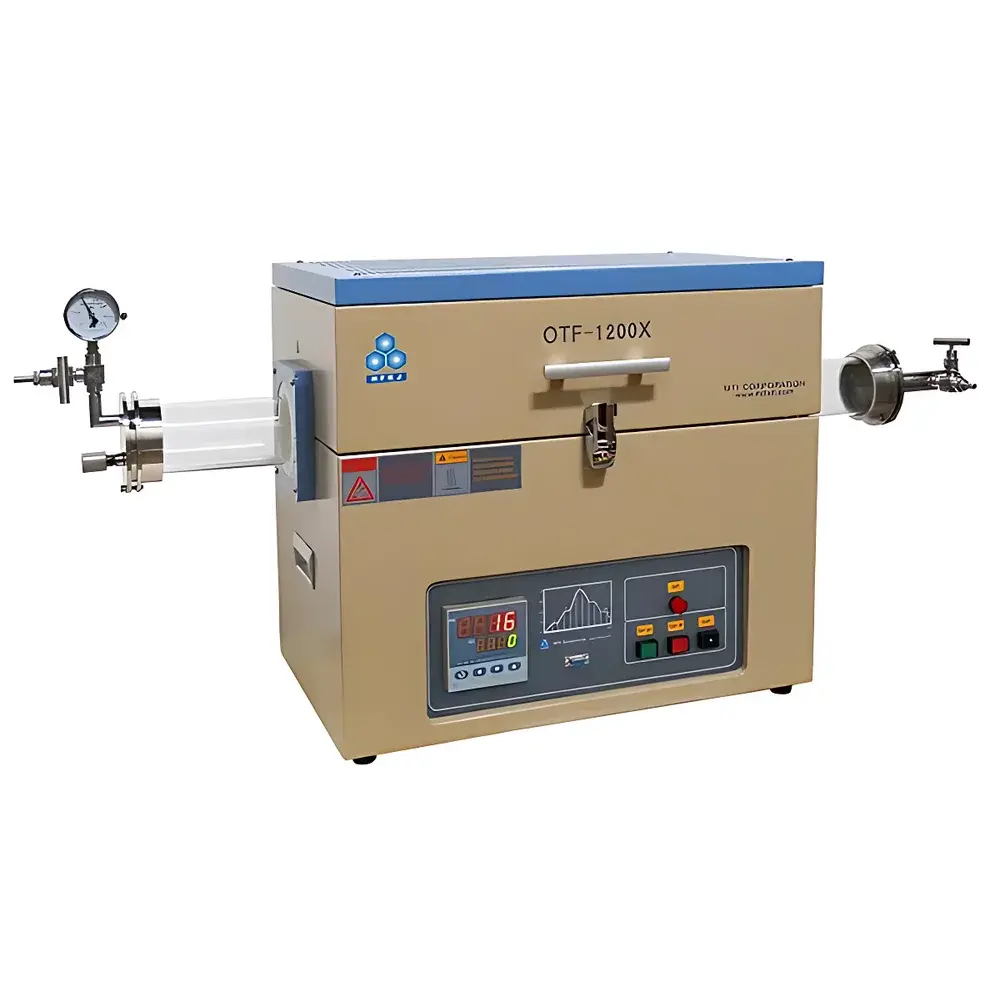
Kojin OTF-1200X Series Open-Type Tube Furnace
| Brand | Kojin |
|---|---|
| Origin | Anhui, China |
| Model | OTF-1200X |
| Maximum Temperature | 1200 °C |
| Temperature Control Accuracy | ±1 °C |
| Rated Power | 3 kW |
| Max Heating Rate | 20 °C/min |
| Heating Method | Resistance Wire (Fe-Cr-Al Alloy doped with Mo, ZrO₂-coated) |
| Tube Dimensions (Standard) | OD 50 mm × ID 44 mm × L 1000 mm |
| Heating Zone Length | 440 mm |
| Uniform Temperature Zone | 150 mm (±1 °C) |
| Vacuum Capability | 10⁻² Torr (with dual-stage rotary vane pump), 10⁻⁵ Torr (with turbomolecular pump system) |
| External Dimensions | 590 × 380 × 520 mm |
| Net Weight | 40 kg |
Overview
The Kojin OTF-1200X Series Open-Type Tube Furnace is a precision-engineered high-temperature thermal processing instrument designed for controlled-atmosphere and vacuum-based synthesis, annealing, sintering, and thermal analysis in academic, industrial, and R&D laboratories. Its open-tube architecture enables rapid sample insertion and real-time process observation, while the dual-layer air-cooled shell ensures surface temperature remains ≤60 °C under full-load operation—enhancing operator safety and lab space compatibility. The furnace employs a high-purity alumina microfiber insulation core formed via vacuum adsorption, offering exceptional thermal stability and low heat loss. A proprietary 1750 °C-rated American-sourced high-emissivity alumina coating is applied to the inner chamber wall to improve radiant heat reflection, increase heating efficiency, and maintain long-term chamber cleanliness—critical for reproducible high-temperature reactions across repeated cycles.
Key Features
- Double-wall air-cooled structural design with integrated forced-air circulation for safe surface temperatures and extended component service life.
- High-density alumina microfiber furnace lining with vacuum-formed geometry and high-temperature ceramic coating (1750 °C rated) for uniform thermal distribution and resistance to thermal shock.
- Mo-doped Fe-Cr-Al resistance heating elements with zirconia protective coating, engineered for oxidative stability and >5,000 hr operational longevity at 1100–1200 °C.
- Intelligent 30-segment programmable temperature controller with fuzzy PID algorithm and auto-tuning capability; supports ramp-hold profiles with real-time deviation compensation.
- Integrated over-temperature and thermocouple break protection circuits, compliant with IEC 61000-4-2/4-4 immunity standards for laboratory electromagnetic environments.
- Modular flange interface system: standard SS304 flanges include precision needle valves, analog vacuum gauges, and flexible hose connectors; optional KF-25 vacuum ports and Φ6.35 mm double-ferrule gas inlets available for high-vacuum or precision gas flow integration.
Sample Compatibility & Compliance
The OTF-1200X accommodates cylindrical quartz, alumina, or silicon carbide tubes (ID 44–94 mm) for processing powders, pellets, thin films, fibers, and small-volume bulk samples under inert, reducing, oxidizing, or vacuum conditions. It meets essential safety and performance benchmarks for Class II laboratory thermal equipment per EN 61010-1:2010 and UL 61010-1. While not certified for GMP production, its repeatable thermal profiles, audit-ready programmable logic, and optional PC-based data logging (via RS485/USB interface) support GLP-aligned experimental documentation. For applications requiring regulatory traceability, the furnace can be integrated into 21 CFR Part 11-compliant data acquisition systems when paired with validated third-party software and electronic signature modules.
Software & Data Management
The built-in temperature controller provides local display and manual setpoint adjustment. For automated process recording and remote supervision, optional PC control software (sold separately) enables real-time acquisition of temperature, power consumption, and alarm status at user-defined intervals (1–60 s resolution). Data export is supported in CSV and Excel-compatible formats, facilitating post-run statistical analysis (e.g., ANOVA of thermal cycle repeatability) and inclusion in technical reports. Firmware updates are performed via USB flash drive, ensuring long-term adaptability without hardware modification. All logged parameters include timestamped metadata—enabling correlation with auxiliary sensor inputs (e.g., mass spectrometer signals or gas flow controllers) in multi-instrument experiments.
Applications
- Synthesis of functional ceramics, battery cathode materials (e.g., LiCoO₂, NMC), and metal–organic frameworks (MOFs) under controlled O₂ partial pressure or Ar/N₂ atmospheres.
- Thermal annealing of CVD-grown 2D materials (graphene, TMDs) on Si/SiO₂ substrates, where precise ramp rates and uniform axial gradients minimize defect formation.
- Reductive carbothermic processing of metal oxides (e.g., NiO → Ni, Fe₂O₃ → Fe) in flowing H₂/Ar mixtures up to 1100 °C.
- High-temperature calibration of thermocouples and reference materials per ASTM E230/E220 protocols.
- Pre-oxidation treatment of refractory alloys prior to hot isostatic pressing (HIP), leveraging the furnace’s stable 150 mm uniform zone for batch consistency.
FAQ
What is the maximum safe operating pressure inside the tube?
The internal tube pressure must not exceed 0.02 MPa (≈0.2 bar gauge). For pressurized gas processes, a certified pressure regulator (0.01–0.1 MPa range) is mandatory upstream of the inlet valve.
Can the furnace operate under high vacuum at 1200 °C?
No. At temperatures above 1000 °C, the quartz tube must be maintained at atmospheric pressure or under slight positive inert gas flow to prevent deformation or fracture. High vacuum (<10⁻³ Torr) is permitted only below 1000 °C.
What is the recommended maximum gas flow rate during heating?
Total inlet gas flow should remain ≤200 SCCM to avoid thermal shock to the hot zone and ensure laminar flow dynamics within the tube.
Is the furnace compatible with custom tube materials such as SiC or Al₂O₃?
Yes—standard flange dimensions accommodate tubes with OD 50–100 mm and wall thicknesses ≥3 mm. Consult technical specifications for maximum allowable thermal expansion mismatch.
Does the unit include vacuum pumping hardware?
The base configuration includes vacuum-rated SS304 flanges and analog vacuum gauge but excludes pumps. Dual-stage rotary vane pumps (10⁻² Torr) and turbomolecular pump systems (10⁻⁵ Torr) are available as configurable options.



