
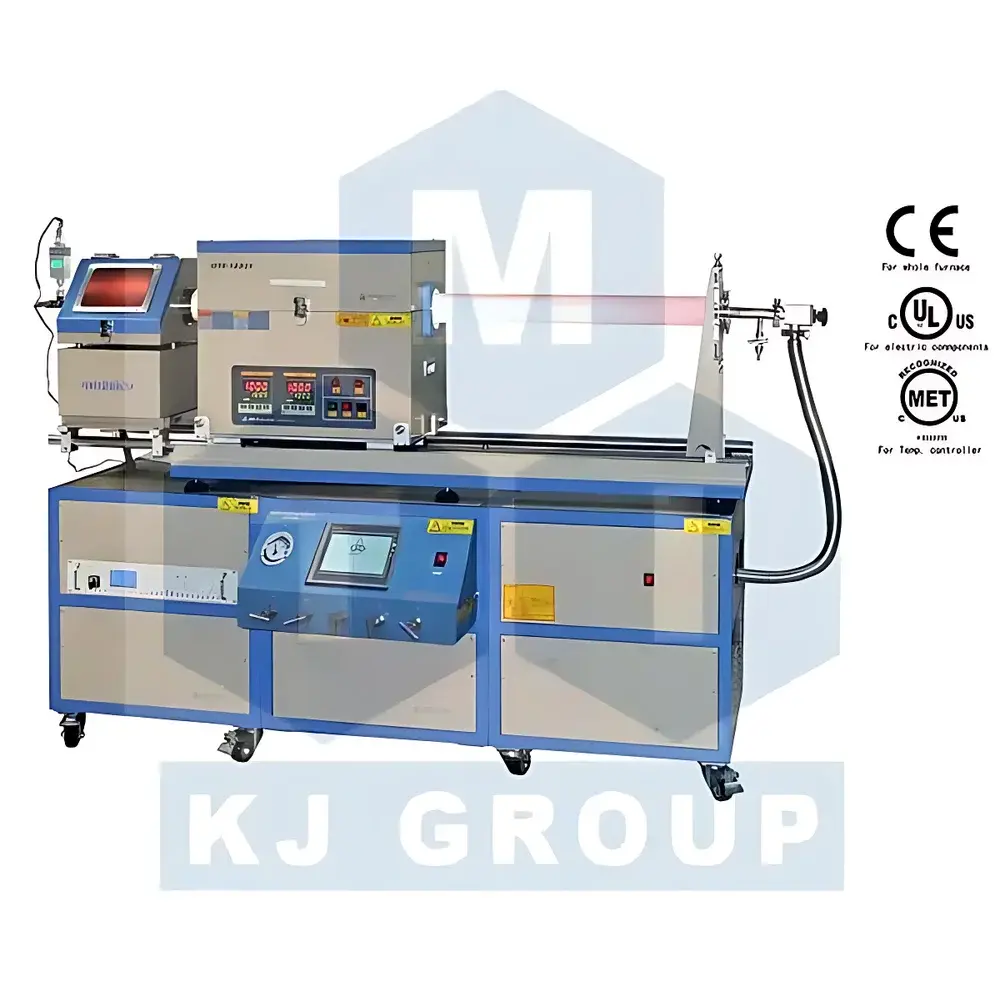
KJG OTF-1200X-II-4CV-PE-SL-UL Sliding Dual-Zone Plasma-Enhanced Chemical Vapor Deposition (PECVD) System
| Brand | KJG (Hefei Kejing Materials Technology Co., Ltd.) |
|---|---|
| Origin | Anhui, China |
| Model | OTF-1200X-II-4CV-PE-SL-UL |
| Furnace Type | Horizontal Tube Furnace |
| Maximum Operating Temperature | 1100 °C |
| Plasma Source Power | 5–500 W ±1% |
| RF Frequency | 13.56 MHz ±0.005% |
| Matching | Automatic RF Matching Network |
| Vacuum Level | ≤1×10⁻² Torr (with optional corrosion-resistant digital vacuum gauge: 3.8×10⁻⁵–1125 Torr) |
| Gas Delivery | Four-channel Mass Flow Controller (MFC) system (0–100 sccm, 0–200 sccm ×2, 0–500 sccm) |
| MFC Accuracy | ±0.02% FS |
| Tube Dimensions (standard) | 80 mm OD × 71.5 mm ID × 1800 mm L |
| Dual Heating Zones | Independent PID control, max ΔT = 200 °C |
| Cooling Method | Forced air cooling for plasma source |
| Electrical Supply | AC 208–240 V, 50/60 Hz |
| Compliance | CE certified |
| Warranty | 12 months (excludes consumables: quartz tube, high-temp O-rings, heating elements) |
Overview
The KJG OTF-1200X-II-4CV-PE-SL-UL is a precision-engineered sliding dual-zone plasma-enhanced chemical vapor deposition (PECVD) system designed for low-temperature synthesis of functional thin films and nanostructures—including graphene, carbon nanotubes, ZnO nanowires, and dielectric layers—under controlled reactive atmospheres. Unlike conventional thermal CVD, this system integrates a 500 W RF (13.56 MHz) plasma source directly into the reaction zone, enabling dissociation of precursor gases at significantly reduced substrate temperatures (typically 300–700 °C), thereby minimizing thermal stress on temperature-sensitive substrates and enabling integration with flexible or pre-patterned platforms. The horizontal double-heating-zone tube furnace features independently controllable zones with up to 200 °C axial temperature gradient, supporting complex thermal profiles essential for graded heterostructures or multi-step growth protocols. The furnace tube is lined with US-sourced high-purity alumina ceramic coating to enhance radiative efficiency and extend service life under repeated thermal cycling. All structural and electrical components comply with IEC 61000 electromagnetic compatibility standards and meet CE requirements for laboratory equipment safety.
Key Features
- Sliding mechanical architecture: Enables rapid sample insertion/extraction and precise positioning within defined thermal zones—reducing thermal shock and improving process reproducibility.
- Dual independent PID-controlled heating zones: Each zone supports programmable ramp/soak profiles; maximum operating temperature 1100 °C with ±1 °C stability at steady state (verified per ASTM E220).
- Integrated 500 W RF plasma generator: Auto-matching network ensures >90% forward power coupling; reflected power <200 W; noise floor <50 dB; air-cooled design for continuous operation.
- Four-channel mass flow control system: High-accuracy MFCs (±0.02% full scale) with digital display and RS485 interface; configurable gas ranges (0–100, 0–200 ×2, 0–500 sccm) and integrated mixing chamber with waste liquid drain port.
- Vacuum subsystem: Includes corrosion-resistant digital Pirani/capacitance manometer (US-made, 3.8×10⁻⁵–1125 Torr range, no gas-species correction required), manual gate valve, stainless-steel bellows, and KF25 quick-connect flanges.
- Comprehensive safety architecture: Overpressure protection (<0.02 MPa limit), real-time vacuum monitoring, interlocked door switches, and fail-safe pressure relief mechanisms compliant with ISO 10527 and EN 61000-6-3.
Sample Compatibility & Compliance
This PECVD system accommodates substrates up to 76 mm in diameter (for 80 mm OD tube configuration) and supports quartz, silicon, fused silica, and metal foils. It is routinely deployed in academic and industrial R&D labs adhering to GLP and GMP-aligned workflows. The system meets CE marking requirements (2014/30/EU EMC Directive and 2014/35/EU Low Voltage Directive). All high-voltage components (>24 V) carry UL, MET, or CSA certification. Optional TÜV Rheinland or CSA single-unit certification is available upon customer request and fee. The quartz tube assembly conforms to ASTM F798 for high-purity fused silica performance in semiconductor-grade processing environments.
Software & Data Management
The system includes free PC-based temperature control software via RS485 communication (USB-to-RS485 adapter and control module sold separately). Software supports multi-segment ramp-soak programming, real-time graphing, data logging (CSV export), and alarm-triggered event capture. Vacuum and gas flow parameters can be logged synchronously when interfaced with third-party DAQ systems. Audit trail functionality—including user login, parameter changes, and run history—is implementable via optional FDA 21 CFR Part 11-compliant add-on modules for regulated environments. All firmware updates are delivered via secure HTTPS portal with version-controlled release notes.
Applications
- Growth of monolayer and few-layer graphene on Cu/Ni foils via methane/hydrogen plasma-assisted decomposition.
- Synthesis of vertically aligned ZnO nanorods using diethylzinc and oxygen plasma at <500 °C.
- Deposition of SiNx, SiOx, and a-Si:H passivation layers for photovoltaic devices.
- Surface functionalization of polymer membranes with hydrophobic or antimicrobial coatings.
- Low-temperature nitridation of transition metals for catalytic electrode fabrication.
- Preparation of carbon-doped TiO2 photocatalysts under mixed CH4/Ar plasma conditions.
FAQ
What is the maximum allowable internal pressure during PECVD operation?
The quartz tube must not exceed 0.02 MPa (≈0.2 bar gauge). Always use a calibrated pressure relief valve and inline regulator (recommended range: 0.01–0.1 MPa) when connecting gas cylinders.
Can the system operate under high vacuum without plasma ignition?
Yes—but operation above 1000 °C requires atmospheric or slightly positive pressure to prevent quartz deformation. Do not hold vacuum >10⁻² Torr at temperatures >1000 °C.
Is the plasma source compatible with corrosive precursors such as NF3 or Cl2?
The RF generator and matching network are rated for inert and mildly corrosive chemistries. For aggressive halogenated gases, optional quartz-lined plasma chamber and Hastelloy gas lines are recommended.
How is temperature uniformity validated across the dual zones?
Uniformity is characterized using NIST-traceable thermocouples per ASTM E220 Annex A3; typical axial uniformity is ±3 °C over 100 mm central zone at 900 °C.
What maintenance intervals are recommended for the RF matching network?
Inspect capacitors and tuning rods quarterly; clean RF contacts with isopropyl alcohol biannually; replace O-rings every 12 months or after 200 plasma cycles.



