
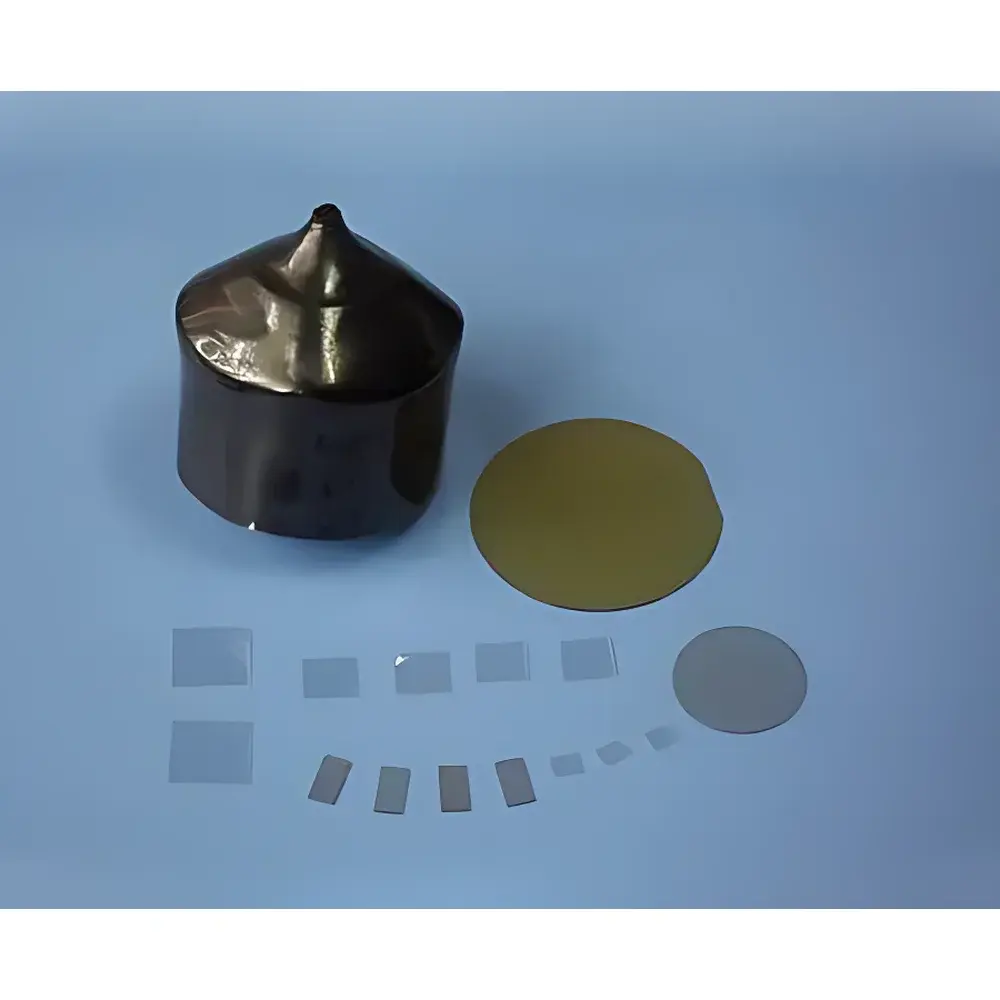
LSAT (La,Sr)(Al,Ta)O₃ Single-Crystal Substrate Wafers
| Brand | Hefei Kejing |
|---|---|
| Origin | Anhui, China |
| Manufacturer Type | Authorized Distributor |
| Origin Category | Domestic |
| Model | LSAT |
| Pricing | Upon Request |
| Chemical Formula | (La,Sr)(Al,Ta)O₃ |
| Crystal Structure | Cubic, a = 3.868 Å |
| Growth Method | Czochralski (CZ) |
| Density | 6.74 g/cm³ |
| Melting Point | 1840 °C |
| Mohs Hardness | 6.5 |
| Thermal Expansion Coefficient | 10 × 10⁻⁶ /K |
| Dielectric Constant | ~22 |
| Color/Appearance | Colorless to light brown (annealing-dependent), twin-free, domain-free |
| Standard Dimensions | 10 × 5 × 0.5 mm, 10 × 10 × 0.5 mm, Ø2″ × 0.5 mm |
| Orientations | <100>, <110>, <111> (tolerance ±0.5°) |
| Surface Roughness (Ra) | <0.5 nm |
| Packaging | Class 1000 cleanroom + Class 100 clean bag or individual cassette |
Overview
LSAT [(La,Sr)(Al,Ta)O₃] is a single-phase, twin-free perovskite-structured oxide crystal engineered for high-precision epitaxial growth of functional oxide thin films. Unlike conventional substrates such as LaAlO₃ or SrTiO₃, LSAT exhibits near-perfect lattice matching with a broad range of complex oxides—including high-temperature superconductors (e.g., YBCO, LSCO), multiferroics (e.g., BiFeO₃), and colossal magnetoresistive manganites—enabling atomically coherent heterostructures with minimized interfacial strain and defect density. Its cubic symmetry (space group Pm3̄m), low twin formation tendency, and thermal expansion coefficient closely aligned with many functional oxides make LSAT particularly suitable for in-situ monitoring applications in quartz crystal microbalance (QCM) systems and electrochemical thin-film deposition platforms where substrate stability, surface homogeneity, and dielectric consistency are critical.
Key Features
- Structural Purity: Grown via optimized Czochralski method under controlled oxygen partial pressure; verified twin-free and domain-free by high-resolution X-ray diffraction (HR-XRD) and transmission electron microscopy (TEM).
- Lattice Matching Precision: Lattice parameter a = 3.868 Å provides ≤0.2% mismatch with YBCO (a = 3.82 Å), LSCO (a = 3.78 Å), and BiFeO₃ (a = 3.96 Å), enabling strain-engineered epitaxy without buffer layers.
- Surface Integrity: Chemomechanically polished and annealed surfaces achieve Ra < 0.5 nm (measured by atomic force microscopy), meeting stringent requirements for molecular beam epitaxy (MBE) and pulsed laser deposition (PLD).
- Thermal & Dielectric Stability: Low thermal expansion coefficient (10 × 10⁻⁶ /K) ensures dimensional stability during thermal cycling (−196 °C to 800 °C); dielectric constant (~22) remains stable up to 1 MHz, supporting reliable QCM frequency calibration.
- Customization Flexibility: Available in standard orientations (, , ) with angular tolerance ±0.5°; custom dimensions, thicknesses (0.3–1.0 mm), and surface terminations (O-terminated vs. cation-terminated) available upon specification.
Sample Compatibility & Compliance
LSAT substrates are compatible with ultra-high vacuum (UHV) environments (base pressure ≤1 × 10⁻¹⁰ mbar) and standard thin-film growth techniques including sputtering, MBE, PLD, and metal-organic chemical vapor deposition (MOCVD). All wafers undergo rigorous pre-shipment inspection per ISO 14644-1 Class 5 (ISO Class 5) cleanroom protocols. Surface particulate count is verified using laser particle counters (≥0.3 µm threshold), and residual carbon contamination is quantified via X-ray photoelectron spectroscopy (XPS) to ensure ≤0.5 at.% C on the as-received surface. While not certified to ASTM F1529 or SEMI F47, LSAT wafers conform to industry-standard handling practices for oxide substrates used in GLP-compliant materials research labs and semiconductor R&D facilities.
Software & Data Management
LSAT substrates themselves are passive crystalline components and do not incorporate embedded firmware or software interfaces. However, when integrated into QCM-based electrochemical instrumentation (e.g., QCM-D systems), they interface seamlessly with industry-standard data acquisition platforms including QSense Analyzer Suite (Biolin Scientific), NOVA (Metrohm Autolab), and Gamry Framework. Raw frequency (Δf) and dissipation (ΔD) outputs from QCM sensors employing LSAT electrodes are fully compatible with ISO/IEC 17025-aligned data traceability workflows. Audit trails, user access logs, and electronic signatures can be implemented via third-party laboratory information management systems (LIMS) compliant with FDA 21 CFR Part 11 when paired with validated instrument drivers.
Applications
- Epitaxial growth of high-Tc superconducting films (YBa₂Cu₃O7−δ, La₂₋xSrxCuO₄) for Josephson junction fabrication.
- Strain-tuned multiferroic heterostructures (e.g., BiFeO₃/LSAT) for voltage-controlled magnetism studies.
- Model dielectric substrates in QCM-based biosensing platforms requiring low dielectric loss and high surface order.
- Reference standards in XRD texture analysis and reciprocal space mapping of oxide heteroepitaxy.
- Substrates for resistive switching oxide memristors (e.g., NiO, TaOx) where interfacial oxygen vacancy control is critical.
FAQ
What is the typical lead time for custom-cut LSAT wafers?
Standard stock sizes ship within 5 business days; custom dimensions/orientations require 3–4 weeks for polishing, annealing, and metrology verification.
Can LSAT substrates be used in reducing atmospheres?
Yes—LSAT demonstrates superior redox stability compared to SrTiO₃ below pO₂ = 10⁻¹⁵ atm, making it suitable for growth of oxygen-deficient phases such as Fe-based superconductors.
Is surface termination specified for QCM electrode applications?
Standard wafers are delivered with O-terminated surfaces; cation-terminated variants are available with prior specification and additional surface reconstruction annealing.
Do you provide XRD rocking curve data for each batch?
Yes—full θ–2θ scans and (002) rocking curves (FWHM ≤ 0.02°) are included in the certificate of analysis for every shipped lot.
Are LSAT wafers compatible with HF-based cleaning protocols?
No—HF etching is not recommended due to Ta–O bond susceptibility; dilute HCl/HNO₃ or ozone UV cleaning is preferred for organic residue removal.




