
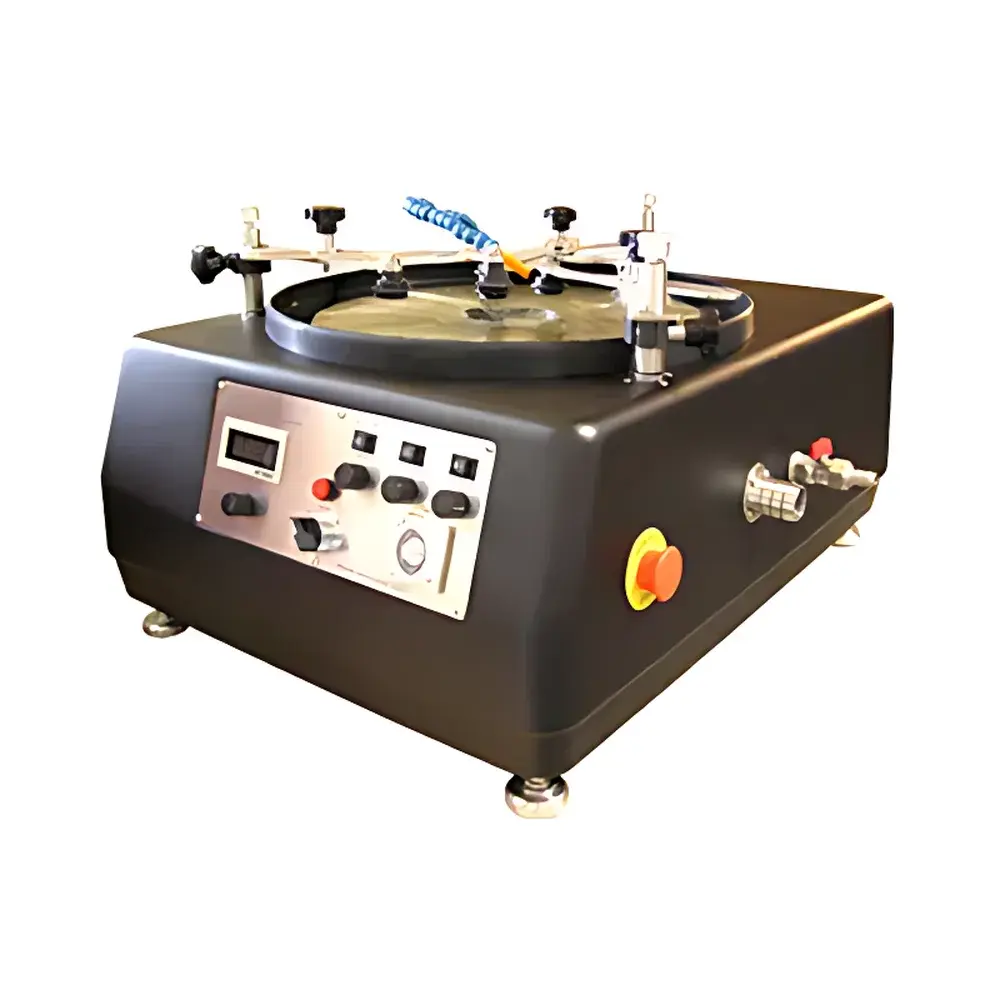
Unipol-1502 Precision Automatic Grinding and Polishing System
| Brand | Hefei Kejing |
|---|---|
| Origin | Anhui, China |
| Manufacturer Type | Authorized Distributor |
| Country of Origin | China |
| Model | Unipol-1502 |
| Power Supply | AC 110 V / 220 V |
| Speed Control | Stepless digital speed adjustment |
| Timer Range | 1 min – 99.99 h |
| Platen Diameter | 381 mm |
| Platen Flatness | < 0.3 µm per 25 mm × 25 mm |
| Spindle Runout (Tray End) | < 8 µm |
| Workstations | 3 independent stations |
| Dimensions (L×W×H) | 650 mm × 510 mm × 300 mm |
| Net Weight | 95 kg |
| Overall Footprint (with accessories) | 810 mm × 800 mm × 800 mm |
| Total System Weight | 200 kg |
| Pressure Adjustment Range | 100 g – 2000 g via calibrated counterweights |
| Optional Accessories | Cast iron & cast aluminum platens (Ø381 mm), truing rings (×3), sample holders (×3), truing ring supports (×3), granite thickness gauge (Grade “00”, 50 mm × 200 mm), automatic dispensing dropper with mixing function, recirculating slurry pump, copper/tin alloy polishing plates, adhesive-backed polishing pads |
Overview
The Unipol-1502 Precision Automatic Grinding and Polishing System is an engineered solution for high-fidelity planar surface preparation of brittle and ductile materials in research laboratories, quality control facilities, and semiconductor R&D environments. Designed around a rigid cast-iron base and precision-machined kinematic architecture, the system implements controlled material removal through sequential abrasive grinding and fine polishing—processes governed by mechanical contact mechanics, slurry-mediated abrasion kinetics, and deterministic pressure distribution. Its three-station configuration enables parallel processing of multiple specimens under identical kinematic and loading conditions, ensuring inter-sample reproducibility essential for comparative microstructural analysis (e.g., SEM cross-sectioning, XRD texture mapping, or TEM lamella preparation). The system complies with foundational metrological requirements defined in ISO 14721 (preparation of metallographic specimens) and ASTM E3 (Standard Guide for Preparation of Metallographic Specimens), supporting traceable, repeatable surface finishing down to sub-micron flatness tolerances.
Key Features
- Ultra-flat platen surface: ≤ 0.3 µm deviation over any 25 mm × 25 mm region—verified via optical interferometry—ensuring uniform material removal rate across large-area samples (≥100 mm diameter or rectangular formats).
- High-precision spindle assembly: Axial runout at the platen interface maintained below 8 µm, minimizing lateral vibration and preserving edge integrity during high-load grinding cycles.
- Triple independent workstations: Each station accommodates individually adjustable sample holders with calibrated mass-loading capability (100–2000 g), enabling simultaneous multi-condition experiments or throughput-optimized batch processing.
- Digital stepless speed control: Motor-driven platen rotation from 0 to 200 rpm with ±0.5 rpm resolution, programmable via front-panel interface to match optimal shear rates for specific abrasives (e.g., SiC, diamond, alumina) and slurries.
- Programmable timer with extended range: Precise cycle duration control from 1 minute to 99.99 hours in 0.01-hour increments—critical for process validation, GLP documentation, and automated unattended operation.
- Integrated fluid management interface: Standard mounting points and electrical I/O for optional automatic slurry dispensing (dropper with mixing chamber) or closed-loop recirculation (peristaltic pump), reducing operator intervention and improving slurry consistency.
Sample Compatibility & Compliance
The Unipol-1502 accommodates a broad spectrum of solid-state materials including single-crystal semiconductors (Si, GaAs, sapphire), polycrystalline ceramics (Al₂O₃, ZrO₂, SiC), metallic alloys (Ti-6Al-4V, stainless steels, Cu, Ni), and composite laminates. Sample geometries supported include discs up to Ø150 mm, rectangles up to 120 mm × 120 mm, and irregular shapes secured via custom-designed fixture blocks (available upon specification). All mechanical and electrical subsystems conform to CE safety directives (2014/35/EU Low Voltage Directive, 2014/30/EU EMC Directive). When operated with documented SOPs and calibrated weights, the system satisfies audit requirements for ISO/IEC 17025-accredited testing laboratories and supports data integrity frameworks aligned with FDA 21 CFR Part 11 for electronic records where integrated software logging is deployed.
Software & Data Management
While the Unipol-1502 operates as a standalone instrument with embedded digital controls, it is fully compatible with external laboratory information management systems (LIMS) and electronic lab notebooks (ELN) via RS-232 or optional USB-to-serial interface. Process parameters—including rotational speed, elapsed time, and manual weight settings—are retained in non-volatile memory and can be exported as CSV logs for traceability. Optional PC-based control software (sold separately) provides real-time parameter monitoring, recipe storage (up to 99 user-defined protocols), and timestamped event logging with operator ID tagging—facilitating compliance with GMP/GLP documentation standards and internal QA audits.
Applications
- Preparation of optically flat substrates for thin-film deposition and epitaxial growth characterization.
- Production of artifact-free cross-sections for scanning electron microscopy (SEM) and focused ion beam (FIB) site-specific milling.
- Surface planarization prior to X-ray diffraction (XRD) texture analysis or electron backscatter diffraction (EBSD) mapping.
- Controlled thickness reduction of wafer-scale samples in photovoltaic and MEMS development workflows.
- Routine quality assurance of sintered ceramic components, where surface roughness (Ra) and flatness (TT) directly correlate with functional performance.
- Research-grade specimen fabrication for hardness testing (Vickers, Knoop), wear resistance evaluation, and thermal conductivity measurement.
FAQ
What materials can be processed on the Unipol-1502 without risk of cracking or delamination?
Brittle materials such as silicon wafers, fused quartz, and alumina ceramics require low-speed grinding with fine-grit abrasives and continuous coolant delivery; the system’s stable platen geometry and low-vibration spindle minimize subsurface damage when operated within recommended parameter envelopes.
Is the Unipol-1502 suitable for preparing TEM lamellae?
While not a dedicated TEM prep system, the Unipol-1502 serves as a robust pre-thinning platform—reducing bulk specimens to ~50–100 µm thickness prior to final ion milling or FIB thinning.
Can the system be integrated into an automated sample preparation line?
Yes—its modular design, standardized mounting interfaces, and serial communication capability support integration with robotic sample handlers and centralized process controllers in Industry 4.0 laboratory environments.
Does the Unipol-1502 meet ISO 14721 requirements for metallographic specimen preparation?
When used with certified abrasives, calibrated weights, and documented procedures, the system fulfills the mechanical stability, dimensional accuracy, and repeatability criteria outlined in Clause 6.2 (Grinding and Polishing Equipment) of ISO 14721:2022.
What maintenance intervals are recommended for long-term metrological stability?
Platen flatness verification every 6 months using a Grade “00” granite reference plate; spindle bearing inspection annually; torque calibration of counterweight assemblies before each high-precision campaign.



