
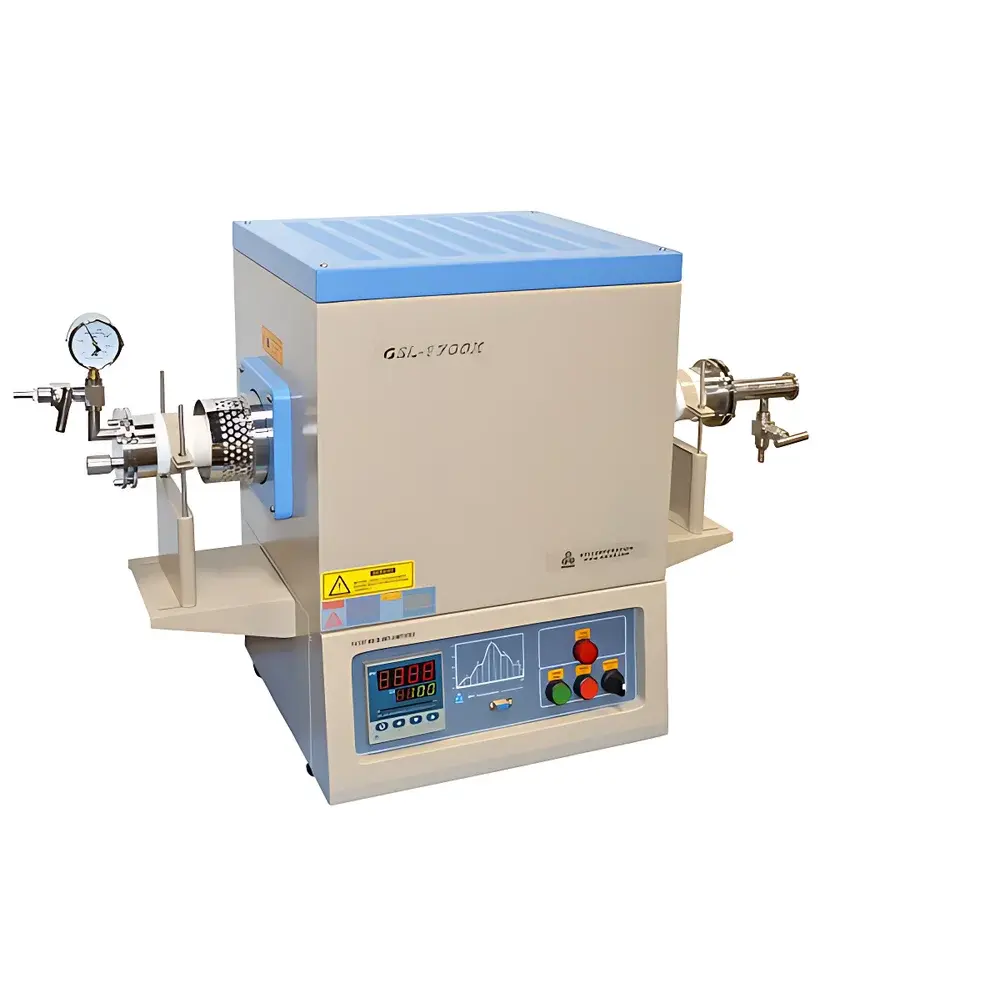
KEJING GSL-1800X High-Temperature Vacuum & Atmosphere Tube Furnace
| Brand | KEJING |
|---|---|
| Origin | Anhui, China |
| Model | GSL-1800X |
| Max Temperature | 1800°C (≤2 h) |
| Continuous Operating Temperature | 1750°C |
| Control Accuracy | ±1°C |
| Heating Rate | 5°C/min (T < 1600°C) |
| Heating Zone Length | 457 mm |
| Uniform Temperature Zone | 150 mm |
| Tube Dimensions (Std.) | OD 60 mm × ID 53 mm × L 1000 mm |
| Tube Material | 99.8% Al₂O₃ Ceramic |
| Heating Element | Kanthal Super-1900 MoSi₂ Rods |
| Power Supply | 220 V AC, 50/60 Hz, 40 A breaker required |
| Max Power | 5 kW |
| Vacuum Level | 1×10⁻² Torr (with mechanical pump) |
| Insulation | High-purity alumina fiber + 10 mm ZrO₂ liner |
| Cooling | Dual-layer air-cooled housing (surface temp. <55°C) |
| Certification | CE, UL/MET/CSA compliant (>24 V components) |
Overview
The KEJING GSL-1800X is a high-precision, dual-shell tube furnace engineered for controlled thermal processing under vacuum or reactive/inert atmospheres. It operates on the principle of resistive heating via silicon molybdenum (MoSi₂) elements, delivering stable, uniform temperature profiles across a 457 mm heating zone—critical for reproducible sintering, annealing, crystal growth, and precursor decomposition in advanced materials research. Its structural design integrates active air cooling, high-emissivity ZrO₂-lined insulation, and a robust 99.8% alumina ceramic tube (OD 60 mm, L 1000 mm), enabling sustained operation at 1750°C and short-term excursions to 1800°C. The furnace meets CE requirements and complies with electrical safety standards (UL/MET/CSA) for all components rated above 24 V, supporting integration into ISO/IEC 17025-accredited laboratories and GMP-aligned pilot-scale synthesis workflows.
Key Features
- Dual-layer stainless steel housing with forced-air cooling ensures external surface temperature remains below 55°C during continuous operation—enhancing lab safety and reducing ambient heat load.
- Zirconia (ZrO₂)-reinforced alumina fiber insulation (10 mm thick liner, refractoriness up to 2300°C) minimizes radial thermal gradient and improves energy efficiency.
- PID-based 30-segment programmable temperature controller enables precise ramp-hold-cool sequences with ±1°C stability over the full operating range.
- Standard vacuum configuration includes dual stainless steel KF-40 flanges, silicone O-rings, two stainless needle valves, and a mechanical Bourdon-tube pressure gauge (range: 0–760 Torr).
- B-type thermocouple (Pt/Rh-Pt) embedded in the furnace wall provides traceable, NIST-compatible temperature feedback with long-term drift <0.5°C/year.
- Modular interface supports optional upgrades: digital capacitance manometer (10⁻⁵ Torr resolution), hinge-mounted flanges for rapid tube access, and KF25 adapters for vacuum line compatibility.
Sample Compatibility & Compliance
The GSL-1800X accommodates cylindrical samples up to 53 mm in diameter and 1000 mm in length within its high-purity Al₂O₃ tube. It is routinely deployed for processing oxide ceramics (e.g., YBCO, BaTiO₃), refractory metals (Mo, W), MAX phases, and solid-state battery cathodes (NMC, LFP). All vacuum and gas-handling components conform to ASTM F2734 (vacuum system integrity) and ISO 10110-7 (optical component cleanliness) guidelines when used with purge protocols. The furnace’s electrical architecture satisfies IEC 61000-6-3 (EMC emissions) and IEC 61000-6-2 (immunity), facilitating use in shared instrumentation facilities subject to GLP audit requirements.
Software & Data Management
While the standard controller features local keypad operation and real-time curve display, optional RS485/Modbus RTU output enables integration with LabVIEW, MATLAB, or SCADA systems for automated data logging. Temperature profiles, hold times, and alarm events are timestamped and exportable as CSV files—supporting 21 CFR Part 11 compliance when paired with validated third-party software platforms that provide electronic signatures, audit trails, and user access controls. Firmware updates are delivered via USB and include version-locked calibration coefficients traceable to national metrology institutes.
Applications
- Sintering of ultra-high-temperature ceramics (UHTCs) and refractory composites under Ar/H₂/N₂ atmospheres.
- Vacuum annealing of graphene oxide films and transition metal dichalcogenide monolayers.
- Controlled pyrolysis of MOFs and covalent organic frameworks (COFs) for porous carbon synthesis.
- Thermal treatment of lithium-ion battery electrode slurries prior to cell assembly.
- Crystal growth of perovskite single crystals via slow-cooling gradient methods.
- Reduction of metal oxides (e.g., NiO → Ni, Co₃O₄ → Co) in H₂/N₂ mixtures for catalyst preparation.
FAQ
What vacuum level can be achieved with the standard mechanical pump configuration?
The base system achieves ≤1×10⁻² Torr using a two-stage rotary vane pump. For applications requiring <10⁻⁵ Torr (e.g., thin-film deposition precursors), a turbomolecular pump station with DN40 CF flange interface is recommended.
Is the furnace suitable for hydrogen atmosphere operation?
Yes—when equipped with leak-tested stainless steel flanges, H₂-compatible needle valves, and appropriate gas flow controllers, the GSL-1800X supports safe operation up to 5% H₂ in N₂ at temperatures ≤1200°C. Hydrogen service requires additional leak-checking per ISO 15848-1.
How often must consumables be replaced under normal use?
Al₂O₃ tubes typically last 100–200 cycles at ≤1600°C; MoSi₂ rods exhibit ~2000 h lifetime at 1750°C continuous duty. Silicone O-rings should be inspected and replaced every 6 months or after 50 thermal cycles.
Does the unit support remote monitoring via Ethernet or Wi-Fi?
Not natively—but the RS485 port allows connection to industrial gateways (e.g., Moxa EDS-G205A) for TCP/IP bridging into enterprise MES or LIMS environments.
Can custom tube dimensions or alternative tube materials (e.g., quartz, SiC) be supplied?
Yes—KEJING offers OEM tube fabrication in fused silica (up to 1100°C), silicon carbide (up to 1600°C), and recrystallized alumina (up to 1800°C), subject to minimum order quantities and lead time validation.



