
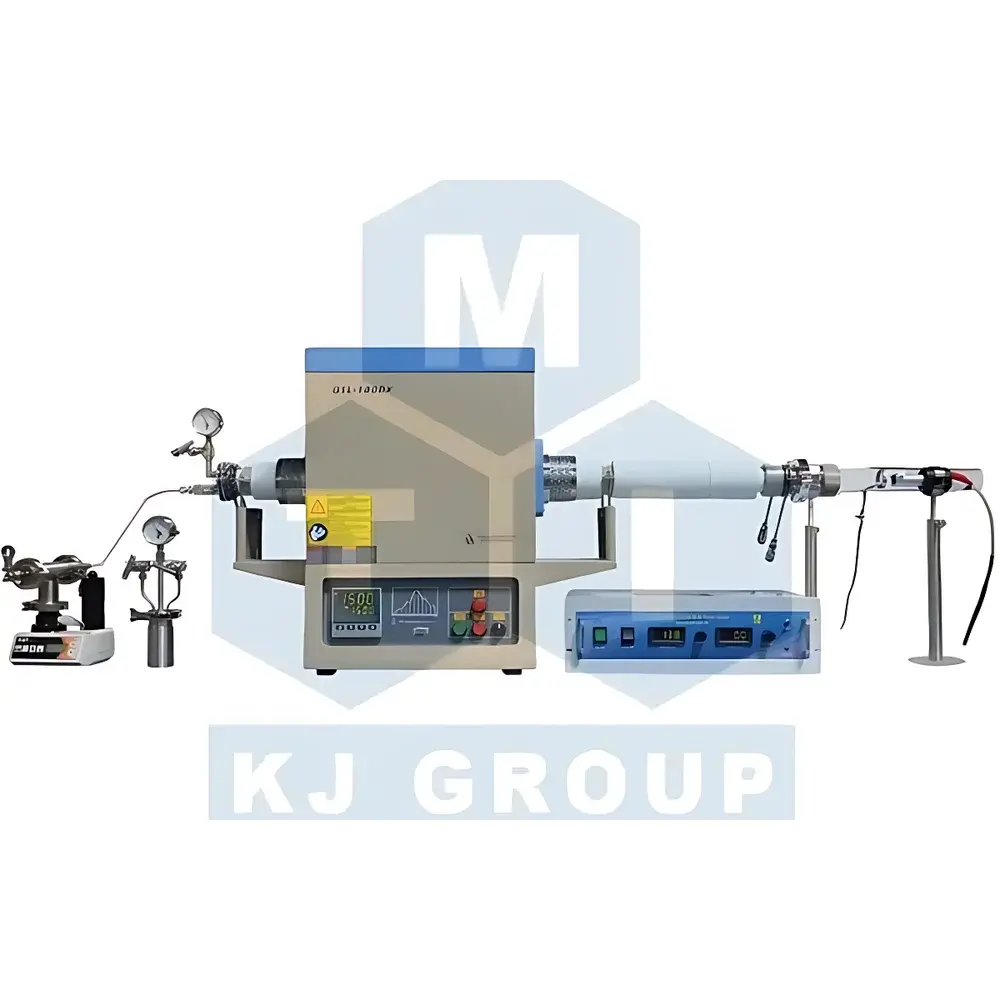
GSL-1800X-PGEP Ultrasonic Nebulization & Electrostatic Precipitation Nanomaterial Synthesis Tube Furnace
| Brand | Hefei Kejing |
|---|---|
| Origin | Anhui, China |
| Manufacturer Type | Authorized Distributor |
| Origin Category | Domestic |
| Model | GSL-1800X-PGEP |
| Instrument Type | Tube Furnace |
| Max Temperature | 1800 °C |
| Temperature Control Accuracy | ±1 °C |
| Max Power | 2.5 kW |
| Heating Rate | 5 °C/min (T < 1600 °C) |
| Heating Element | Kanthal Super 1900-grade MoSi₂ Rods |
| Tube Dimensions | ID 54 mm × OD 60 mm × L 1200 mm |
Overview
The GSL-1800X-PGEP is an integrated high-temperature synthesis platform engineered for the controlled, one-step production of crystalline metal oxide nanomaterials via ultrasonic nebulization–thermal decomposition–electrostatic precipitation. Unlike conventional solid-state or sol-gel routes, this system enables continuous, gas-phase precursor delivery and in situ thermal transformation within a precisely defined high-temperature zone, minimizing agglomeration and enabling reproducible control over primary particle size (typically 5–100 nm), morphology (spherical, hollow, or core-shell), and phase purity. The furnace operates on the principle of rapid thermal processing (RTP) in a purified inert or reactive atmosphere (e.g., Ar, N₂, O₂, or diluted H₂), with precursor aerosols generated by high-frequency (2.4 MHz) piezoelectric atomization—ensuring narrow droplet size distribution (<5 µm SMD) prior to vaporization and nucleation. Its architecture supports fundamental research in catalysis, battery materials (e.g., LiCoO₂, Ni-rich NMC), transparent conducting oxides (ITO, AZO), and high-κ dielectrics under repeatable, traceable thermal profiles.
Key Features
- Triple-module integration: independent ultrasonic nebulizer, 1800 °C high-purity alumina tube furnace, and 30 kV electrostatic precipitator—all synchronized via interlocked gas flow and temperature control logic.
- High-stability heating system: dual-zone Kanthal Super 1900 MoSi₂ heating elements provide uniform axial temperature distribution; certified ±1 °C control accuracy over a 75 mm isothermal zone (±1 °C) within a 300 mm heating length.
- Robust gas-handling infrastructure: mass flow controller (0–100 sccm range, N₂/Ar calibrated), stainless-steel (316) fluidic manifolds, fluoropolymer-sealed liquid reservoir (150 mL), and KF-25 quick-connect flanges for leak-tight assembly and rapid module exchange.
- Controlled aerosol delivery: 2.4 MHz ultrasonic transducer with 0–100% adjustable power (5% increments); integrated condensate trap ensures only sub-10 µm droplets enter the reaction zone—preventing liquid carryover and thermal shock to the furnace tube.
- Safety-certified electronics: CE-marked; all components rated >24 V comply with UL 61010-1 / CSA C22.2 No. 61010-1 / MET requirements; optional TÜV or CSA single-unit certification available upon customer request.
Sample Compatibility & Compliance
The GSL-1800X-PGEP accommodates aqueous, alcoholic, or ethylene glycol-based metal salt solutions (e.g., nitrates, acetates, chlorides of Fe, Co, Ni, Mn, Sn, Zn, Ti, Y, La) and organometallic precursors compatible with rapid pyrolysis. It supports synthesis under ambient pressure (≤0.02 MPa gauge) with strict adherence to ISO 15195:2019 (calibration of high-temperature furnaces) and ASTM E2550-21 (thermal stability by TGA). All operational parameters—including ramp rates, dwell times, gas composition, and voltage settings—are programmable and logged to support GLP-compliant documentation. The system meets IEC 61000-6-3 (EMC emission) and IEC 61000-6-2 (immunity) standards. For regulated environments, audit trails, user access control, and electronic signature capability can be implemented via optional third-party SCADA integration (e.g., LabVIEW or Ignition SCADA), aligning with FDA 21 CFR Part 11 data integrity requirements when paired with validated software layers.
Software & Data Management
The furnace utilizes a programmable 30-segment PID controller with real-time temperature logging (1 Hz sampling) and configurable alarm thresholds (over-temperature, thermocouple break, pressure deviation). While the base unit does not include proprietary PC software, RS485 Modbus RTU interface enables seamless integration into existing laboratory informatics systems. Data export (CSV/TXT) supports post-run analysis of thermal history, gas flow correlation, and precipitator voltage-current curves. Optional firmware upgrades enable time-stamped event logging (e.g., “nebulizer ON”, “precipitator engaged”, “cool-down initiated”) for full process traceability—critical for method validation in QC/QA workflows compliant with ISO/IEC 17025.
Applications
- Synthesis of high-surface-area transition metal oxides for lithium-ion cathode precursors (e.g., nano-LiFePO₄, doped LiMn₂O₄).
- Production of plasmonic metal oxide nanoparticles (SnO₂, WO₃, VOₓ) for gas sensor development.
- Scalable generation of doped ceria (Ce₀.₉Gd₀.₁O₂₋δ) electrolytes for low-temperature SOFCs.
- In situ formation of core–shell structures (e.g., SiO₂@TiO₂) via sequential precursor injection and differential thermal decomposition.
- Fundamental studies of aerosol thermophoresis, coagulation kinetics, and charged particle deposition efficiency at elevated temperatures.
FAQ
What is the maximum allowable working pressure inside the alumina tube?
The absolute gauge pressure must not exceed 0.02 MPa (20 kPa) above atmospheric pressure to prevent tube deformation or seal failure.
Can the system operate continuously at 1800 °C?
No—the 1800 °C rating is for short-term operation only (≤2 hours per cycle); continuous duty is limited to 1750 °C to ensure heating element longevity and thermal stability.
Is the electrostatic collector compatible with corrosive precursor vapors?
Yes—the precipitator’s quartz housing and gold-plated electrodes resist oxidation and halogen corrosion; however, aggressive fluorinated precursors require optional quartz liner replacement between runs.
What maintenance intervals are recommended for consumables?
Alumina tube and MoSi₂ rods are warranted for one year but require visual inspection after every 50 high-temperature cycles; fluoropolymer O-rings should be replaced every 6 months or after exposure to acidic mists.
Does the system support automated precursor solution replenishment?
Not natively—the current design requires manual refilling of the 150 mL reservoir; however, third-party peristaltic pump integration (with level sensing) is feasible via the 0–10 V analog control input port.
Related Products



