
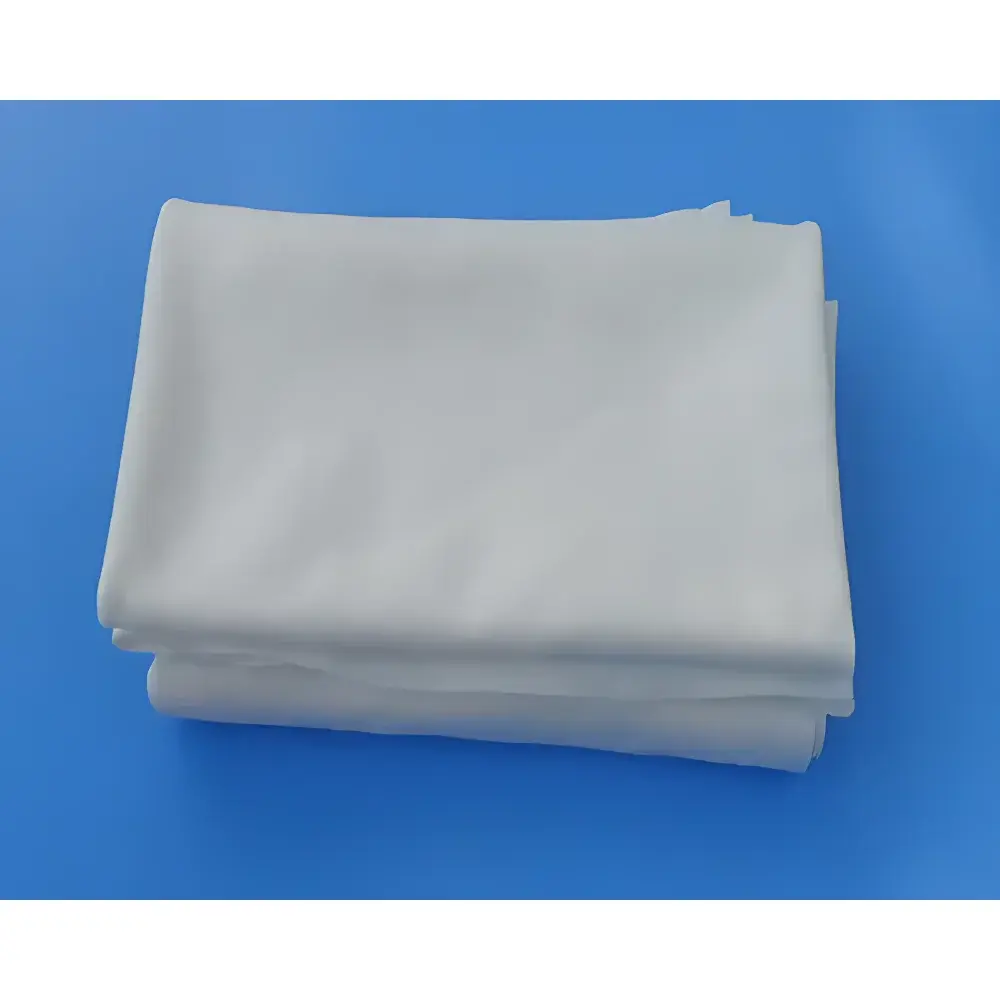
Hefei Kejing Ultra-Low Particulate Wipe for QCM Sensor Surface Maintenance
| Brand | Hefei Kejing |
|---|---|
| Origin | Anhui, China |
| Manufacturer Type | Authorized Distributor |
| Product Origin | Domestic (China) |
| Model | Ultra-Low Particulate Wipe |
| Dimensions | 50 cm × 23 cm |
| Material | Premium-Grade Split Polyamide/Polyester Microfiber |
| Edge Treatment | Laser-Sealed Perimeter |
| Water Absorption Capacity | High (≥4× own weight) |
| Ionic Leachables | <1.0 µg/cm² (Na⁺, K⁺, Cl⁻, SO₄²⁻ per ASTM F3337) |
| Particle Shedding | ≤5 particles ≥0.5 µm per cm² (per ISO 14644-1 Class 5 cleanroom testing protocol) |
Overview
The Hefei Kejing Ultra-Low Particulate Wipe is a purpose-engineered consumable designed specifically for the contamination-sensitive maintenance of quartz crystal microbalance (QCM) sensor surfaces, electrode substrates, and other ultra-clean electrochemical interfaces. Unlike generic cleaning cloths, this wipe integrates metrologically validated material science and cleanroom-grade fabrication to meet the stringent surface integrity requirements of gravimetric and impedance-based sensing platforms. Its function is not merely mechanical removal but preservation of nanoscale surface topography—critical when QCM frequency shifts (Δf) must correlate directly with mass changes (Δm) per the Sauerbrey equation. The wipe operates within the framework of controlled particulate management, ensuring that post-cleaning residual contamination does not introduce baseline drift, hysteresis, or spurious resonant mode coupling in high-resolution QCM-D (dissipation monitoring) systems.
Key Features
- Sub-micron particle capture capability: Engineered split-fiber architecture traps particles as small as 0.3 µm without redeposition, verified via SEM/EDS analysis of post-wipe residue.
- Non-abrasive tactile profile: Surface roughness (Ra) < 0.15 µm ensures zero micro-scratching on gold-coated QCM electrodes (typical thickness: 50–200 nm), preserving piezoelectric coupling efficiency.
- Laser-sealed perimeter: Eliminates fraying and fiber shedding—critical for maintaining ISO Class 5 (Class 100) cleanroom compliance during sensor chamber access procedures.
- Low ionic extractables: Compliant with ASTM F3337 for semiconductor-grade wipes; total ion release <1.0 µg/cm² enables use in electrolyte-sensitive applications such as corrosion monitoring or biomolecular binding assays.
- Bidirectional fluid compatibility: Optimized capillary action supports both dry wiping (for loose particulates) and solvent-assisted cleaning (e.g., IPA, ethanol, or low-conductivity deionized water) without linting or polymer dissolution.
Sample Compatibility & Compliance
This wipe is validated for direct contact with QCM crystals (AT-cut, 5–25 MHz), sputtered metal electrodes (Au, Pt, Ag), functionalized self-assembled monolayers (SAMs), and hydrogel-coated sensors. It meets the physical handling criteria outlined in ISO 14644-1 for cleanroom environments and aligns with GLP documentation requirements for instrument maintenance logs. While not an active analytical component, its use is referenced in method validation protocols for QCM-based thin-film deposition QC (e.g., ASTM E2983) and is compatible with USP guidelines for analytical instrument qualification where consumables impact measurement uncertainty.
Software & Data Management
As a passive consumable, the wipe requires no software integration. However, its usage should be documented in laboratory information management systems (LIMS) or electronic lab notebooks (ELN) under instrument maintenance records. Recommended metadata fields include lot number, date of first opening, wipe count per sensor, and visual inspection notes (e.g., “no visible fiber residue observed under 100× optical magnification”). Traceability supports FDA 21 CFR Part 11-compliant audit trails when used in regulated electrochemical assay workflows.
Applications
- Precleaning of QCM crystals prior to vapor-phase deposition or spin-coating of sensing layers.
- Removal of residual photoresist or developer residues from patterned electrode substrates.
- Post-calibration surface refresh between standard/reference film measurements.
- Decontamination of quartz sensor housings and flow cell gaskets in liquid-phase QCM systems.
- Supporting reproducible baseline establishment in real-time biosensing (e.g., antibody-antigen binding kinetics).
FAQ
Can this wipe be autoclaved for sterilization?
No. Autoclaving induces thermal degradation of the microfiber matrix and compromises laser-sealed edge integrity. Sterility is maintained via gamma irradiation (25 kGy)—certified lot documentation available upon request.
Is it suitable for cleaning QCM crystals immersed in aqueous electrolytes?
Yes—provided the wipe is pre-rinsed with ultrapure water and used in a controlled laminar flow hood to prevent airborne recontamination. Do not reuse after aqueous contact.
How many times can one wipe be used per QCM sensor?
Single-use only. Reuse increases risk of cross-contamination and fiber fatigue-induced particle release—validated per ISO 14644-1 surface sampling protocols.
Does it leave organic residue detectable by XPS or TOF-SIMS?
No detectable hydrocarbon residue was observed in X-ray photoelectron spectroscopy (XPS) surveys following wipe use on Au-coated quartz, confirming absence of silicone or surfactant carryover.




