
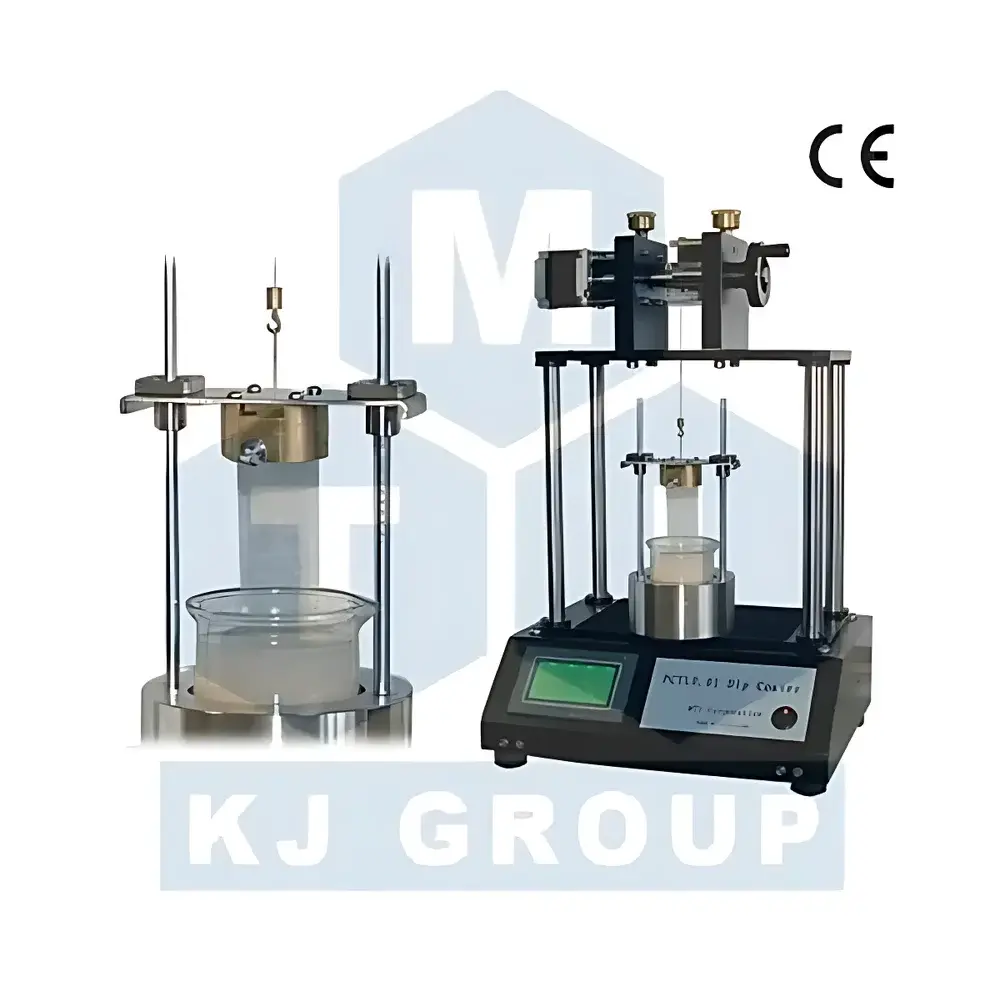
PTL-MM02 Programmable Vertical Dip-Coating System by Hefei Kejing
| Brand | Hefei Kejing |
|---|---|
| Model | PTL-MM02 |
| Type | Vertical Dip-Coating System |
| Maximum Coating Speed | 1–200 mm/min |
| Speed Stability | ±0.05% |
| Sample Holder Dimensions | 75 × 25 × 2.5 mm |
| Overall Dimensions | 320 × 260 × 560 mm |
| Weight | 17 kg |
| Touchscreen Interface | Full-color LCD HMI |
| Control System | Industrial PLC-based Programmable Logic Controller |
| Standard Accessories | (1) Sample Clip Fixture, (2) Immersion Beaker, (3) Three Stainless Steel Dip Wires |
Overview
The PTL-MM02 Programmable Vertical Dip-Coating System is an engineered solution for controlled thin-film deposition via vertical immersion and withdrawal—commonly referred to as dip coating or liquid-phase epitaxy (LPE). Unlike thermal processing equipment such as muffle furnaces or tube furnaces, the PTL-MM02 operates at ambient temperature and does not involve heating, drying, or sintering. Its core function is precise mechanical manipulation of substrates through a liquid precursor bath to generate uniform, reproducible thin films—ideal for sol-gel processing, colloidal nanoparticle assembly, functional polymer layer formation, and perovskite precursor film preparation. The system implements a classic two-phase motion profile: controlled descent into the solution (immersion phase), followed by programmable dwell time at the meniscus interface, and finally a precisely regulated upward withdrawal (coating phase). This sequence governs film thickness, morphology, and interfacial continuity according to the Landau–Levich–Derjaguin model, where final thickness correlates with withdrawal speed, liquid viscosity, surface tension, and substrate wettability.
Key Features
- Industrial-grade PLC control architecture ensures deterministic timing, repeatability, and immunity to environmental voltage fluctuations—critical for multi-cycle, multi-step coating protocols.
- Full-color high-resolution touchscreen HMI enables intuitive parameter entry, real-time motion visualization, and on-screen diagnostic feedback without external software dependency.
- Programmable motion parameters include immersion speed, dwell time at liquid-air interface (0–999 s), withdrawal speed (1–200 mm/min), and total cycle count (1–999), supporting complex multilayer architectures.
- High-precision stepper motor drive with closed-loop feedback maintains speed stability within ±0.05% across the full operational range—essential for sub-10 nm thickness control in optical and electronic thin-film research.
- Modular sample holder accommodates standard substrates up to 75 × 25 × 2.5 mm (e.g., glass slides, silicon wafers, ITO-coated PET), with clamping force optimized to prevent slippage during acceleration/deceleration phases.
- Stainless steel dip wires (supplied in sets of three) provide corrosion resistance and dimensional consistency; compatible with aqueous, alcoholic, and mild organic solvent systems (e.g., isopropanol, ethanol, DMF).
Sample Compatibility & Compliance
The PTL-MM02 supports rigid planar substrates used in materials science, photovoltaics, and sensor development—including fused silica, borosilicate glass, silicon, quartz, and flexible conductive foils. It is not intended for volatile, highly viscous (>1000 mPa·s), or particulate-laden suspensions without prior filtration. The system complies with EU Machinery Directive 2006/42/EC and carries CE marking for safe operation in laboratory environments. While it does not perform thermal treatment, its mechanical design conforms to ISO 14121-1 (risk assessment principles) and meets electromagnetic compatibility requirements per EN 61326-1. No GMP/GLP-specific hardware features (e.g., audit trail logs or user access levels) are embedded; however, all motion parameters are fully recordable via optional RS-232 or USB export when interfaced with external lab data management software.
Software & Data Management
The onboard PLC firmware stores up to 20 independent coating recipes with timestamped execution history (date/time, speed, cycles, operator ID if manually entered). Parameter changes are logged in non-volatile memory and persist after power loss. For integration into regulated workflows, raw motion logs can be exported as CSV files for traceability. Though no proprietary PC software is bundled, the system supports Modbus RTU protocol over RS-232 for third-party SCADA or LIMS integration. FDA 21 CFR Part 11 compliance is achievable only when paired with validated external software that enforces electronic signatures, audit trails, and role-based access controls—functions not implemented in the base unit.
Applications
- Sol-gel synthesis of TiO₂, SiO₂, and ZnO antireflective or photocatalytic coatings on optical components.
- Deposition of perovskite precursor layers for scalable fabrication of optoelectronic devices (e.g., solar cells, LEDs).
- Controlled assembly of colloidal quantum dots, metal-organic frameworks (MOFs), or 2D nanomaterial dispersions into ordered monolayers.
- Functionalization of biosensor surfaces using biopolymer (e.g., chitosan, gelatin) or enzyme-loaded hydrogels.
- Preparation of calibration standards for ellipsometry, profilometry, and UV-Vis spectroscopy through thickness-gradient films.
FAQ
Does the PTL-MM02 include heating or temperature control capabilities?
No. It is a purely mechanical dip-coating system designed for ambient-temperature liquid-phase deposition. Temperature-sensitive processes require integration with external thermostatted baths.
Can the system handle viscous solutions above 500 mPa·s?
Performance degrades significantly above ~300 mPa·s due to meniscus instability and wire drag effects; pre-filtration and dilution are recommended for optimal film uniformity.
Is the CE marking valid for use in North America?
CE certification confirms conformity with European safety directives but does not substitute for UL/ETL listing required for commercial deployment in the U.S. or Canada.
What maintenance is required for long-term reliability?
Routine inspection of dip wire alignment, cleaning of beaker mounts, and periodic lubrication of linear guide rails every 6 months under continuous use.
How is process repeatability verified across different laboratories?
Users are advised to perform inter-laboratory validation using certified reference substrates and cross-check film thickness via independent metrology (e.g., spectroscopic ellipsometry or stylus profilometry).



