OTF-1200X-4-NW CVD Tube Furnace with Integrated Preheating Zone
| Brand | Hefei Kejing |
|---|---|
| Origin | Anhui, China |
| Manufacturer Type | Authorized Distributor |
| Region of Manufacture | Domestic (China) |
| Model | OTF-1200X-4-NW |
| Quotation | Upon Request |
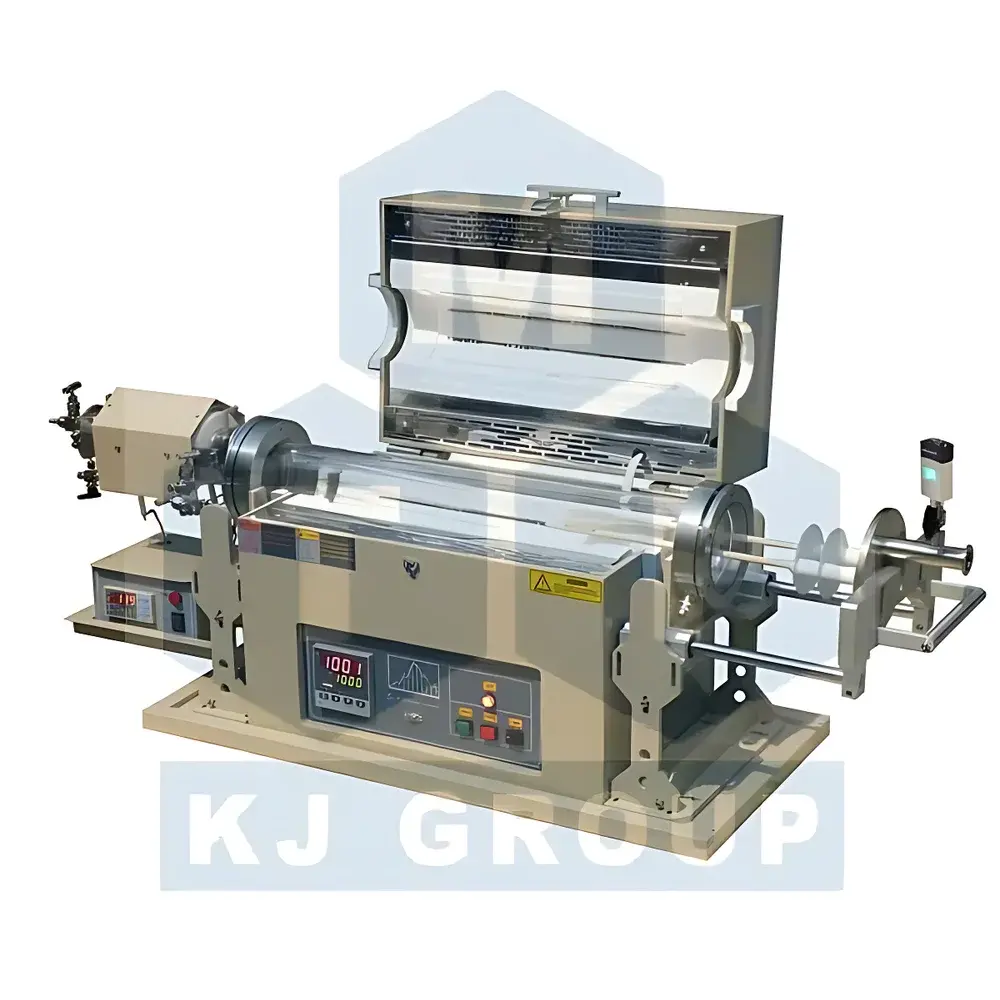
| Main Tube | 100 mm OD × 94 mm ID × 750 mm L (Fused Quartz) |
| Max Operating Temp (Main Zone) | 1100 °C (<2 hr), 1000 °C continuous |
| Preheat Zone | 30 mm OD × 150 mm L (Stainless Steel), RT–600 °C continuous |
| Heating Zones | Main: 440 mm (100 mm isothermal) |
| Preheat | 150 mm |
| Max Ramp Rate | 20 °C/min (both zones) |
| Power Supply | 220 V AC, 50/60 Hz, single-phase |
| Max Power | 3.6 kW |
| Cooling | Water-cooled KF25 flange with integrated seal cooling |
| Gas Inlets | Four 1/8" Swagelok ports on left flange |
| Vacuum Compatibility | KF25 interface for turbomolecular or rotary vane pump |
| Control System | Dual independent PID controllers, 30-segment programmable ramp-soak profiles, K-type thermocouples, ±1 °C accuracy |
| Optional | PC-based temperature control software (USB/RS485) |
| Dimensions (closed) | 1580 × 458 × 585 mm (62" × 18" × 23") |
| (fully extended) | 2040 × 458 × 585 mm (80" × 18" × 23") |
| Weight | 110 kg |
| Warranty | 12 months parts & labor (excludes consumables: quartz tube, O-rings, heating elements) |
| Safety Certification | UL-listed electrical components (>24 V) |
Overview
The OTF-1200X-4-NW CVD Tube Furnace with Integrated Preheating Zone is a precision-engineered thermal platform designed for controlled chemical vapor deposition (CVD) synthesis under inert, reducing, or reactive gas atmospheres. Its dual-zone architecture—comprising a high-temperature main reaction chamber and an independently regulated preheating zone—enables precise thermal management of volatile precursors prior to introduction into the growth region. This configuration supports reproducible nucleation and growth kinetics essential for synthesizing uniform nanowires, 2D materials (e.g., MoS₂, h-BN), metal oxides (e.g., ZnO, TiO₂), and epitaxial thin films. The furnace operates on fundamental principles of thermal CVD: precursor vaporization, transport via carrier gas, surface adsorption, decomposition, and solid-phase film formation—all governed by Arrhenius-dependent reaction rates and boundary-layer mass transfer. The system’s fused quartz main tube (100 mm OD) ensures optical transparency for in situ observation and compatibility with halogen- or oxygen-containing chemistries, while its water-cooled KF25 sliding flange enables rapid sample insertion and removal without thermal cycling of the entire assembly.
Key Features
- Dual independent PID temperature control systems—one for the main furnace (up to 1100 °C) and one for the stainless-steel preheating zone (RT–600 °C)—ensuring decoupled thermal profiling of precursors and substrates.
- Integrated water-cooled sliding flange with KF25 vacuum interface, enabling rapid sample exchange under dynamic vacuum or controlled atmosphere conditions without compromising thermal stability.
- Four standardized 1/8″ Swagelok gas inlets on the left end flange, plus two dedicated cross-zone ports and one preheated delivery line, supporting multi-precursor co-injection, carrier gas blending, and sequential purging protocols.
- 30-segment programmable temperature ramp-soak profiles with ±1 °C thermal accuracy, facilitating complex thermal cycles required for annealing-assisted CVD, two-step growth, or stress-relief treatments.
- UL-certified electrical architecture (components >24 V), with optional TUV/CSA certification documentation support for institutional procurement and GLP-compliant lab integration.
- Robust mechanical design: 110 kg structural mass minimizes vibration-induced thermal drift; all high-temp insulation is ceramic fiber-based with low thermal conductivity and high emissivity consistency.
Sample Compatibility & Compliance
The OTF-1200X-4-NW accommodates standard 3-inch (76 mm) wafers, silicon/sapphire/quartz substrates, and custom holders mounted on a removable graphite or alumina sample stage. It supports both horizontal and tilted substrate configurations via adjustable stage mounts. The quartz tube complies with ASTM F798 (specifications for high-purity fused silica tubing used in semiconductor processing), and the system’s vacuum integrity—verified to ≤5×10⁻³ mbar with a standard two-stage rotary pump—meets ISO 27401 requirements for cleanroom-compatible CVD tooling. All gas-handling components conform to SEMI F57 standards for semiconductor-grade fluidic interfaces. For regulated environments, the optional PC-based control software supports audit trails, user-level access control, and electronic signature logging aligned with FDA 21 CFR Part 11 requirements when deployed with validated IT infrastructure.
Software & Data Management
An optional USB/RS485-enabled temperature control software package provides real-time monitoring, remote parameter adjustment, and automated data logging at user-defined intervals (1–60 s resolution). Logged parameters include setpoint, actual temperature (dual-channel), ramp rate, hold time, and system status flags (e.g., over-temperature alarm, cooling active). Export formats include CSV and MATLAB-compatible .mat files, enabling post-acquisition kinetic modeling (e.g., Arrhenius activation energy extraction, diffusion-limited growth analysis). The software architecture supports batch recipe storage with version timestamping, facilitating method transfer between instruments and long-term process repeatability tracking across multiple research groups.
Applications
- Growth of transition metal dichalcogenide (TMD) monolayers and heterostructures via two-zone sulfurization/selenization.
- Synthesis of SiC, GaN, and AlN nanowires using chloride- or hydride-based precursors requiring staged thermal decomposition.
- Low-temperature oxide CVD (e.g., Al₂O₃, HfO₂) for gate dielectric deposition on temperature-sensitive flexible substrates.
- Post-deposition annealing under controlled N₂/H₂ forming gas to modulate stoichiometry and defect density in perovskite thin films.
- In situ thermal desorption spectroscopy (TDS) experiments enabled by synchronized gas flow modulation and real-time mass spectrometer interfacing via auxiliary vacuum port.
FAQ
What vacuum level can the OTF-1200X-4-NW achieve with standard pumping configuration?
With a two-stage rotary vane pump and KF25 connection, base pressure reaches ≤5×10⁻³ mbar. For UHV applications (≤10⁻⁷ mbar), a turbomolecular pump with appropriate foreline trap is recommended.
Is the quartz tube included in the standard configuration?
Yes—a high-purity fused quartz tube (100 mm OD × 94 mm ID × 750 mm L) is supplied as standard equipment, rated for continuous operation up to 1000 °C.
Can the preheating zone be operated independently while the main furnace remains at ambient temperature?
Yes. Both zones feature fully isolated power circuits and independent thermocouple feedback loops, allowing standalone operation or synchronized thermal gradients.
Does the system support liquid precursor delivery via bubbler integration?
Yes. Two 1/8″ ports on the left flange are designated for bubbler inlet/outlet lines; compatible Swagelok fittings and temperature-stabilized carrier gas manifolds are available as accessories.
What maintenance intervals are recommended for optimal thermal performance?
Quartz tube inspection every 50 operational cycles; O-ring replacement every 6 months under continuous use; heating element resistance verification annually. Full calibration of thermocouples is advised before critical growth campaigns.