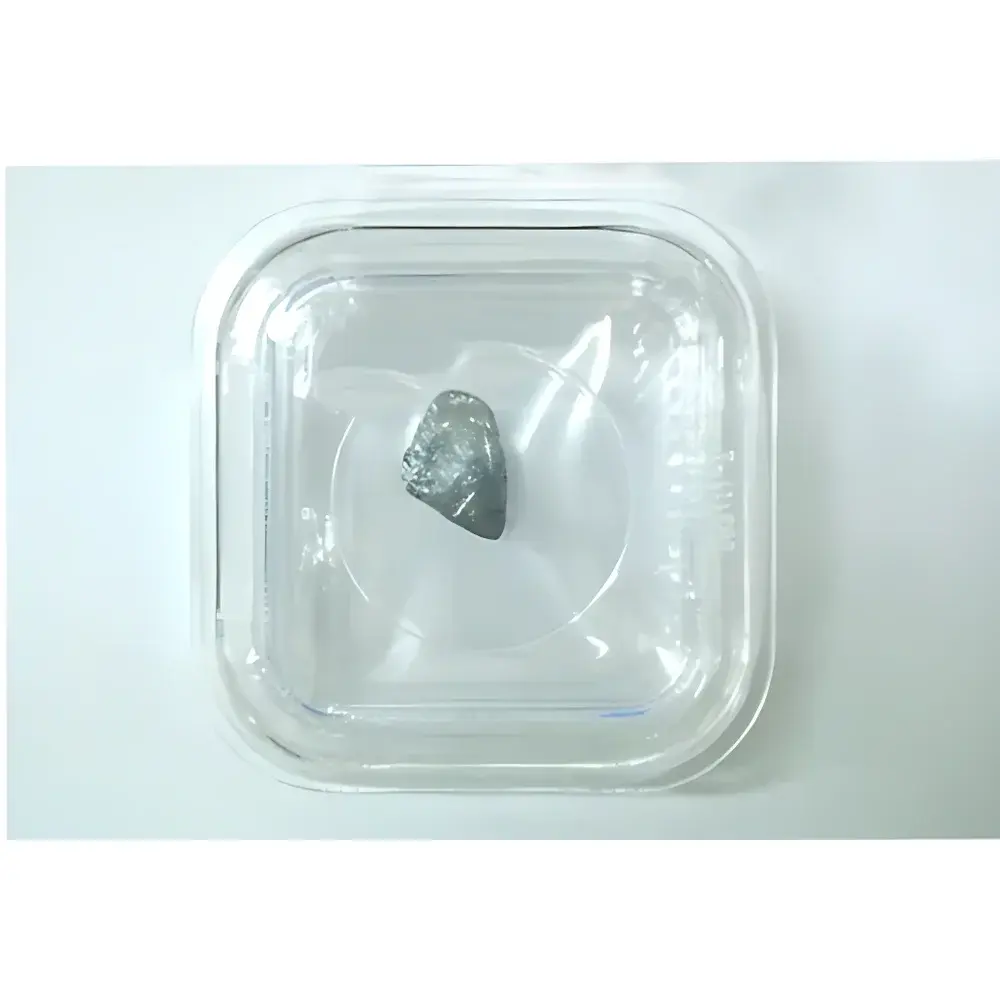
Black Phosphorus (BP) Single Crystal Flakes
| Brand | Hefei Kejing |
|---|---|
| Origin | Anhui, China |
| Manufacturer Type | Authorized Distributor |
| Origin Classification | Domestic (China) |
| Model | BP-2D-0.2mm |
| Price | Upon Request |
| Dimensions | 8 mm × 8 mm × 0.2 mm |
| Purity | ≥99.99% |
Overview
Black phosphorus (BP) is a layered two-dimensional (2D) semiconductor with a tunable direct bandgap ranging from ~0.3 eV (bulk) to ~2.0 eV (monolayer), making it uniquely suited for optoelectronic, thermoelectric, and quantum transport applications. Unlike graphene (zero-bandgap) or transition metal dichalcogenides (TMDs) with fixed bandgaps, BP exhibits strong in-plane anisotropy and layer-dependent electronic structure—properties critical for polarization-sensitive photodetectors, field-effect transistors (FETs), and valleytronic devices. This product consists of high-quality, mechanically exfoliable black phosphorus single crystal flakes, grown via high-pressure vapor transport and purified under inert atmosphere to minimize oxidation and defect density.
Key Features
- High-purity single-crystal structure (≥99.99% elemental phosphorus, verified by X-ray fluorescence and residual gas analysis)
- Controlled thickness: nominal 0.2 mm bulk crystal—optimized for mechanical cleavage into few-layer and monolayer flakes via standard dry/wet transfer techniques
- Uniform lateral dimensions: 8 mm × 8 mm surface area ensures reproducible flake yield and minimizes edge-to-area ratio effects during device fabrication
- Grown and processed under ultra-dry nitrogen/hydrogen atmosphere (<1 ppm O₂, <0.1 ppm H₂O) to suppress surface passivation and preserve intrinsic carrier mobility
- Supplied in hermetically sealed, argon-purged quartz vials with oxygen/moisture indicator strips for real-time storage integrity monitoring
Sample Compatibility & Compliance
These BP crystals are compatible with standard cleanroom microfabrication workflows including electron-beam lithography, atomic layer deposition (ALD), and reactive ion etching (RIE). Each batch undergoes pre-shipment characterization—including Raman spectroscopy (Ag1, B2g, Ag2 modes at ~362 cm⁻¹, ~438 cm⁻¹, and ~466 cm⁻¹), AFM thickness profiling, and low-energy electron diffraction (LEED) confirmation of crystallinity. Material traceability complies with ISO/IEC 17025–2017 requirements for reference material certification. While not classified as a regulated hazardous substance under UN GHS or EU CLP, handling requires glovebox-integrated protocols (O₂ < 0.1 ppm, H₂O < 0.1 ppm) per ASTM D7213–18 guidelines for air-sensitive 2D semiconductors.
Software & Data Management
No embedded firmware or proprietary software is associated with this passive reference material. However, users are advised to integrate BP flake characterization data into laboratory information management systems (LIMS) compliant with FDA 21 CFR Part 11 for audit-trail–enabled metadata logging—including exfoliation date, ambient exposure duration, Raman acquisition parameters, and AFM scan settings. Batch-specific certificates of analysis (CoA) include spectral fingerprints, purity quantification reports, and crystallinity metrics; digital CoAs are provided in PDF/A-2b format for long-term archival compliance with ISO 14721 (OAIS).
Applications
- Gate-tunable FETs and heterostructure p–n junctions for low-power logic and analog circuits
- Polarization-resolved infrared photodetectors operating in the 3–10 µm mid-IR range
- Electrochemical intercalation studies for Li/Na-ion battery anode modeling
- Van der Waals heterostructures with h-BN, MoS₂, or WSe₂ for twistronics and moiré engineering
- Ultrafast pump-probe spectroscopy to probe anisotropic carrier relaxation dynamics
- Substrate-supported catalytic platforms for CO₂ reduction and hydrogen evolution reaction (HER) studies
FAQ
What is the recommended storage environment for black phosphorus crystals?
Store under continuous argon flow or in a glovebox with O₂ and H₂O levels maintained below 0.1 ppm. Avoid repeated air exposure—even brief ambient contact induces irreversible surface oxidation.
Can these crystals be used for mechanical exfoliation to obtain monolayers?
Yes. The 0.2 mm thickness and high crystallinity enable consistent cleavage using PDMS or PC film; typical monolayer yield per 8×8 mm flake exceeds 15 usable regions under optical contrast optimization.
Is batch-to-batch variability controlled?
Each production lot undergoes full spectroscopic and structural qualification. Certificates of Analysis include Raman peak width (FWHM ≤ 2.5 cm⁻¹ for Ag1 mode), surface roughness (Ra < 0.4 nm over 5×5 µm AFM scan), and stoichiometric deviation (P:P impurity ratio < 1:10⁴).
Do you provide technical support for device integration?
Yes—application engineers offer remote consultation on flake transfer, encapsulation strategies (e.g., Al₂O₃ ALD capping), and electrical contact metallization (Ti/Au vs. Cr/Au adhesion layers) based on published literature protocols.
Are custom dimensions or thicknesses available?
Custom growth (e.g., 5 mm × 5 mm × 0.1 mm or 10 mm × 10 mm × 0.3 mm) is available under NRE agreement with minimum order quantity of 5 units and lead time of 12 weeks.
Related Products