
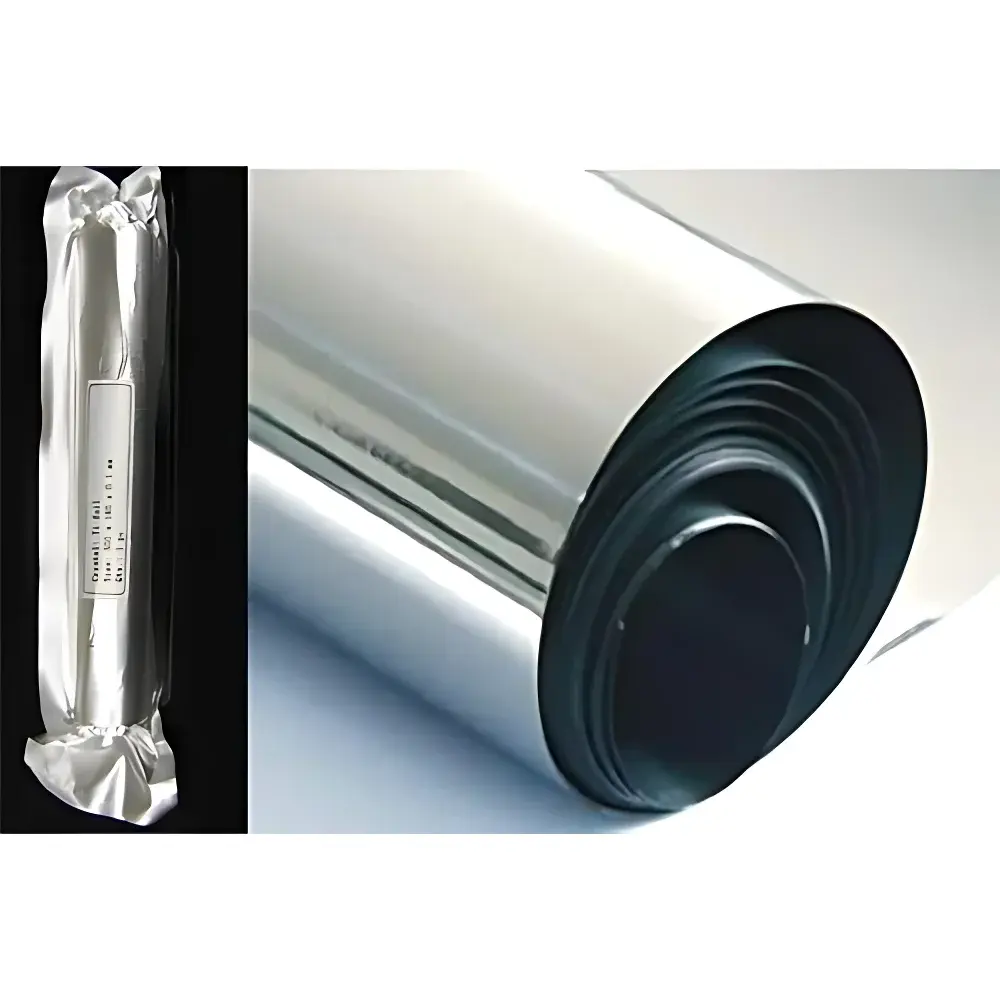
Ti Foil Sheet –合肥科晶 Quartz Crystal Microbalance (QCM) Sensor Substrate
| Brand | Hefei Kejing |
|---|---|
| Origin | Anhui, China |
| Manufacturer Type | Authorized Distributor |
| Origin Category | Domestic |
| Model | Ti Foil Sheet |
| Price Range | USD 0.15–150.00 (FOB) |
| Standard Dimensions | 500 × 105 × 0.1 mm & 700 × 105 × 0.1 mm |
| Packaging | Vacuum-sealed in Class 100 cleanroom bags, certified for Class 1000 cleanroom handling |
| Purity | ≥99.6% Ti (ASTM B265 Grade 1 equivalent) |
| Surface Roughness (Ra) | ≤0.4 µm (as-rolled, single-side polished option available) |
| Density | 4.506 g/cm³ |
| Melting Point | 1668 °C |
| Tensile Strength | 240–370 MPa |
| Elongation at Break | ≥24% |
| Compliant with ISO 9001 | 2015 manufacturing controls |
Overview
Ti Foil Sheet is a high-purity, precision-rolled titanium substrate engineered specifically for integration into quartz crystal microbalance (QCM) sensor platforms and thin-film deposition systems. As a piezoelectric transducer substrate material, titanium foil serves as the functional electrode layer or mass-sensitive interface in QCM-based real-time monitoring of nanogram-level mass changes during electrochemical processes, vapor-phase adsorption, biomolecular binding, or thin-film growth. Its low acoustic impedance mismatch with AT-cut quartz crystals, combined with excellent corrosion resistance in aqueous and acidic electrolytes, ensures stable resonance frequency shifts (Δf) and high signal-to-noise ratio in dynamic QCM-D (quartz crystal microbalance with dissipation monitoring) configurations. Unlike gold or platinum foils, Ti foil offers superior adhesion to oxide-based dielectrics and enables robust co-sputtering or thermal evaporation of TiO2, TiN, or biocompatible Ti-based coatings—making it indispensable for biosensor development, corrosion studies, and solid-state battery interfacial characterization.
Key Features
- High-purity titanium (≥99.6 wt%, ASTM B265 Grade 1 compliant), with trace impurities (Fe, O, C, N) strictly controlled to minimize parasitic damping effects on QCM resonance
- Precision cold-rolled thickness tolerance: ±0.005 mm at 0.1 mm nominal, enabling consistent acoustic coupling and predictable Sauerbrey mass sensitivity (≈17.7 ng·cm−2·Hz−1 for 5 MHz crystals)
- Double-side degreased and passivated surface; optional single-side electropolished finish (Ra ≤ 0.2 µm) for enhanced uniformity in sputtered electrode layers
- Vacuum-compatible (≤1×10⁻⁶ Torr), non-outgassing packaging validated per ASTM E595 for space-qualified thin-film applications
- Thermally stable up to 400 °C in inert atmosphere—suitable for in situ annealing of QCM-supported catalysts or oxide films
- Supplied with full traceability documentation: lot-specific certificate of conformance, residual gas analysis report, and surface contamination screening (XPS/EDS summary)
Sample Compatibility & Compliance
Ti foil sheets are compatible with standard 5–10 MHz AT-cut quartz resonators and support both electrode configuration (two-terminal QCM) and multi-harmonic excitation (QCM-I). The material meets ISO/IEC 17025-accredited testing requirements for substrate qualification in GLP-compliant electrochemical labs. It is routinely used in ASTM G102 (electrochemical impedance spectroscopy), ISO 15197 (biosensor interface validation), and USP particulate matter testing setups where metallic substrates require minimal leachables. All batches undergo routine ICP-MS screening for heavy metal contaminants (Pb, Cd, As, Hg) to ensure compliance with RoHS Directive 2011/65/EU and FDA-recommended thresholds for implantable device material sourcing.
Software & Data Management
While Ti foil itself is a passive substrate, its performance is directly referenced in QCM instrument calibration workflows. When used with industry-standard platforms (e.g., Q-Sense E4, MaxWave QCM, or custom LabVIEW-based acquisition systems), the foil’s known density and thickness allow precise calculation of areal mass loading and viscoelastic correction factors in QCM-D data modeling (using Voigt or Kelvin–Voigt structural models). Raw frequency shift datasets generated using Ti-coated crystals are fully exportable in CSV/ASCII format and interoperable with MATLAB, Python (SciPy, lmfit), and OriginPro for advanced time-resolved fitting of adsorption isotherms (Langmuir, Freundlich) or polymer swelling kinetics.
Applications
- Real-time monitoring of protein adsorption/desorption on TiO2-modified surfaces under physiological buffer conditions
- In situ characterization of solid-electrolyte interphase (SEI) formation on Ti current collectors in Li-ion and Na-ion battery half-cells
- Gas-phase sensing of H2S or NH3 using Ti-functionalized metal–organic frameworks (MOFs) deposited via ALD
- Electrodeposition studies of Ti-based alloys (e.g., Ti–Al–V) in molten salt electrolytes
- Reference substrate for calibrating nanoindentation tip geometry on QCM-integrated AFM systems
- Biofunctionalization platform for immobilizing RGD peptides or heparin via silane–TiO2 hybrid interfaces
FAQ
Is this Ti foil suitable for direct use as a working electrode in three-electrode electrochemical cells?
Yes—when bonded to a conductive feedthrough (e.g., Pt wire or stainless-steel pin) and sealed with acid-resistant epoxy (e.g., Torr-Seal™), the foil functions as a stable, low-background working electrode in pH 1–12 aqueous media and non-aqueous LiPF6 electrolytes.
Can I order custom dimensions or thicknesses beyond the standard 0.1 mm?
Custom rolling is available for orders ≥500 sheets; minimum thickness: 0.025 mm (±0.002 mm), maximum: 0.5 mm (±0.01 mm); lead time: 6–8 weeks from drawing approval.
Do you provide surface analysis reports (XPS, AFM) for each lot?
XPS survey scans and RMS roughness values are included in the CoC for every production lot; full high-resolution XPS or AFM topography maps are available upon request at additional cost.
How does Ti foil compare to Au or Pt foil in QCM stability under reducing potentials?
Ti maintains structural integrity and minimal hydrogen absorption below −1.2 V vs. Ag/AgCl, whereas Au begins reconstructing and Pt exhibits irreversible hydride formation—making Ti preferred for cathodic interfacial studies.
Is vacuum annealing recommended prior to thin-film deposition?
Yes—annealing at 300 °C for 2 h under 1×10⁻⁶ Torr removes adventitious carbon and hydroxyl groups, improving nucleation density of subsequently deposited oxides or nitrides.
Related Products






