
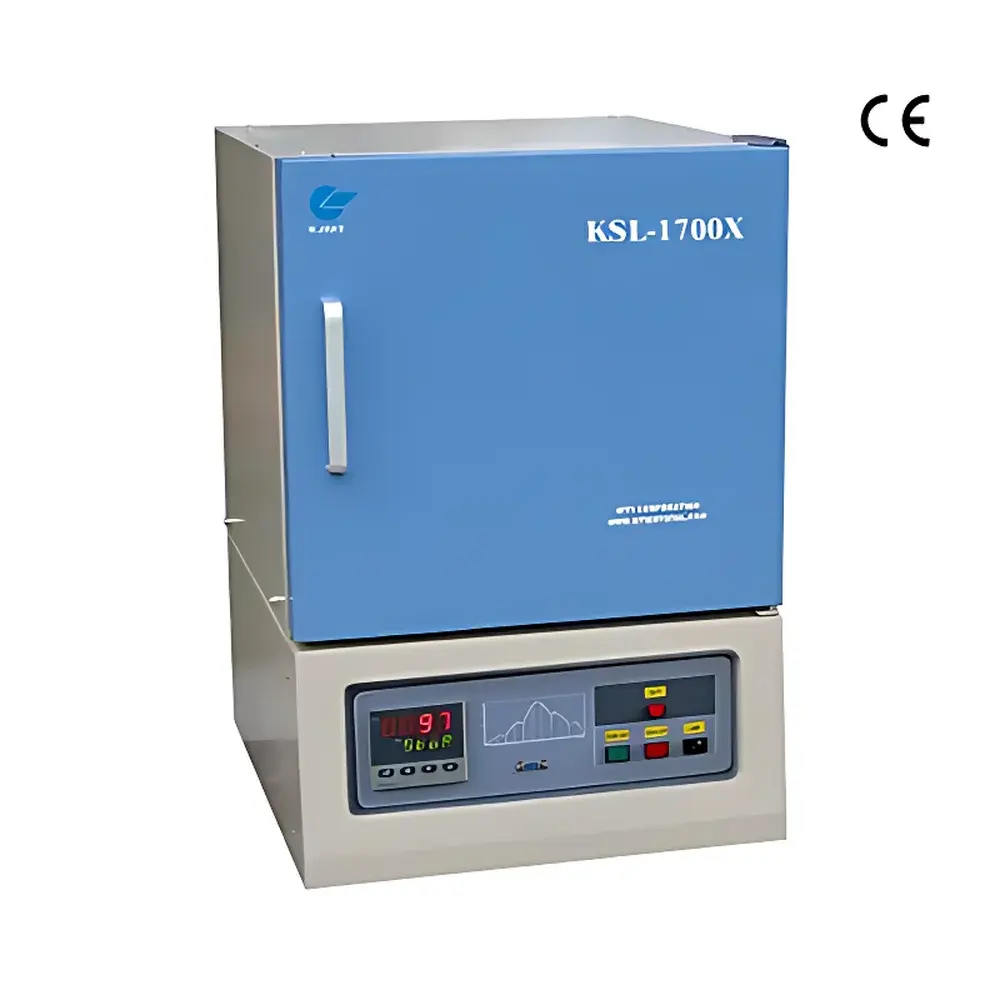
KSL-1700X-A3 19-Liter 1700°C High-Temperature Box Furnace
| Brand | Hefei Kejing |
|---|---|
| Origin | Anhui, China |
| Model | KSL-1700X-A3 |
| Chamber Dimensions (L×W×H) | 250×300×250 mm |
| Effective Volume | 19 L |
| Max Temperature | 1700 °C |
| Operating Temperature | ≤1650 °C |
| Heating Element | Silicon Molybdenum (MoSi₂) Rods |
| Thermocouple Type | Type B (PtRh30/PtRh6) |
| Temperature Control | 30-Stage Programmable PID Controller (708P) |
| Ramp Rate | Up to 10 °C/min |
| Isothermal Accuracy | ±1 °C |
| Door Configuration | Side-Swing |
| Power Supply | AC 220 V / 50 Hz |
| Rated Power | 9 kW |
| External Dimensions | 600×650×560 mm |
| Net Weight | 140 kg |
| Certifications | CE |
Overview
The KSL-1700X-A3 is a high-temperature box furnace engineered for precision thermal processing in research laboratories and advanced materials development facilities. Designed around the fundamental principles of resistive heating and closed-chamber thermal uniformity, it employs silicon molybdenum (MoSi₂) heating elements—known for exceptional stability and oxidation resistance above 1500 °C—to achieve a maximum operating temperature of 1700 °C. Its 19-liter effective chamber volume (250 × 300 × 250 mm) supports larger sample batches or multi-position crucible arrangements without compromising thermal homogeneity. Temperature measurement and regulation are performed using a calibrated Type B (PtRh30/PtRh6) thermocouple integrated with a 708P intelligent PID controller, enabling precise, repeatable thermal profiles across extended dwell periods. The furnace operates within a robust, double-layer insulated stainless steel housing with ceramic fiber insulation, minimizing heat loss and ensuring surface temperatures remain within occupational safety thresholds per OHSAS 18001-aligned design practices.
Key Features
- High-stability MoSi₂ heating elements rated for continuous operation up to 1650 °C and intermittent use at 1700 °C
- 30-stage programmable temperature controller supporting complex ramp-hold-cool sequences with user-defined setpoints and dwell times
- Type B thermocouple with cold-junction compensation, traceable calibration documentation available upon request
- Side-swing door with high-temperature ceramic fiber gasket ensures rapid access while maintaining seal integrity during thermal cycling
- Integrated over-temperature protection circuitry (independent of main controller) with audible alarm and automatic power cutoff
- CE-certified electrical architecture compliant with EN 61000-6-3 (EMC) and EN 61000-6-2 (immunity) standards
Sample Compatibility & Compliance
The KSL-1700X-A3 accommodates standard high-purity alumina, zirconia, and graphite crucibles (up to Φ120 mm × 100 mm height), as well as custom fixtures for sintering, annealing, ashing, and calcination applications. Its chamber geometry supports uniform gas atmosphere distribution when used with optional quartz tube inserts or inert gas purging systems (N₂, Ar). All materials in direct contact with the hot zone—including refractory brick linings and insulation—are low-emission and RoHS-compliant. The unit meets ISO 14001 environmental performance criteria for energy efficiency and off-gas emissions under normal operation. It is suitable for GLP-compliant thermal treatment protocols where audit-trail-capable controllers are deployed (note: native 708P controller does not include 21 CFR Part 11 electronic signature functionality; third-party data logging modules may be integrated for regulated environments).
Software & Data Management
While the standard 708P controller provides local front-panel programming and real-time temperature display, optional RS485/Modbus RTU interface enables integration with laboratory-wide SCADA or LIMS platforms. Users can export time-stamped temperature logs (CSV format) via external USB data loggers connected through the controller’s analog output terminals. Firmware updates are performed via proprietary configuration software compatible with Windows-based engineering workstations. For GMP or ISO/IEC 17025-accredited labs, validation documentation—including IQ/OQ templates, sensor calibration records, and thermal mapping reports—can be supplied upon order specification.
Applications
- Sintering of advanced ceramics (e.g., SiC, AlN, YSZ) and metal oxide powders
- Heat treatment of battery cathode precursors (LiCoO₂, NMC, LFP) under controlled atmospheres
- Ashing of organic matrices in environmental and food testing laboratories (per ASTM D3174)
- Thermal gravimetric analysis (TGA) pre-conditioning and residue quantification
- Crystal growth support annealing for semiconductor substrates (SiC, GaN)
- Calibration reference furnaces for secondary thermocouple verification (in conjunction with certified transfer standards)
FAQ
What is the recommended maintenance interval for MoSi₂ heating elements?
Under continuous operation at ≤1600 °C with proper atmosphere control, MoSi₂ rods typically retain functional integrity for 1,200–1,800 hours. Visual inspection every 200 operating hours is advised.
Can this furnace be operated under vacuum or reducing atmospheres?
No—the standard configuration is designed for ambient air or inert gas purge only. Vacuum or hydrogen-compatible variants require modified seals, feedthroughs, and specialized refractory lining (available as custom-engineered options).
Is the CE marking affixed to the unit supported by full EU Declaration of Conformity?
Yes. A complete DoC referencing Directive 2014/35/EU (Low Voltage Directive) and 2014/30/EU (EMC Directive) is provided with each shipment, including harmonized standards EN 61000-6-2 and EN 61000-6-3.
Does the furnace include built-in data logging capability?
The base 708P controller supports analog output (4–20 mA or 0–5 V) for connection to external recorders. Internal memory logging is not included but can be added via optional expansion modules.
What safety certifications apply to personnel exposure during operation?
Surface temperature rise on exterior panels remains below 45 °C at maximum setpoint, satisfying EN 61000-3-2 Class A limits and aligning with OHSAS 18001 clause 4.4.6 for thermal hazard mitigation.



