
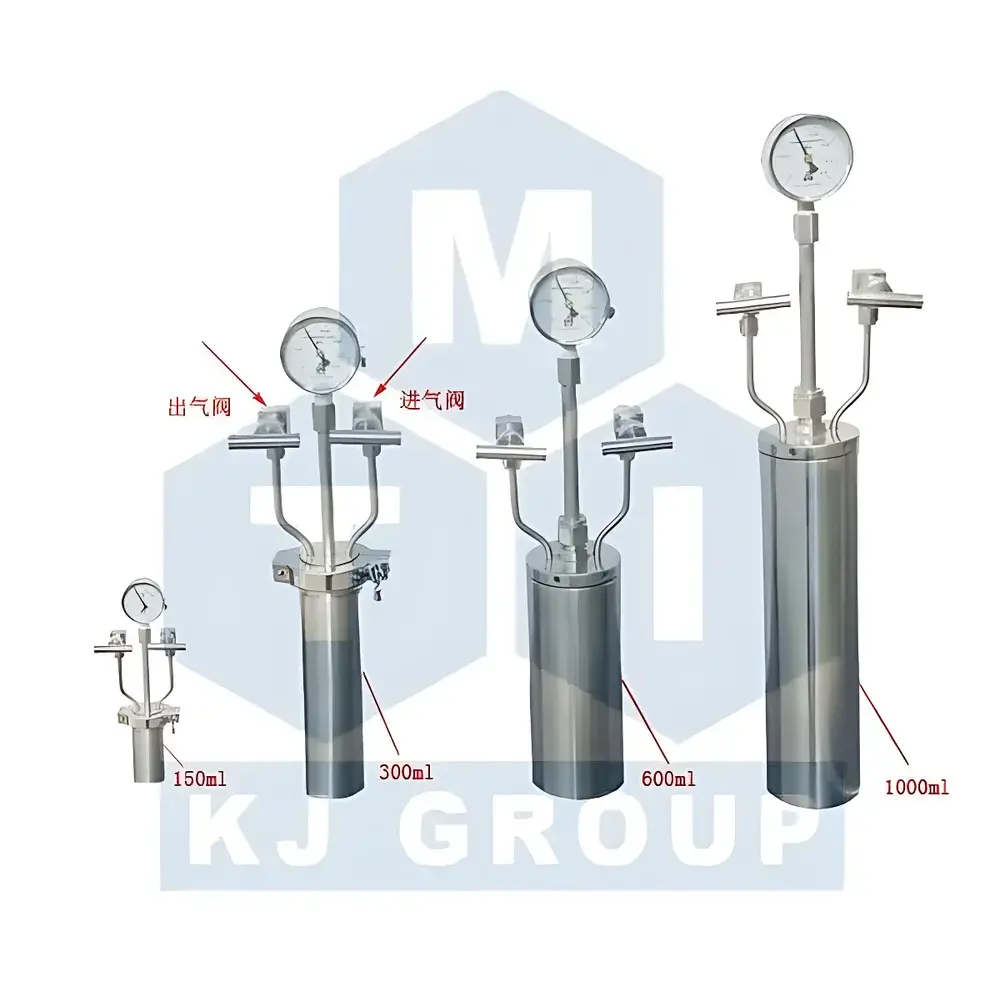
Kejing BL-200 Gas-Liquid Mixing Vessel for CVD Precursor Delivery
| Brand | Kejing |
|---|---|
| Model | BL-200 |
| Construction Material | 316 Stainless Steel |
| Maximum Operating Pressure | 0.15 MPa (gauge) |
| Maximum Operating Temperature | 250 °C |
| Vessel Capacity | 200 mL (nominal, based on BL-SS series scaling) |
| Pressure Gauge Range | −0.1 to +0.15 MPa |
| Inlet/Outlet Fitting | 1/4″ (6.35 mm) Swagelok®-compatible compression ferrule |
| Compliance | Designed for laboratory-scale CVD precursor vaporization and carrier gas saturation |
| Heating Compatibility | Compatible with external heating mantles (e.g., 3″ diameter heating rings) or hotplate platforms (e.g., HP-250) |
Overview
The Kejing BL-200 Gas-Liquid Mixing Vessel is an engineered stainless-steel vapor delivery module designed specifically for controlled introduction of volatile liquid precursors into chemical vapor deposition (CVD) and atomic layer deposition (ALD) reaction chambers. It operates on the principle of carrier gas saturation—where a regulated inert or reactive gas stream passes through or over a heated liquid phase, achieving thermodynamically stable vapor-phase concentration prior to delivery. Unlike bubblers relying solely on passive diffusion, the BL-200 integrates precise pressure monitoring, thermal stability up to 250 °C, and robust mechanical sealing to support reproducible precursor partial pressure control under moderate positive pressure (up to 0.15 MPa gauge). Its compact geometry and standardized 6.35 mm compression fittings enable seamless integration into existing gas distribution manifolds and mass flow controller (MFC)-based delivery systems.
Key Features
- 316 stainless-steel construction ensures corrosion resistance against halogenated, oxygenated, and organometallic precursors commonly used in thin-film synthesis.
- Integrated dual stainless-steel needle valves at inlet and outlet ports allow fine-tuned regulation of gas flow rate and backpressure—critical for stabilizing vapor concentration and minimizing condensation downstream.
- Front-mounted mechanical pressure gauge (−0.1 to +0.15 MPa range) provides real-time verification of system integrity and operational pressure, supporting safe operation under both vacuum-assisted and pressurized delivery modes.
- Optimized thermal mass and uniform wall thickness facilitate rapid, homogeneous heating when paired with externally mounted heating elements—reducing thermal gradients that cause localized boiling or precursor decomposition.
- Swagelok®-compatible 6.35 mm (1/4″) ferrule fittings ensure leak-tight connections compatible with standard laboratory gas tubing (e.g., SS, PFA, or EPDM-lined lines), simplifying system validation and maintenance.
- Designed for ambient-to-250 °C continuous operation; maximum vessel pressure rating is validated per ASME B31.3 process piping guidelines for laboratory-scale equipment.
Sample Compatibility & Compliance
The BL-200 accommodates a broad spectrum of low-to-moderate volatility precursors—including metal alkoxides (e.g., Ti(OC4H9)4), amides (e.g., TDMAT), chlorides (e.g., TiCl4, AlCl3), and carbonyls (e.g., Ni(CO)4)—provided their vapor pressure curves intersect the operational temperature–pressure envelope. It is not intended for highly corrosive anhydrous HF, fuming nitric acid, or pyrophoric liquids without additional engineering controls. The vessel conforms to general laboratory safety standards per ISO/IEC 17025:2017 Annex A.3 (equipment suitability) and supports GLP-compliant recordkeeping when used with calibrated pressure gauges and traceable temperature sources. While not certified to PED or ASME Section VIII, its design adheres to recognized good engineering practice for Class I, Division 2 hazardous location compatibility when installed within ventilated enclosures.
Software & Data Management
The BL-200 is a standalone, manually operated hardware module and does not include embedded electronics, firmware, or digital interfaces. Its operation is fully compatible with third-party process control ecosystems: pressure data from analog gauges may be logged via external transducers (e.g., 4–20 mA output sensors); temperature profiles can be recorded using PT100 or Type K thermocouples mounted on the vessel jacket or base plate. When integrated into automated CVD platforms, it supports audit-trail generation under FDA 21 CFR Part 11 when paired with validated SCADA or PLC systems—provided user-defined SOPs document calibration frequency, leak-check procedures, and cleaning protocols per batch.
Applications
- Vapor-phase delivery of liquid metalorganic precursors in low-pressure and atmospheric CVD systems for metal oxide, nitride, and sulfide thin-film growth.
- Carrier-gas saturation for ALD dose pulsing where precise stoichiometric control of co-reactants (e.g., H2O + TMAl) requires stable, non-condensing vapor streams.
- In situ generation of reactive gas mixtures—e.g., NH3/H2 blends from heated ammonium salt solutions—for nitridation processes.
- Calibration reference vessels for vapor concentration validation using FTIR or quartz crystal microbalance (QCM) downstream monitoring.
- Research-scale solvent vapor introduction in catalytic reaction studies requiring controlled partial pressures (e.g., ethanol, acetone, THF).
FAQ
Can the BL-200 be used under vacuum?
Yes—it is rated for full vacuum (−0.1 MPa) and can operate in draw-through mode when connected downstream of a vacuum pump; however, vapor delivery efficiency decreases significantly below ~10 kPa absolute due to reduced mass transfer driving force.
Is internal heating supported?
No—the BL-200 lacks integrated heaters or thermowells; heating must be applied externally via compatible mantles or hotplates to avoid thermal stress cracking and maintain pressure integrity.
What cleaning protocol is recommended between precursor changes?
Rinse thoroughly with high-purity solvent matching the previous precursor’s solubility (e.g., IPA for alkoxides, hexane for chlorides), followed by dry N2 purge at elevated temperature (≤200 °C) for ≥30 minutes; verify cleanliness via residual gas analysis if required for high-purity film applications.
Does the BL-200 include pressure relief protection?
No—users must implement external pressure-relief devices (e.g., rupture discs or spring-loaded relief valves) in accordance with local laboratory safety regulations when operating above 0.1 MPa gauge.
Is the 200 mL capacity nominal or usable volume?
It is a nominal geometric capacity; recommended working fill level is ≤60% (i.e., ~120 mL) to prevent liquid entrainment during gas sparging and ensure stable vapor-phase equilibrium.



