
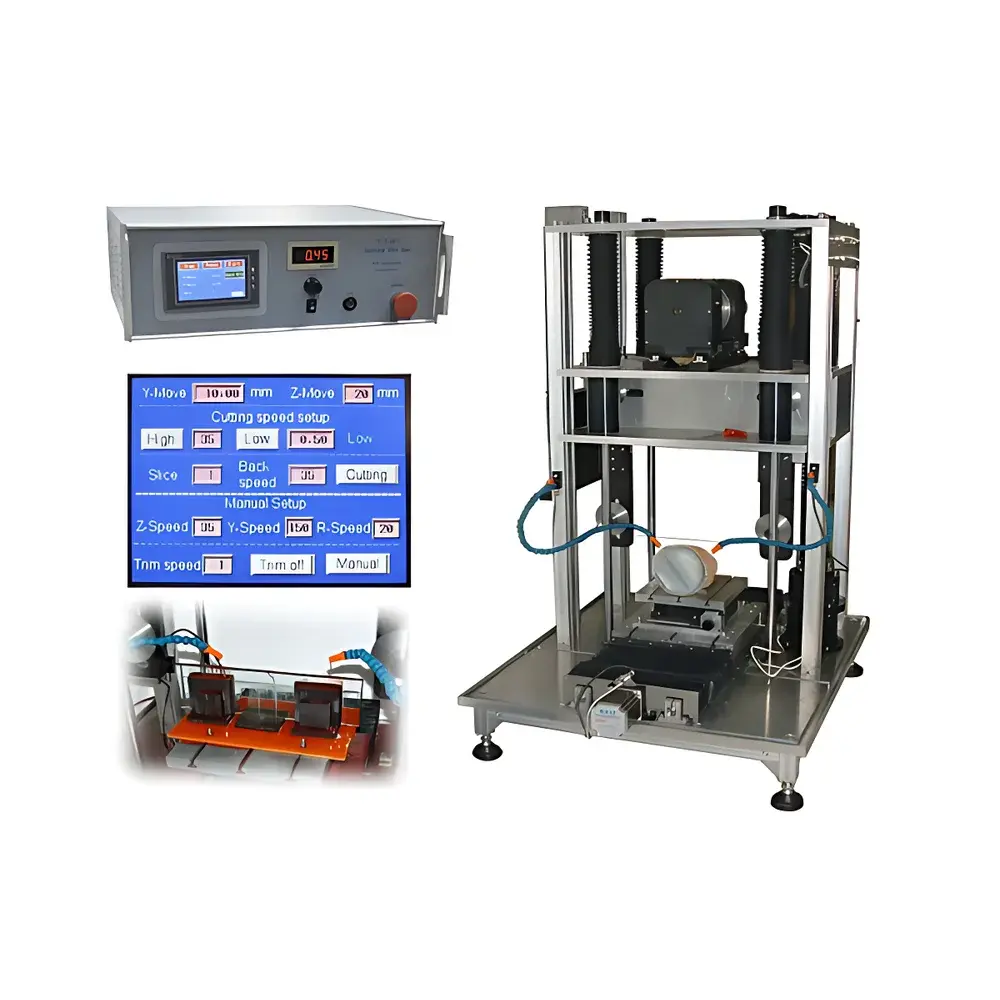
English Product Name
| Brand | Hefei Kejing |
|---|---|
| Origin | Anhui, China |
| Model | STX-1202 |
| Cutting Capacity | 300 × 300 mm (max. 12-inch diameter) |
| Diamond Wire Length | 30–64 m (adjustable) |
| Diamond Wire Diameter | 0.25–0.45 mm |
| Frame Material | Aluminum alloy |
| Control System | PLC with 7-inch touchscreen HMI |
| Sample Stage | Motorized 360° rotary stage (step motor driven) |
| Feed Mechanism | Step motor–driven automatic feed, infinitely variable cutting speed |
| Wire Tensioning | Pneumatic tensioning system (imported components) |
| Dimensions (W×D×H) | 1000 × 900 × 1045 mm |
| Weight | 300 kg |
| Instrument Type | Precision diamond wire saw for brittle material sectioning |
Overview
The Hefei Kejing STX-1202 Fully Automated Diamond Wire Saw is an industrial-grade precision sectioning instrument engineered for high-reproducibility slicing of brittle, anisotropic, and value-sensitive materials. Based on the principle of abrasive wire cutting—where a continuously moving diamond-impregnated wire acts as a flexible, low-damage cutting tool—the STX-1202 delivers controlled material removal with minimal thermal stress, kerf loss, and subsurface damage. Unlike rotary blade or abrasive wheel systems, diamond wire sawing enables clean, parallel cuts in crystals exhibiting cleavage planes (e.g., ZnO, BTO, YAG, BBO), geological specimens (rocks, meteorites, manganese nodules), and engineered ceramics without inducing microcracking or delamination. Its CE-compliant architecture integrates mechanical stability, programmable motion control, and process repeatability—making it suitable for R&D laboratories, quality control facilities, and academic crystal growth labs requiring consistent wafering or thin-section preparation prior to XRD, SEM, TEM, or optical characterization.
Key Features
- Motorized 360° programmable sample stage—enables precise angular alignment for anisotropic crystallographic orientation cutting and multi-angle serial sectioning.
- Step motor–driven automatic feed system with infinitely adjustable cutting speed (0.01–10 mm/min typical range)—optimizes wire life and surface finish across diverse hardness profiles (Mohs 5–9).
- Pneumatic wire tensioning using imported pneumatic components—maintains stable line tension (±0.5 N) throughout extended operation, critical for straightness and dimensional accuracy.
- Modular wire path design accommodating both diamond-impregnated wire (0.25–0.45 mm Ø) and slurry-based metal wire + abrasive suspension cutting—providing flexibility for hard-to-cut composites or heat-sensitive samples.
- Aluminum structural frame with vibration-damped base—ensures mechanical rigidity during high-precision slicing; reduces resonance-induced deviation in long-duration cuts.
- PLC-based control architecture with 7-inch capacitive touchscreen HMI—supports recipe storage, real-time parameter monitoring, emergency stop logic, and fault logging compliant with IEC 61508 functional safety principles.
Sample Compatibility & Compliance
The STX-1202 is validated for sectioning materials with heterogeneous mechanical behavior, including single-crystal semiconductors (SiC, GaN, LiNbO₃), piezoelectric oxides (BTO, PZT), laser host crystals (YAG, YVO₄), optical glasses (BK7, fused silica), refractory ceramics (Al₂O₃, Si₃N₄), geological aggregates (granite, basalt, quartzite), and metallurgical composites. It complies with CE marking requirements under Directive 2006/42/EC (Machinery Directive) and EN 60204-1 (electrical safety). While not inherently GLP/GMP-certified, its PLC-controlled operation, parameter traceability, and repeatable motion profiles support integration into ISO/IEC 17025-accredited testing workflows. Optional audit-trail-enabled firmware upgrades may be deployed to meet FDA 21 CFR Part 11 data integrity expectations in regulated environments.
Software & Data Management
The embedded control system stores up to 100 user-defined cutting protocols—including wire speed, feed rate, tension setpoint, total cut depth, and stage rotation angle—with timestamped execution logs exportable via USB. No proprietary software installation is required; all configuration and diagnostics occur locally on the HMI. For laboratory information management system (LIMS) integration, optional RS-485/Modbus RTU or Ethernet/IP interfaces support bidirectional communication with external MES or QC platforms. Raw motion data (position vs. time) can be logged at 10 Hz resolution for post-process kinematic analysis, facilitating root-cause investigation of edge chipping or wire breakage events.
Applications
- Preparation of wafers from boules of nonlinear optical crystals (e.g., BBO, LBO) for laser cavity assembly.
- Sectioning of geological core samples for petrographic thin-section analysis under polarized light microscopy.
- Serial block-face slicing of ceramic matrix composites for 3D microstructural reconstruction via FIB-SEM tomography.
- Cutting of thermally fragile scintillator crystals (e.g., CsI:Tl, NaI:Tl) where conventional sawing induces cracking or luminescence quenching.
- Production of mirror-finish substrates for epitaxial growth—achieving surface roughness Ra < 0.8 µm post-polish without subsurface damage layers.
FAQ
What is the maximum recommended cutting thickness for optimal wire life and surface quality?
For diamond wire (0.35 mm Ø), the recommended single-pass depth is ≤ 25 mm for materials with Vickers hardness > 12 GPa (e.g., sapphire); deeper cuts require multi-pass strategies with intermediate wire repositioning.
Can the STX-1202 perform angled cuts without manual repositioning?
Yes—the motorized 360° rotary stage allows fully automated compound-angle slicing when programmed via the HMI; tilt-axis articulation requires external fixtures.
Is coolant circulation integrated or externally supplied?
A built-in recirculating pump (included) delivers cutting fluid (water-based or glycol–ethanol mixtures) at 2–5 L/min; external reservoirs (>10 L capacity) are supported via quick-connect fittings.
Does the system support vacuum chucking for non-magnetic samples?
No vacuum chuck is standard; however, the stage accepts custom-machined graphite or aluminum sample holders with threaded inserts for secure mechanical clamping.
What maintenance intervals are recommended for pneumatic and motion subsystems?
Pneumatic filter elements should be replaced every 6 months; linear guide rails require dry-lubricant reapplication every 200 operational hours; stepper motor drivers undergo thermal calibration annually per ISO 10012 guidelines.



