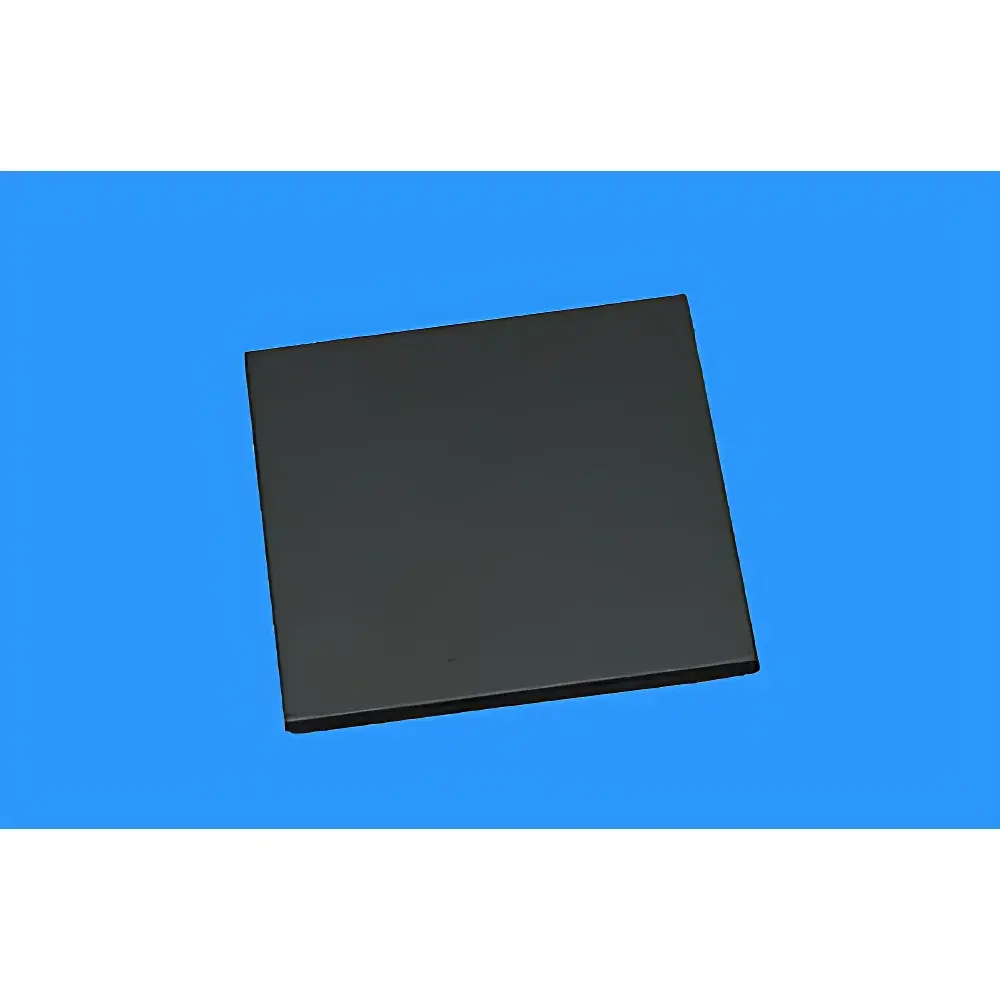
合肥科晶 Imported High-Purity α-Fe₂O₃ Single Crystal Substrates (Hematite, C-axis Oriented)
| Brand | Hefei Kejing |
|---|---|
| Origin | USA |
| Supplier Type | Authorized Distributor |
| Origin Category | Imported |
| Model | Imported Fe₂O₃ |
| Pricing | Upon Request |
| Crystal Structure | Hexagonal (R3̄c) |
| Lattice Parameters | a = 5.04 Å, c = 13.77 Å |
| Density | 5.20 g/cm³ |
| Mohs Hardness | 6.5 |
| Standard Orientations | <0001>, <10–10>, <11–20> (orientation tolerance ≤ 0.4°) |
| Standard Dimensions | 5 × 5 × 1.0 mm, 10 × 10 × 0.5 mm |
| Surface Finish | Single-side polished |
| Cleanroom Packaging | Class 1000 cleanroom assembled, sealed in Class 100 cleanroom bags |
Overview
Hefei Kejing’s imported high-purity α-Fe₂O₃ (hematite) single crystal substrates are engineered for advanced research and thin-film deposition applications requiring well-defined magnetic, electronic, and optical anisotropy. As a naturally occurring antiferromagnetic transition metal oxide with a rhombohedral (hexagonal) crystal structure (space group R3̄c), hematite exhibits strong spin–orbit coupling, a Néel temperature of ~950 K, and a bandgap of ~2.2 eV—making it a benchmark material for spintronics, photocatalysis, gas sensing, and epitaxial oxide heterostructure studies. These substrates are sourced from U.S.-based crystal growers specializing in natural mineral-derived single crystals, followed by precision orientation verification via X-ray diffraction (XRD) and surface preparation under controlled cleanroom conditions.
Key Features
- High structural integrity with low dislocation density (< 1 × 10⁴ cm⁻²), verified by synchrotron-based topography and rocking curve FWHM < 0.15° for -oriented wafers
- Consistent lattice matching for heteroepitaxy of functional oxides such as CoFe₂O₄, BiFeO₃, and La₀.₇Sr₀.₃MnO₃ due to minimal interfacial strain
- Rigorous orientation control: standard cuts include (c-axis normal), (m-plane), and (a-plane), all with angular tolerance ≤ ±0.4° as confirmed by Laue diffraction and θ–2θ scans
- Single-side mechanical polishing yields RMS surface roughness < 0.3 nm over 5 × 5 µm AFM scan areas; no chemical mechanical polishing (CMP) or etching is applied to preserve stoichiometric surface termination
- Trace impurity levels maintained below detection limits for Fe, O, Si, Al, and Ca per ICP-MS analysis (detection limit: < 1 ppb)
Sample Compatibility & Compliance
These substrates are compatible with ultra-high vacuum (UHV) environments up to 10⁻¹⁰ mbar and withstand thermal cycling between –196 °C and +800 °C without delamination or cracking. They meet ASTM F1529-22 standards for substrate dimensional stability and surface quality assessment. All batches undergo full traceability documentation—including XRD pole figure reports, SEM cross-sectional imaging, and EDX elemental mapping—supporting GLP-compliant lab workflows. Packaging adheres to ISO 14644-1 Class 1000 cleanroom assembly protocols, with final sealing in ISO Class 5 (100) cleanroom bags to prevent particulate contamination prior to use.
Software & Data Management
While the substrate itself is a passive component, Hefei Kejing provides digital certificate-of-analysis (CoA) packages upon request, including downloadable XRD data (.xye), orientation report PDFs, and cleanroom handling instructions. For integration into automated thin-film fabrication platforms (e.g., PLD, sputtering, MBE), substrate dimensions and orientation metadata are compatible with standard wafer-handling software protocols (SEMI E10/E142 compliant). Audit trails for lot-specific characterization data are retained for ≥7 years in accordance with ISO/IEC 17025:2017 requirements for reference material providers.
Applications
- Epitaxial growth of multiferroic and magnetoelectric heterostructures for fundamental spin–lattice coupling studies
- Model system for probing interfacial exchange bias mechanisms in Fe₃O₄/α-Fe₂O₃ bilayers
- Photoelectrochemical water oxidation electrodes—leveraging hematite’s favorable valence band position and visible-light absorption
- Substrate for atomic layer deposition (ALD) of high-κ dielectrics where surface hydroxyl density and termination influence nucleation uniformity
- Calibration reference for Raman spectroscopy of iron oxide phases (characteristic Eg, A1g, and phonon modes at ~225, 245, 290, 410, 495, and 610 cm⁻¹)
FAQ
Are these substrates suitable for molecular beam epitaxy (MBE)?
Yes—low outgassing rates and native oxygen-terminated surfaces enable stable oxide MBE growth when pre-annealed in O₂ partial pressure ≥1 × 10⁻⁶ Torr.
Can custom orientations or larger sizes be supplied?
Yes—orientations such as or off-cut angles (0.5°–4°) and dimensions up to 20 × 20 × 1.0 mm are available upon technical review and minimum order quantity agreement.
Is surface termination verified prior to shipment?
Yes—XPS analysis (O 1s and Fe 2p core levels) is performed on representative samples per batch to confirm stoichiometric α-Fe₂O₃ surface composition and absence of Fe₃O₄ or γ-Fe₂O₃ secondary phases.
What is the typical lead time for standard orders?
Standard configurations ship within 10–14 business days after order confirmation; custom specifications require 4–6 weeks for crystal orientation cutting and metrology validation.