
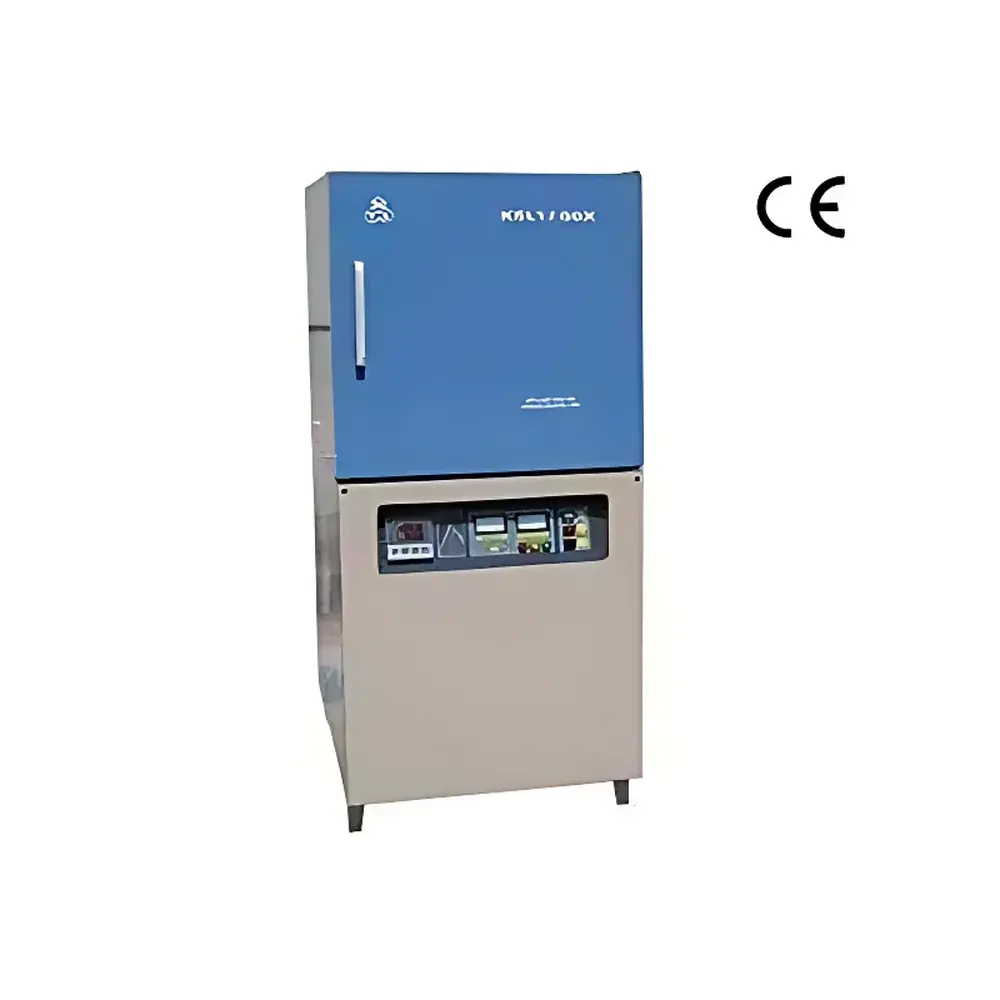
Hefei Kejing KSL-1700X-A4 36L High-Temperature Box Furnace
| Brand | Hefei Kejing |
|---|---|
| Model | KSL-1700X-A4 |
| Maximum Temperature | 1700 °C |
| Operating Temperature | ≤1650 °C |
| Chamber Dimensions (W×D×H) | 300 mm × 400 mm × 300 mm |
| Effective Volume | 36 L |
| Heating Element | Silicon Molybdenum (MoSi₂) Rods |
| Temperature Control | 30-Stage Programmable Controller (708P) |
| Thermocouple Type | Type B (PtRh30–PtRh6) |
| Accuracy | ±1 °C at steady state |
| Max. Ramp Rate | 10 °C/min |
| Power Supply | AC 220 V, 50 Hz |
| Rated Power | 15 kW |
| External Dimensions | 650 mm × 760 mm × 1550 mm |
| Net Weight | 140 kg |
| Door Configuration | Side-opening |
| Certifications | CE |
Overview
The Hefei Kejing KSL-1700X-A4 is a high-temperature box furnace engineered for precision thermal processing in research laboratories, materials science departments, and quality control environments. Designed around the fundamental principles of resistive heating and closed-chamber thermal uniformity, this furnace utilizes silicon molybdenum (MoSi₂) heating elements—known for stable resistance characteristics and exceptional oxidation resistance above 1500 °C—to achieve reliable operation up to 1700 °C. The furnace chamber measures 300 mm × 400 mm × 300 mm (36 L effective volume), enabling consistent heat distribution across larger sample loads while maintaining tight thermal gradients (<±5 °C across the working zone at 1600 °C, per internal validation). Temperature measurement and regulation are performed via a Type B (PtRh30–PtRh6) thermocouple, paired with a 30-stage programmable 708P temperature controller that supports ramp-hold-soak profiles, real-time deviation monitoring, and user-defined alarm thresholds. Its side-opening door design minimizes heat loss during loading/unloading and integrates mechanical interlocks to prevent operation when the door is ajar—supporting laboratory safety protocols.
Key Features
- High-stability MoSi₂ heating elements rated for continuous operation up to 1700 °C in air atmosphere
- 30-segment programmable temperature controller (708P) with adjustable ramp rates (0.1–10 °C/min) and hold durations
- Type B dual-platinum-rhodium thermocouple with NIST-traceable calibration capability and ±0.5 °C base accuracy
- Thermal insulation system comprising multi-layer ceramic fiber modules (density ≥128 kg/m³) and low-conductivity refractory brick lining
- Integrated over-temperature protection circuit with independent limit controller and audible/visual alarm
- CE-compliant electrical architecture meeting EN 61000-6-3 (EMI) and EN 61000-6-2 (immunity) standards
- Side-hinged, counterbalanced door with high-temp ceramic gasket and mechanical safety latch
Sample Compatibility & Compliance
The KSL-1700X-A4 accommodates standard crucibles (alumina, zirconia, graphite), ceramic sintering boats, and metal oxide compacts without requiring atmosphere control—making it suitable for air-sintering, ashing, calcination, and pre-firing applications. It complies with ISO 9001:2015 manufacturing quality requirements and carries CE marking under the EU Machinery Directive 2006/42/EC and Low Voltage Directive 2014/35/EU. All materials in contact with the hot zone meet RoHS 2011/65/EU restrictions on hazardous substances. The furnace’s thermal performance adheres to ASTM E220-19 for thermocouple calibration verification and supports GLP-compliant documentation workflows when integrated with external data loggers or SCADA systems.
Software & Data Management
While the 708P controller operates as a standalone unit, its RS485 communication interface (Modbus RTU protocol) enables integration into centralized lab management platforms. Users may configure automated data export to CSV via optional USB-to-RS485 adapters, supporting audit-ready records for ISO/IEC 17025-accredited testing labs. Firmware updates are delivered via secure vendor portal; configuration backups can be saved locally and restored without recalibration. The system supports time-stamped event logging—including power interruptions, setpoint changes, and alarm triggers—with retention periods configurable up to 30 days.
Applications
- Sintering of advanced ceramics (e.g., Al₂O₃, SiC, YSZ) and powder metallurgy compacts
- Thermal gravimetric analysis (TGA) sample pre-treatment and residue quantification
- Ash content determination per ASTM D3174 and ISO 1171
- Calcination of catalyst precursors and battery cathode materials (e.g., LiCoO₂, NMC)
- Heat treatment of refractory metals and high-entropy alloys
- Pre-firing of dental porcelain and bioceramic implants
FAQ
What atmosphere options are supported?
This model is configured for ambient air operation only. For inert or reducing atmospheres, external gas purge kits or custom flanged modifications must be specified separately.
Is the furnace compatible with GLP/GMP documentation requirements?
Yes—when used with validated data acquisition hardware and timestamped logging, it meets core traceability requirements of 21 CFR Part 11 for electronic records in regulated environments.
How often does the thermocouple require recalibration?
Annual recalibration against a reference standard is recommended; Type B thermocouples exhibit drift <0.2 °C/year under typical lab use conditions.
Can the furnace be operated continuously at 1650 °C?
Yes—rated for continuous duty at ≤1650 °C with proper ventilation and periodic inspection of heating element integrity.
What maintenance is required for the MoSi₂ heating elements?
No routine replacement is needed; however, visual inspection every 200 operating hours is advised to detect surface oxidation or warping indicative of thermal stress.



