
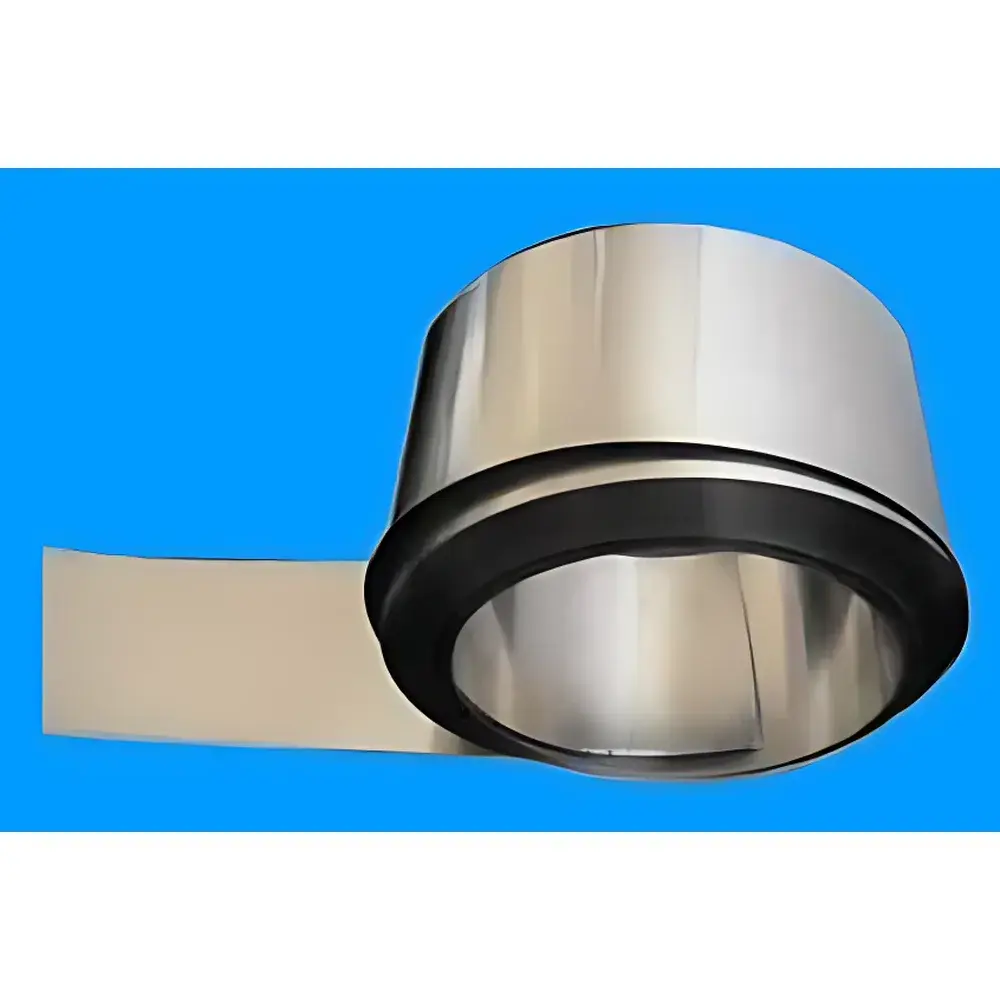
Ni Foil Sheet for Quartz Crystal Microbalance (QCM) Electrode Applications
| Brand | Hefei Kejing |
|---|---|
| Origin | Anhui, China |
| Manufacturer Type | Authorized Distributor |
| Origin Classification | Domestic |
| Model | Ni Foil Sheet |
| Price | USD 1,400 (FOB) |
| Dimensions (Standard) | 5000 mm × 150 mm × 0.03 mm |
| Purity | 99.5% (2N5) |
| Resistivity | 6.97 μΩ·cm at 20°C |
| Packaging | Vacuum-sealed in Class 100 cleanroom bags, stored and shipped under Class 1000 cleanroom conditions |
Overview
Ni Foil Sheet is a high-purity metallic substrate engineered specifically for electrode fabrication and sensor integration in quartz crystal microbalance (QCM) systems and electrochemical measurement platforms. As a fundamental component in gravimetric sensing, the nickel foil serves as both a conductive working electrode and a functionalized surface for thin-film deposition, interfacial reaction monitoring, and mass-sensitive detection of adsorption/desorption processes. Its use in QCM applications leverages the piezoelectric coupling between the AT-cut quartz resonator and the metal electrode layer—where precise control over foil thickness, surface roughness, and electrical homogeneity directly influences frequency stability, Sauerbrey sensitivity, and baseline noise performance. This product meets stringent material consistency requirements for reproducible sensor fabrication in research laboratories and industrial QC environments.
Key Features
- High-purity nickel (99.5%, 2N5) with trace impurity levels controlled to <50 ppm total metallic contaminants, minimizing catalytic side reactions and background drift during long-term QCM operation.
- Consistent thickness tolerance of ±5% across full sheet dimensions (standard: 5000 mm × 150 mm × 0.03 mm), enabling uniform current distribution and predictable acoustic impedance matching with quartz substrates.
- Low and stable electrical resistivity (6.97 μΩ·cm at 20°C), critical for minimizing ohmic losses in potentiostatic QCM-electrochemistry (QCM-E) configurations where simultaneous electrochemical perturbation and mass tracking are performed.
- Surface finish optimized for vacuum thermal evaporation, sputtering, and electrodeposition—compatible with standard metallization protocols used in QCM sensor chip manufacturing.
- Vacuum-sealed packaging in ISO Class 5 (100-level) cleanroom bags within ISO Class 6 (1000-level) controlled environment ensures oxide-free surface integrity and eliminates particulate contamination prior to handling.
Sample Compatibility & Compliance
This Ni foil is routinely employed as an electrode material in QCM-D (dissipation monitoring) cells, flow-through electrochemical QCM cells, and custom-built resonator assemblies operating in liquid-phase or controlled-atmosphere environments. It exhibits compatibility with common electrolytes (e.g., aqueous KCl, H2SO4, LiPF6-based carbonate solutions) and withstands typical electrochemical polarization ranges (−1.0 V to +0.8 V vs. Ag/AgCl). While not certified to ASTM E2657 or ISO 17025 as a finished instrument, the foil conforms to raw material specifications referenced in ASTM B160 (Standard Specification for Nickel Rod, Bar, and Wire) and supports GLP-compliant documentation workflows when integrated into validated QCM sensor production lines.
Software & Data Management
As a passive consumable material, the Ni foil itself does not interface with software. However, its consistent physical properties directly enhance data fidelity in QCM platforms utilizing frequency-tracking software such as QCM-IQ (Biolin Scientific), QSoft (Sartorius), or custom LabVIEW-based acquisition systems. When paired with instruments supporting FDA 21 CFR Part 11-compliant audit trails (e.g., certain Q-Sense E4 systems), documented lot traceability—including supplier batch number, purity certificate, and resistivity verification report—can be embedded into electronic lab notebooks (ELN) to satisfy GMP/GLP data integrity requirements.
Applications
- Working electrode fabrication for QCM-based corrosion studies of Ni-containing alloys in acidic or chloride-rich media.
- Substrate for in situ electrodeposition of catalytic nanoparticles (e.g., Pt, Pd, NiFe LDH) with real-time mass monitoring during nucleation and growth.
- Base layer for co-sputtered Ni–Cu or Ni–Ti multilayer films used in temperature-compensated QCM sensors.
- Reference electrode support in dual-resonator differential QCM setups requiring matched electrode mass and acoustic loading.
- Thin-film calibration standard for Sauerbrey-based mass sensitivity validation across multiple harmonics (5 MHz, 10 MHz, 25 MHz).
FAQ
Is this Ni foil suitable for high-frequency QCM applications (e.g., 25 MHz or higher)?
Yes—the 30 µm nominal thickness provides optimal mechanical rigidity and acoustic coupling for fundamental-mode operation up to 25 MHz when bonded to standard AT-cut quartz blanks.
Can I request certificates of analysis (CoA) for individual lots?
Yes—certificates including ICP-MS trace elemental analysis, four-point probe resistivity verification, and surface roughness (Ra) measurements are available upon order confirmation.
What is the recommended cleaning protocol before electrode deposition?
Standard procedure includes sequential ultrasonication in acetone, isopropanol, and deionized water (10 min each), followed by O2 plasma treatment (50 W, 2 min) to remove organic residues and activate the surface.
Do you offer custom annealing or passivation treatments?
Yes—custom thermal annealing (under Ar/H2 atmosphere, 400–600°C) and electropolishing services are available for orders ≥50 m².
How does this Ni foil compare to evaporated Ni films in terms of QCM performance?
Rolled foil offers superior long-term mechanical stability and lower intrinsic stress versus evaporated films, reducing frequency hysteresis during repeated hydration/dehydration cycles—particularly advantageous for biosensing and polymer swelling studies.



