
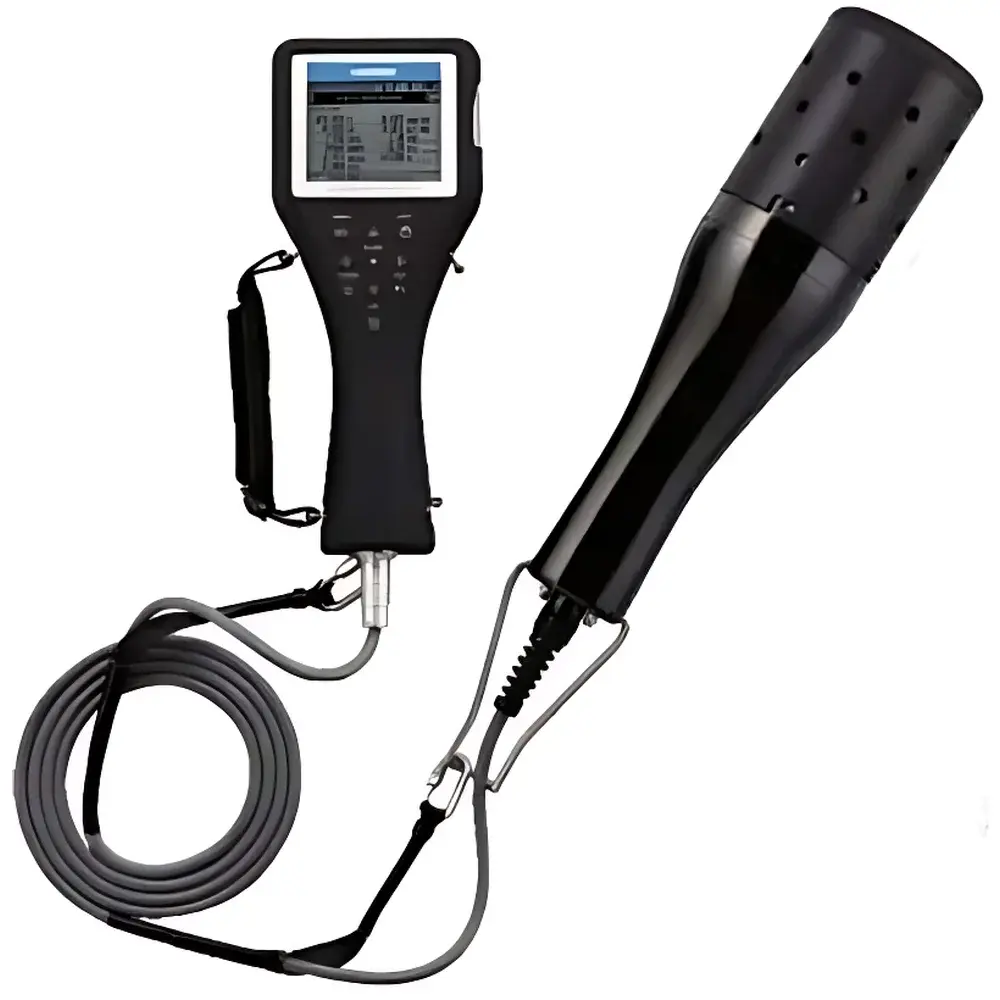
HORIBA U-50 Series Multi-Parameter Portable Water Quality Analyzer
| Brand | HORIBA |
|---|---|
| Origin | Japan |
| Model | U-50 Series |
| Instrument Type | Portable / Handheld Water Quality Analyzer |
| Measured Parameters | pH, ORP, Dissolved Oxygen (DO), Conductivity, Salinity, TDS, Specific Gravity (Seawater), Temperature, Turbidity (LED or Tungsten Lamp), Depth (U-52G/U-53G/U-54G) |
| Turbidity Standards | U-53 — US EPA Method |
| Turbidity Resolution | 0.01 NTU |
| DO Sensor Response Time | Enhanced for rapid stabilization |
| Electrode Material | PPS, Glass, SUS316L/SUS304, FKM, PEEK, Titanium, FEP Membrane, POM |
| IP Rating | IP68 (JIS Protection Class 8 for probe), IP67 (JIS Protection Class 7 for main unit with cable connected) |
| Operating Temperature | –5 to 45 °C |
| Storage Temperature | –10 to 60 °C |
| Battery | Four AA alkaline batteries (≈70 h operation without backlight |
| Data Storage | 10,000 sets |
| Communication | USB |
| Display | 320 × 240 monochrome LCD with backlight |
| Weight | Probe ≈1.8 kg |
| Cable Length | Standard 2 m (optional 10 m or 30 m) |
Overview
The HORIBA U-50 Series is a rugged, field-deployable multi-parameter water quality analyzer engineered for high-reliability environmental monitoring in diverse aquatic settings—including rivers, lakes, groundwater wells, estuaries, wastewater treatment plants, and coastal zones. Built on HORIBA’s legacy of precision electrochemical and optical sensing, the U-50 platform integrates seven core sensor modalities—pH, ORP, dissolved oxygen (DO), conductivity, salinity, total dissolved solids (TDS), and temperature—with optional turbidity (via LED or tungsten lamp detection) and depth (pressure-based) measurement. Its modular probe architecture supports interchangeable sensor configurations across seven model variants (U-51 through U-54G), enabling application-specific deployment while maintaining hardware and firmware interoperability. The instrument operates on a stable potentiometric and amperometric foundation: pH and ORP are measured using glass and platinum electrodes per JIS Z 8802 and ASTM D1293; DO employs a Clark-type polarographic membrane sensor with temperature-compensated diffusion kinetics; conductivity utilizes a four-electrode AC method compliant with ISO 7888 and ASTM D1125; and turbidity adheres to either US EPA Method 180.1 (U-53) or EN ISO 7027 (U-54), ensuring regulatory traceability in compliance-driven programs.
Key Features
- Ruggedized IP68-rated probe housing constructed from chemically resistant materials including titanium, SUS316L stainless steel, PEEK, and FEP membrane—validated for continuous submersion up to 30 meters.
- Simultaneous real-time display of up to 11 parameters: pH, pH(mV), ORP, DO, conductivity, salinity, TDS, seawater specific gravity (δt), temperature, turbidity, and depth (model-dependent).
- Dual turbidity options: U-53 probe implements forward-scatter LED detection (30°) meeting US EPA requirements; U-54 probe uses 90° tungsten-lamp nephelometry aligned with EN ISO 7027 for enhanced particulate sensitivity in marine and freshwater matrices.
- Integrated automatic brush-cleaning mechanism on U-53G and U-54G turbidity sensors to minimize biofouling and drift during extended deployments.
- GPS-enabled models (U-52G, U-53G, U-54G) feature 12-channel reception for georeferenced data logging—critical for spatial mapping, regulatory reporting, and longitudinal site characterization.
- Multi-language UI supporting English, Japanese, Russian, Spanish, and Portuguese—designed for international field teams and multilingual regulatory environments.
- Auto-ranging conductivity with built-in temperature compensation to 25 °C, plus configurable TDS conversion factors and salinity derivation from conductivity per PSS-78.
Sample Compatibility & Compliance
The U-50 Series is validated for use across natural and anthropogenic water matrices—including fresh surface water, groundwater, brackish estuaries, seawater, treated effluent, and industrial process streams. Its sensor suite meets key international performance benchmarks: pH accuracy conforms to ASTM D1293 and ISO 10523; conductivity measurements align with ISO 7888 and ASTM D1125; DO resolution and repeatability satisfy US EPA Method 360.1 criteria; and turbidity modules are certified to recognized regulatory standards (US EPA 180.1 for U-53; EN ISO 7027 for U-54). The system supports GLP-compliant workflows via timestamped, GPS-tagged data storage and user-accessible calibration logs. While not inherently 21 CFR Part 11–compliant, audit trails and calibration records can be exported in CSV format for integration into validated LIMS or QA/QC documentation systems.
Software & Data Management
Data acquisition and configuration are managed via HORIBA’s proprietary U-50 PC software, compatible with Windows OS. The software enables full instrument setup—including sensor calibration (2-point pH, multi-point conductivity/turbidity), unit selection (NTU, FNU, mg/L, mS/cm, ppt, δt), alarm thresholds, and GPS metadata tagging. All measurements are stored internally in non-volatile memory (10,000 datasets), with time/date stamps, temperature, and GPS coordinates (where equipped). Data export occurs via USB interface in standardized CSV format—facilitating direct import into Excel, R, Python pandas, or enterprise environmental databases. No cloud connectivity or proprietary drivers are required; firmware updates are delivered as signed binary packages with version-controlled release notes.
Applications
- Regulatory ambient water quality monitoring per national programs (e.g., US Clean Water Act Section 305(b), EU WFD, China GB 3838–2002).
- Wastewater influent/effluent characterization in municipal and industrial treatment facilities.
- Groundwater plume tracking and remediation verification, particularly where redox gradients (ORP), pH, and DO inform biogeochemical modeling.
- Coastal and estuarine research requiring concurrent salinity, specific gravity, and turbidity profiling under variable density conditions.
- Educational field laboratories and rapid-response environmental assessments where portability, battery endurance, and multi-parameter efficiency reduce logistical overhead.
FAQ
What calibration standards are required for routine operation?
Standard buffer solutions (pH 4.01, 7.00, 10.01), ORP standard (e.g., Zobell’s solution), DO saturation standards (air-saturated water at known temperature/pressure), and conductivity standards (e.g., KCl 1413 µS/cm, 12.88 mS/cm) are recommended. Two-point pH and single-point DO calibration are sufficient for most field applications.
Can the U-50 be used in seawater without sensor degradation?
Yes—the probe body incorporates titanium and SUS316L wetted parts, and the DO membrane is specifically formulated for chloride resistance. Conductivity and salinity algorithms apply Practical Salinity Scale (PSS-78) corrections to ensure accuracy across 0–70 ppt ranges.
How does the turbidity cleaning brush operate?
The motorized brush on U-53G and U-54G models rotates automatically before each turbidity reading (configurable interval), physically removing particulate adhesion from the optical window—reducing maintenance frequency and improving long-term measurement stability.
Is depth measurement available on all models?
No—depth functionality is exclusive to U-52G, U-53G, and U-54G models, utilizing a pressure transducer calibrated for 0–30 m range with ±0.3 m absolute accuracy and 0.05 m resolution.
Does the instrument support GLP or 21 CFR Part 11 compliance?
The U-50 maintains full audit trails (calibration history, operator ID, timestamps) but lacks electronic signature capability and role-based access control. It is suitable for GLP environments when paired with documented procedural controls; for 21 CFR Part 11, data must be transferred to a validated downstream system for signature and archival.







