
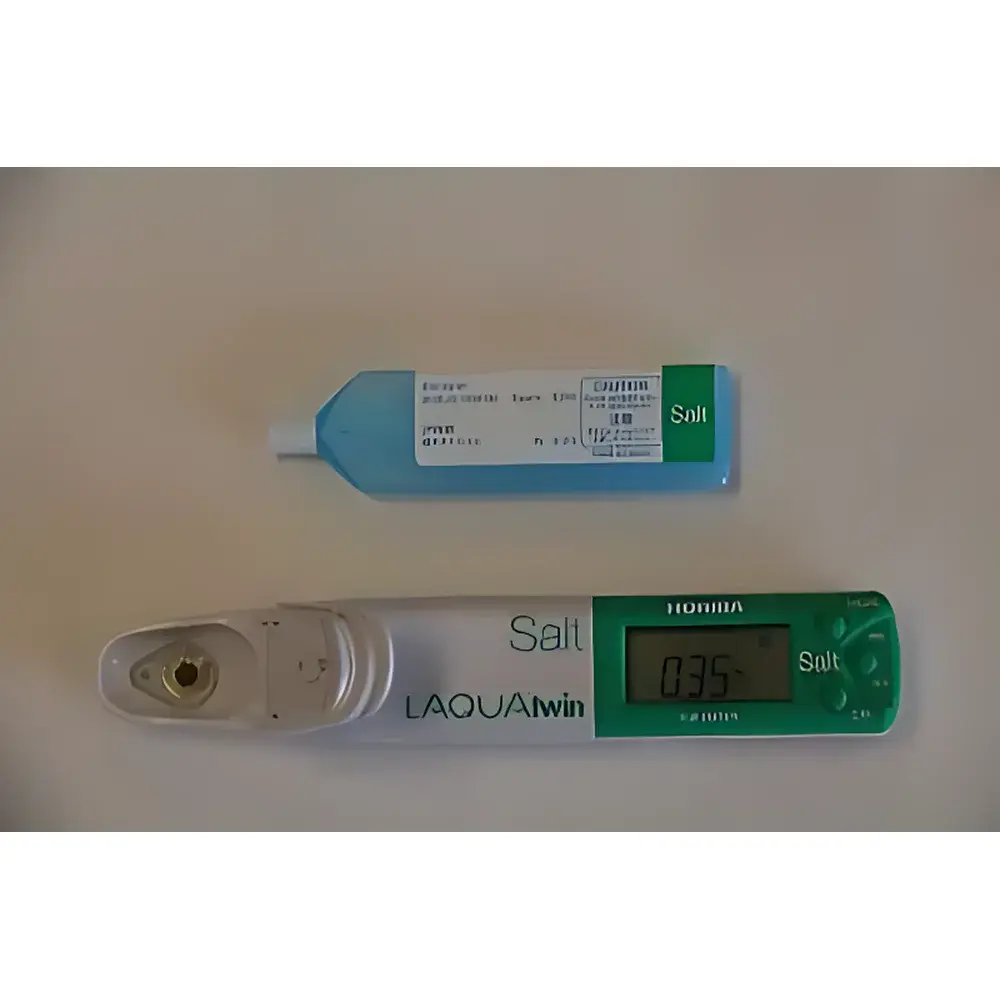
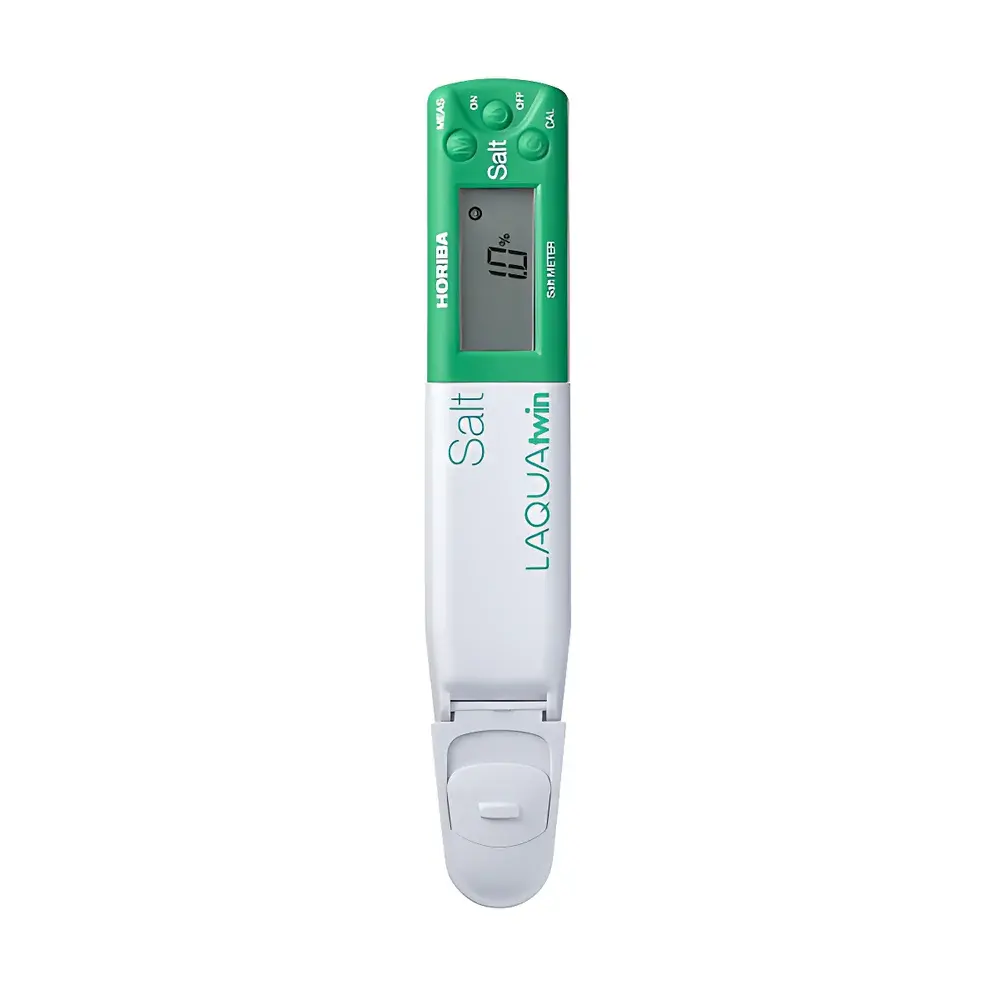
HORIBA B-721 Portable Salinity Meter
| Brand | HORIBA |
|---|---|
| Origin | Japan |
| Model | B-721 |
| Portability | Pen-type |
| Salinity Measurement Range | 0.0–10% (NaCl) |
| Conductivity Range | 0–19.9 mS/cm |
| TDS Range | 0–9900 ppm |
| Resistivity Range | 0–19.9 mS/cm (expressed as reciprocal conductivity) |
| Temperature Range | 5–40 °C |
| Accuracy | ±10% of reading |
| Minimum Resolution | 0.1% (salinity), 0.1 mS/cm (conductivity), 1 ppm (TDS), 0.1 °C (temperature) |
| Calibration | Two-point calibration with NaCl standard solutions |
| Temperature Compensation | Automatic, fixed 2%/°C coefficient |
| Ingress Protection | IP67 |
| Power Supply | Two CR2032 batteries |
| Dimensions | 164 × 29 × 20 mm (excl. probe protrusion) |
| Weight | Approx. 50 g (instrument only, batteries excluded) |
Overview
The HORIBA B-721 is a compact, rugged pen-type salinity meter engineered for rapid, field-deployable quantification of sodium chloride concentration in aqueous samples. Unlike optical or refractive index-based instruments, the B-721 employs a robust ion-selective electrode (ISE) principle—specifically optimized for NaCl detection—combined with conductometric measurement and built-in temperature compensation. This dual-signal approach enables reliable salt concentration estimation across diverse sample matrices including seawater, brine solutions, food processing liquids, hydroponic nutrient reservoirs, and aquarium water. Its design prioritizes operational simplicity without compromising metrological integrity: measurements are initiated with a single button press, stabilized via automatic endpoint hold, and displayed with clear digital resolution. The instrument operates exclusively within the validated environmental envelope of 5–40 °C and <85% RH (non-condensing), ensuring consistent electrochemical response under typical laboratory, industrial, or outdoor conditions.
Key Features
- Pen-form factor (164 × 29 × 20 mm; ~50 g) optimized for one-handed operation and pocket portability
- IP67-rated housing providing full protection against dust ingress and immersion in water up to 1 m for 30 minutes
- Two-point calibration protocol using certified NaCl standard solutions (e.g., 0.5% and 5.0% w/w) to correct for electrode drift and solution-specific conductivity-to-salinity conversion nonlinearity
- Automatic temperature compensation (ATC) with fixed 2%/°C coefficient aligned with ISO 7888 and ASTM D1125 conductivity correction conventions
- Simultaneous display of salinity (% NaCl), conductivity (mS/cm), TDS (ppm), and temperature (°C) on a high-contrast LCD
- Low-power architecture powered by two replaceable CR2032 coin cells, supporting >5000 measurements per set under typical usage
- No moving parts or fluid-filled reference junctions—minimizing maintenance and susceptibility to clogging in turbid or particulate-laden samples
Sample Compatibility & Compliance
The B-721 is validated for use with homogeneous, low-viscosity aqueous solutions containing dissolved NaCl as the dominant ionic species. It is not intended for samples with high concentrations of interfering ions (e.g., K⁺, Ca²⁺, NO₃⁻) unless compensated via empirical correction factors derived from matrix-matched standards. While not certified to GLP or GMP validation protocols out-of-the-box, its two-point calibration traceability, stable electrode response, and documented accuracy (±10% of reading within 0.1–10% range) support routine quality control applications compliant with ISO/IEC 17025 internal method verification requirements. The device meets IEC 60529 for IP67 classification and conforms to RoHS Directive 2011/65/EU for hazardous substance restrictions.
Software & Data Management
The B-721 operates as a standalone, firmware-controlled instrument with no onboard data logging or PC connectivity. All measurement data remain on-device until manually recorded. This architecture eliminates software validation overhead and aligns with environments where electronic records are not mandated (e.g., preliminary screening, educational labs, field sanitation checks). For regulated settings requiring audit trails, users may integrate the B-721 into documented manual data capture workflows—including logbook entries annotated with operator ID, timestamp, calibration lot numbers, and environmental conditions—as permitted under FDA 21 CFR Part 11 Annex 11 “paper-based record” equivalency provisions.
Applications
- Marine biology and aquaculture: Real-time monitoring of salinity stability in hatcheries and recirculating aquaculture systems (RAS)
- Food & beverage QC: Verification of brine concentration in pickling, curing, and fermentation processes
- Agricultural water management: Assessment of irrigation water salinity risk (ECₑ values inferred from mS/cm readings)
- Environmental field testing: Rapid screening of coastal runoff, estuarine mixing zones, and desalination plant effluent
- Educational laboratories: Hands-on instruction in electrochemical sensing principles, calibration theory, and ionic strength effects
- Swimming pool and spa maintenance: Spot-checking of salt-chlorinator system electrolyte concentration
FAQ
What calibration standards are required for the B-721?
Two NaCl standard solutions—typically 0.5% (w/w) and 5.0% (w/w)—are recommended for two-point calibration. HORIBA provides certified reference materials (CRM-B721-KIT) traceable to NIST SRM 1023.
Can the B-721 measure seawater accurately?
Yes, within its 0.0–10% range and with appropriate two-point calibration using seawater-matched standards. Note that natural seawater (~3.5% NaCl) falls well within optimal accuracy bounds.
Is temperature compensation adjustable?
No—the B-721 applies a fixed 2%/°C compensation coefficient, consistent with standard conductivity-to-salinity conversion models used in marine and industrial hydrometry.
How often should the electrode be cleaned?
Rinse with deionized water after each measurement. For routine use, clean the sensor tip weekly with mild detergent and soft brush; avoid abrasive agents or organic solvents.
Does the B-721 comply with ISO 5725 or ISO 8466?
While not formally accredited to these standards, its ±10% accuracy specification and two-point calibration methodology support alignment with ISO 8466-1:1993 for univariate calibration function validation in routine analysis.




