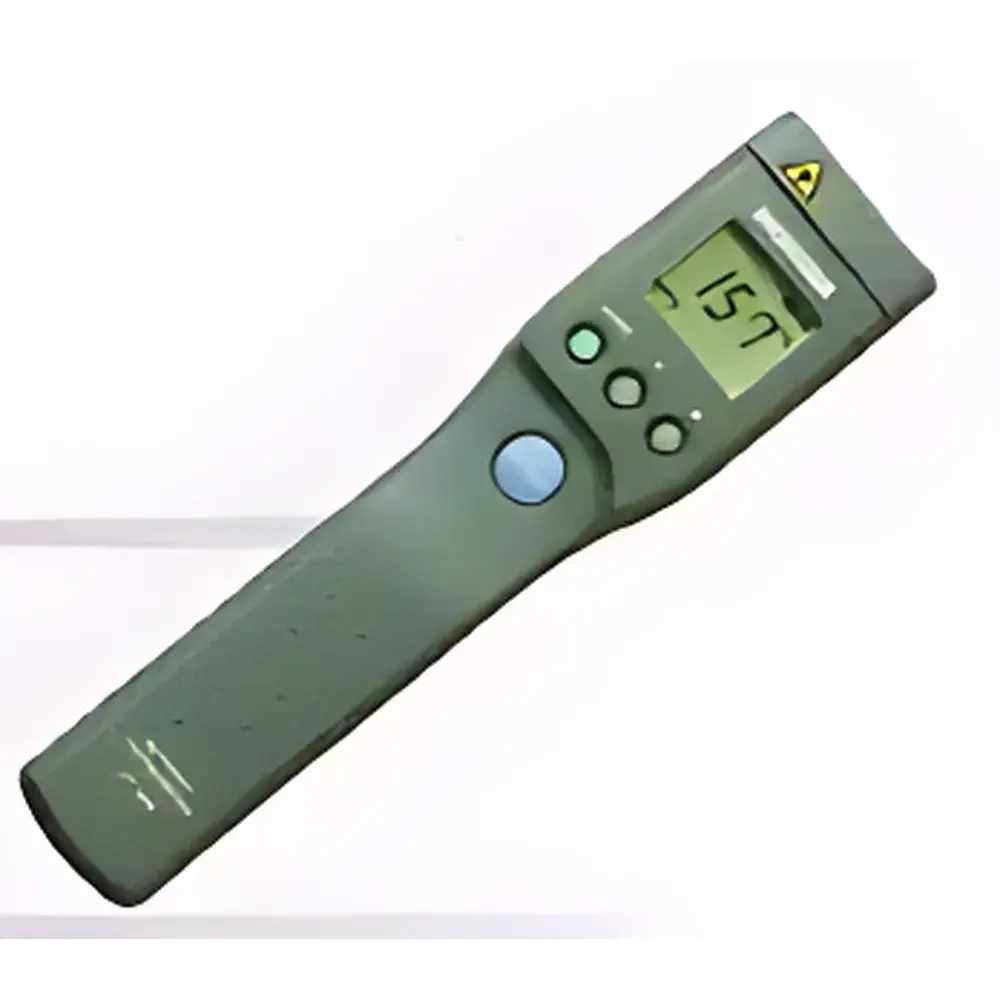
HORIBA IT-540 Non-Contact Infrared Radiometric Thermometer
| Brand | HORIBA |
|---|---|
| Origin | Japan |
| Model | IT-540 |
| Temperature Range | –50 °C to 1000 °C |
| Measurement Time | 1–2 s |
| Spot Size (S-type) | Ø25 mm |
| Optical Resolution | High |
| Indication Method | Dual-Beam Laser Pointer |
| Mounting | Handheld / Optional Tripod Mount |
| Compliance | CE, RoHS, JIS C 1607-1 (Infrared Thermometers) |
Overview
The HORIBA IT-540 is a precision-engineered non-contact infrared radiometric thermometer designed for rapid, reliable surface temperature measurement across industrial and maintenance applications. Operating on the principle of Planck’s radiation law, the IT-540 detects emitted mid-infrared energy (typically 8–14 µm spectral band) from target surfaces and converts it into a calibrated temperature reading without physical contact. Its wide operational range—from –50 °C to 1000 °C—enables consistent monitoring of both cryogenic components and high-temperature assets such as transformer bushings, furnace linings, molten metal surfaces, and semiconductor processing equipment. The instrument features a fixed-focus optical system optimized for short-to-medium working distances (0.3–1 m typical), delivering stable repeatability (< ±1.5 °C or ±1.5% of reading, whichever is greater, under standard conditions) and minimizing emissivity-related uncertainty through adjustable emissivity compensation (0.10–1.00 in 0.01 steps).
Key Features
- Dual-beam laser targeting system: Two coaxial visible lasers converge precisely at the center of the measurement spot, providing unambiguous spatial localization—even at extended distances or in cluttered environments.
- S-type spot configuration: Engineered for high spatial resolution on small targets; achieves effective measurement diameter of Ø25 mm at 0.5 m distance, supporting thermal evaluation of busbars, solder joints, and localized hotspots on PCBs or power electronics.
- Fast response time: Delivers stabilized readings within 1–2 seconds, facilitating real-time scanning of moving parts (e.g., conveyor-borne components) or transient thermal events during startup/shutdown cycles.
- Robust handheld ergonomics: Compact form factor (170 × 140 × 55 mm), lightweight construction (< 0.5 kg), and IP54-rated enclosure ensure durability in factory-floor, substation, and outdoor utility environments.
- On-device emissivity adjustment and max/min/avg/diff temperature functions: Supports comparative analysis across multiple points and compensates for variable surface characteristics (e.g., oxidized steel vs. polished aluminum).
Sample Compatibility & Compliance
The IT-540 is validated for use on non-transmissive, opaque solid and liquid surfaces with stable emissivity properties—including painted metals, ceramics, rubber, plastics, and refractory materials. It is not intended for measuring transparent or semi-transparent media (e.g., glass, thin films) or highly reflective bare metals without surface treatment. The device conforms to JIS C 1607-1:2020 (Japanese Industrial Standard for radiation thermometers), meets CE marking requirements under the EU Electromagnetic Compatibility Directive 2014/30/EU and Low Voltage Directive 2014/35/EU, and complies with RoHS 2011/65/EU restrictions on hazardous substances. Calibration certificates traceable to the National Metrology Institute of Japan (NMIJ) are available upon request for ISO/IEC 17025-compliant quality systems.
Software & Data Management
While the IT-540 operates as a standalone field instrument, optional PC connectivity via USB interface enables data logging and post-processing using HORIBA’s proprietary ThermView Lite software. This application supports time-stamped CSV export, emissivity profile libraries, annotation of measurement locations, and overlay of thermal trend charts—facilitating integration into preventive maintenance (PM) programs aligned with ISO 55000 asset management frameworks. Audit trails and user access controls comply with basic GLP documentation requirements; full 21 CFR Part 11 compliance requires external validation protocols implemented by end users.
Applications
- Electrical infrastructure diagnostics: Detection of abnormal heating in circuit breakers, disconnect switches, insulators, and cable terminations per IEEE C37.90 and IEC 60255 standards.
- Manufacturing process control: Monitoring mold surface temperatures in injection molding, curing profiles in composite layup, and thermal uniformity in annealing ovens.
- Mechanical condition monitoring: Identifying bearing overheating, misalignment-induced friction, and lubrication failure in rotating machinery.
- Research & development labs: Rapid prototyping thermal validation, material characterization under thermal stress, and calibration cross-checks against reference blackbody sources.
- Energy efficiency audits: Quantifying heat loss from steam traps, insulation breaches, and HVAC ductwork in commercial and industrial facilities.
FAQ
What is the minimum measurable spot size, and how does distance affect it?
The S-type optical configuration maintains a Ø25 mm spot diameter at 0.5 m; spot size scales linearly with distance (e.g., Ø50 mm at 1.0 m). Optimal accuracy is achieved when the target fully fills the spot.
Can the IT-540 measure through glass or plastic windows?
No—it cannot reliably measure through most transparent materials due to spectral transmission mismatch and reflection artifacts. Dedicated IR-transparent windows (e.g., Ge or ZnSe) require custom calibration.
Is factory recalibration required, and how often?
Annual recalibration is recommended for critical applications; intervals may extend to 2 years under stable environmental conditions and documented performance verification per ISO/IEC 17025.
Does the device support data export for CMMS integration?
Yes—CSV files generated via ThermView Lite can be imported into common computerized maintenance management systems (CMMS) such as IBM Maximo or SAP PM for work order linkage and historical trending.
What safety certifications apply to operation near high-voltage equipment?
The IT-540 carries CAT III 1000 V pollution degree 2 rating per IEC 61010-1, permitting safe use within 1 m of energized medium-voltage assets up to 35 kV under arc-flash mitigation protocols.