
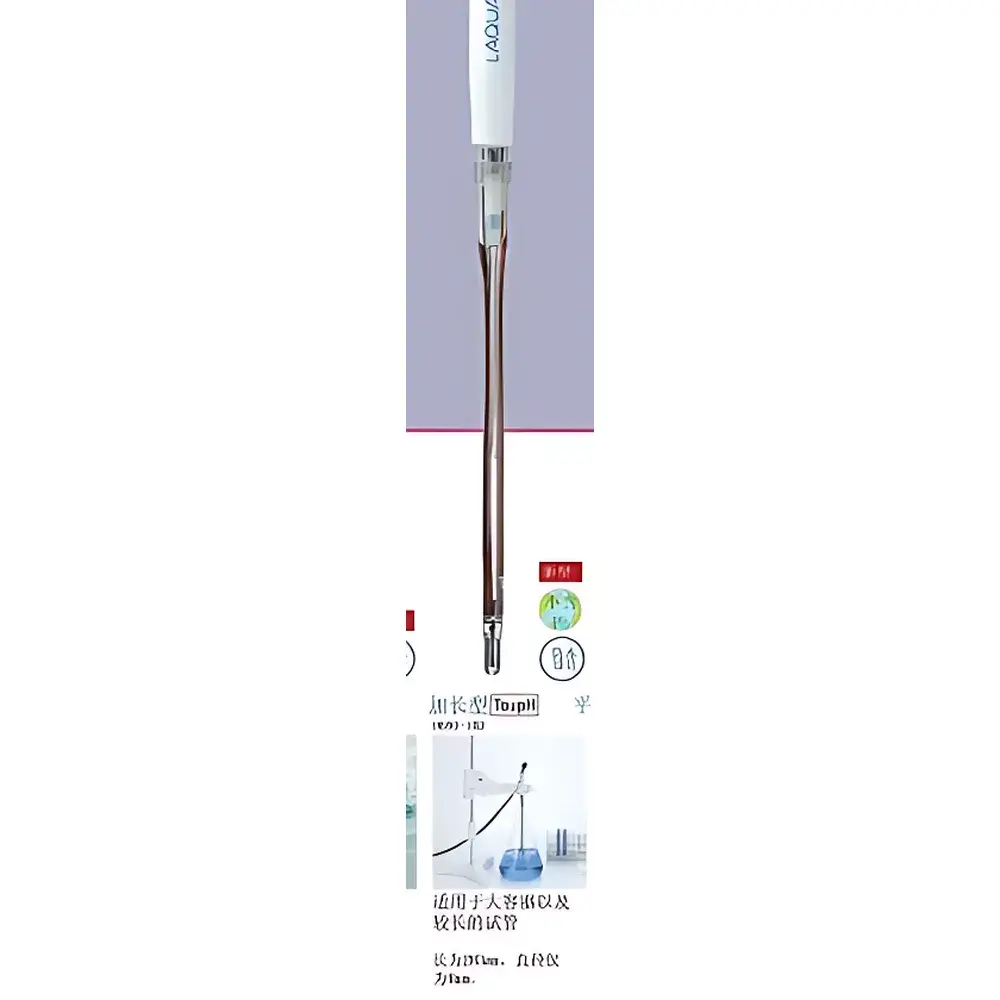
HORIBA 9680-10D Extended-Length ToupH pH Electrode
| Brand | HORIBA |
|---|---|
| Origin | Japan |
| Model | 9680-10D |
| Temperature Range | 0–100 °C |
| pH Range | 0–14 |
| Electrode Type | Composite Glass pH Electrode with Integrated Reference System |
| Body Material | Chemically Resistant Plastic |
| Tip Geometry | Flat-Surface, Semi-Hemispherical Bulb |
| Compliance | JIS Z 8802 (pH Electrode Performance Standards), ISO 7027 (for optical interface compatibility in hybrid systems) |
Overview
The HORIBA 9680-10D is an extended-length composite pH electrode engineered for high-reliability measurements in demanding laboratory, industrial process, and quality control environments. Designed as part of HORIBA’s flagship ToupH series, it employs a dual-patent-pending architecture combining a rare-earth-doped pH-sensitive glass membrane and an ion-selective hollow-fiber reference junction. Its measurement principle follows the Nernst equation, where the potential difference between the sensing glass membrane and the stable internal reference system is linearly proportional to pH across the full 0–14 range. The electrode operates within a temperature range of 0–100 °C, enabling direct immersion into hot aqueous solutions, sterilized bioreactor effluents, or high-temperature food processing streams without thermal drift compensation artifacts. Unlike conventional electrodes, the 9680-10D integrates structural innovations—such as a semi-hemispherical bulb geometry and sub-100 µm clearance between sensor face and protective sleeve—to minimize bubble entrapment and enable surface pH mapping of semi-solid matrices and micro-volume droplets (≥5 µL).
Key Features
- Patent-pending rare-earth doped glass membrane: Incorporates proprietary lanthanide-based additives to reduce response time by up to 50% versus standard pH glasses while simultaneously enhancing mechanical robustness—exceeding JIS Z 8802 mechanical strength requirements by >10×.
- Hollow-fiber cation-conductive reference junction: Limits Ag⁺ leaching and silver complex precipitation to <0.1% of conventional double-junction designs, ensuring long-term stability of liquid junction potential and minimizing baseline drift during continuous monitoring.
- Flat-surface semi-hemispherical tip: Enables direct contact measurement on gels, pastes, films, and solid surfaces; optimized for low-volume samples where conventional spherical bulbs induce air gaps or insufficient wetting.
- Electrostatic discharge (ESD)-hardened semiconductor interface: Integrates HORIBA’s proprietary ESD suppression circuitry and passivated gate oxide layers, eliminating false offsets caused by static charge accumulation—a known failure mode in ISFET-integrated or high-impedance electrochemical interfaces.
- Dry-storage compatible design: Maintains calibration integrity for ≥72 hours after rinsing and air-drying; eliminates mandatory storage in KCl solution, reducing contamination risk in multi-analyte workflows.
Sample Compatibility & Compliance
The 9680-10D demonstrates broad compatibility with aqueous buffers, pharmaceutical formulations, dairy emulsions, wastewater effluents, and low-conductivity ultrapure water (≥1 µS/cm). Its flat-tip geometry prevents capillary bridging errors in viscous media and avoids mechanical damage when scanning across textured surfaces such as tablet coatings or polymer films. It complies with ISO/IEC 17025 documentation requirements for traceable calibration records and supports GLP-compliant audit trails when paired with HORIBA LAQUA Smart software. While not certified for intrinsic safety in hazardous locations, its plastic housing meets UL 94 V-0 flammability standards. For applications requiring FDA 21 CFR Part 11 compliance, the electrode is validated for use with HORIBA’s secure data acquisition platforms featuring electronic signatures, audit logs, and user-access controls.
Software & Data Management
The 9680-10D is fully interoperable with HORIBA’s LAQUA Twin and LAQUA Smart software suites via RS-232, USB, or Bluetooth 5.0 interfaces. Real-time data streaming supports automated timestamped logging at user-defined intervals (100 ms–60 s), with built-in statistical functions including moving average, standard deviation, and slope-based endpoint detection. Calibration routines follow ASTM D1293 and ISO 3696 protocols, allowing up to five-point non-linear curve fitting with automatic buffer recognition. All raw mV/pH/temperature values are stored in encrypted .csv or .xlsx formats with embedded metadata (operator ID, calibration certificate ID, ambient humidity, and probe serial number), satisfying traceability requirements under ISO/IEC 17025 Clause 7.7.
Applications
- Surface pH mapping of pharmaceutical tablets and transdermal patches during QC release testing
- In-line monitoring of fermentation broth pH in single-use bioreactors (SUTs)
- Stability testing of cosmetic emulsions and hydrogels under accelerated aging conditions
- Quality assurance of dairy products—including yogurt, cheese curds, and whey—where traditional bulb electrodes fail to achieve uniform contact
- Environmental analysis of sediment pore water and biofilm-covered substrates in aquatic toxicity assays
- Micro-volume titration endpoints in nanoliter-scale reaction screening platforms
FAQ
Can the 9680-10D be used for direct solid surface measurement?
Yes—the flat-surface tip and sub-100 µm sleeve clearance allow reliable contact with hydrated solids, gels, and membranes without requiring sample dissolution.
Is this electrode compatible with non-aqueous solvents?
It is not recommended for pure organic solvents (e.g., acetonitrile, THF); however, it performs reliably in aqueous-organic mixtures with ≥30% water content and conductivity >50 µS/cm.
What is the expected service life under continuous operation?
Under typical lab use (8 h/day, 5 days/week, pH 4–10, 25 °C), mean time between recalibrations exceeds 200 hours; reference system longevity is verified to ≥12 months per JIS Z 8802 accelerated aging tests.
Does the electrode require special cleaning procedures?
No—routine rinsing with deionized water suffices; for protein fouling, soak in 0.1 M HCl for 5 min followed by DI rinse; avoid abrasive tools or ultrasonic baths.
Can multiple 9680-10D electrodes be operated simultaneously on one meter?
Yes, provided the meter supports multi-channel input and each electrode is individually calibrated; however, simultaneous use with non-ToupH electrodes may introduce cross-talk due to differing junction potentials and impedance profiles.



