
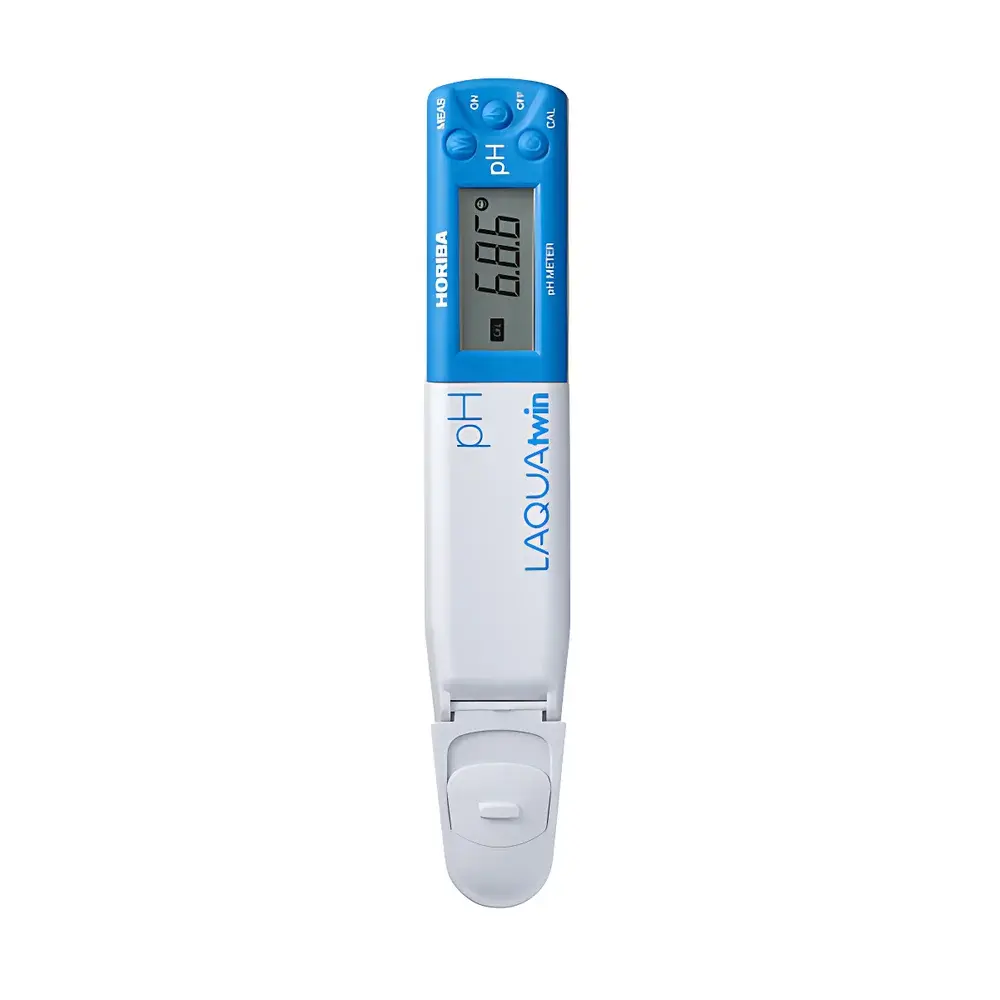
HORIBA LAQUAtwin B-711/B-712 Pocket pH Meter
| Brand | HORIBA |
|---|---|
| Origin | Japan |
| Model | B-711 / B-712 |
| Instrument Type | Pocket-style pH meter |
| Parameter Type | Single-parameter (pH) |
| Measurement Range | 2.0–12.0 pH |
| Resolution | 0.1 pH |
| Accuracy | ±0.1 pH (after calibration with standard buffers) |
| Calibration Solutions | pH 4.01, 7.00, and 9.01 buffer solutions |
| Calibration Modes | B-711 — single-point calibration |
| Temperature Compensation | Automatic (ATC), 5–40 °C operating range |
| IP Rating | IP67 (dust-tight |
| Sample Volume | ≥0.05 mL (with optional sampling film) |
| Power Supply | Two CR2032 lithium coin cells |
| Dimensions (L×W×H) | 164 × 29 × 20 mm (excl. protrusions) |
| Weight | Approx. 50 g (instrument only, batteries excluded) |
Overview
The HORIBA LAQUAtwin B-711 and B-712 are compact, handheld pocket pH meters engineered for rapid, reliable field and laboratory pH measurement in aqueous samples. Based on proven glass electrode potentiometry, these instruments employ a flat-surface pH electrode architecture optimized for minimal sample consumption and high electrochemical stability. Unlike conventional combination electrodes requiring immersion in bulk solution, the LAQUAtwin’s planar sensing surface enables accurate measurement from as little as 0.05 mL of sample—ideal for micro-volume applications such as food surface testing, agricultural soil extracts, cosmetic formulations, and small-batch bioprocess monitoring. The B-712 model extends functionality with selectable one- or two-point calibration capability, improving traceability across broader pH ranges, while the B-711 provides streamlined operation for routine checks where single-point (e.g., pH 7.00) verification suffices. Both models feature automatic temperature compensation (ATC) referenced to the built-in thermistor, ensuring consistent readings across ambient conditions from 5 to 40 °C.
Key Features
- Ultra-low sample requirement: Measures accurately from ≥0.05 mL using optional sampling film (B-711/B-712 compatible), minimizing waste and enabling analysis of viscous or scarce samples.
- One-touch operation: Intuitive interface with dedicated calibration and measurement buttons; visual confirmation via smiley-face icon upon stable reading acquisition.
- IP67-rated enclosure: Fully dust-tight and water-resistant—tested to withstand immersion at 1 m depth for 30 minutes—making it suitable for harsh industrial, outdoor, or wet-lab environments.
- Robust flat-surface glass electrode: Engineered for mechanical durability and reduced clogging risk; compatible with particulate-containing samples when used with optional filtration membranes.
- Auto-hold function: Freezes displayed value once measurement stability is detected, eliminating manual timing errors during data recording.
- Long battery life: Powered by two standard CR2032 lithium cells (typical service life >1,000 measurements), with low-battery indicator.
Sample Compatibility & Compliance
The LAQUAtwin B-711/B-712 is validated for use with aqueous, non-oily, low-viscosity solutions within pH 2.0–12.0. It is not intended for non-aqueous solvents, highly buffered biological media without dilution, or samples containing strong oxidizers or hydrofluoric acid. For particulate-laden samples (e.g., fruit pulp, slurry extracts), users must apply the optional filter membrane accessory to prevent electrode fouling. The device complies with IEC 60529 (IP67), JIS Z 8401 (pH measurement standards), and supports GLP-aligned workflows through documented calibration records (user-maintained). While not inherently 21 CFR Part 11 compliant due to lack of electronic audit trail, its calibration and measurement repeatability (±0.1 pH) meets ASTM E70 and ISO 3696 Grade 3 water quality verification requirements when operated per manufacturer instructions.
Software & Data Management
These standalone instruments operate without external software or connectivity. All calibration and measurement data are retained only on-screen during active use; no internal memory or export capability is provided. Users are required to manually log calibration dates, buffer values, and measured results in laboratory notebooks or LIMS-compatible spreadsheets. This design prioritizes simplicity, regulatory transparency, and operational independence—particularly advantageous in ISO/IEC 17025-accredited labs where instrument validation emphasizes traceable, user-controlled procedures over automated digital logging. Optional accessories include protective carrying case, calibration kit (pH 4.01/7.00/9.01 sachets), and electrode cleaning solution (HORIBA Part No. 9511-20K).
Applications
- Quality control of beverages, dairy products, sauces, and fermented foods—direct surface or drip-drop testing without sample dilution.
- Agricultural field testing: leaf sap, nutrient solutions, compost leachates, and irrigation water.
- Environmental monitoring: streamside pH screening, wastewater effluent spot checks, and aquarium/hydroponic system maintenance.
- Educational laboratories: undergraduate chemistry and biology experiments requiring portable, intuitive pH instrumentation.
- Pharmaceutical excipient verification: quick pH assessment of aqueous suspensions and ointment bases prior to formulation.
FAQ
What is the minimum sample volume required for accurate measurement?
For the B-711/B-712, ≥0.05 mL is sufficient when using the optional sampling film (HORIBA Part No. 9511-10F); otherwise, ≥0.1 mL is recommended under standard conditions.
Can the instrument measure outside the 2.0–12.0 pH range?
No—operation beyond this range may cause irreversible electrode drift or signal saturation; samples outside this interval should be diluted and re-measured.
Is the electrode replaceable?
Yes—the flat-surface glass electrode module (HORIBA Part No. 9511-10E) is field-replaceable and designed for >2,000 measurements under typical usage.
Does the device support automatic calibration recognition?
No—calibration is manual: users select buffer value via button sequence and confirm immersion; no RFID or barcode recognition is implemented.
How often should calibration be performed?
Daily calibration is recommended for critical applications; for routine checks, recalibration before each use batch or after exposure to extreme pH or temperature is advised per ISO 7870-2 guidelines.




