
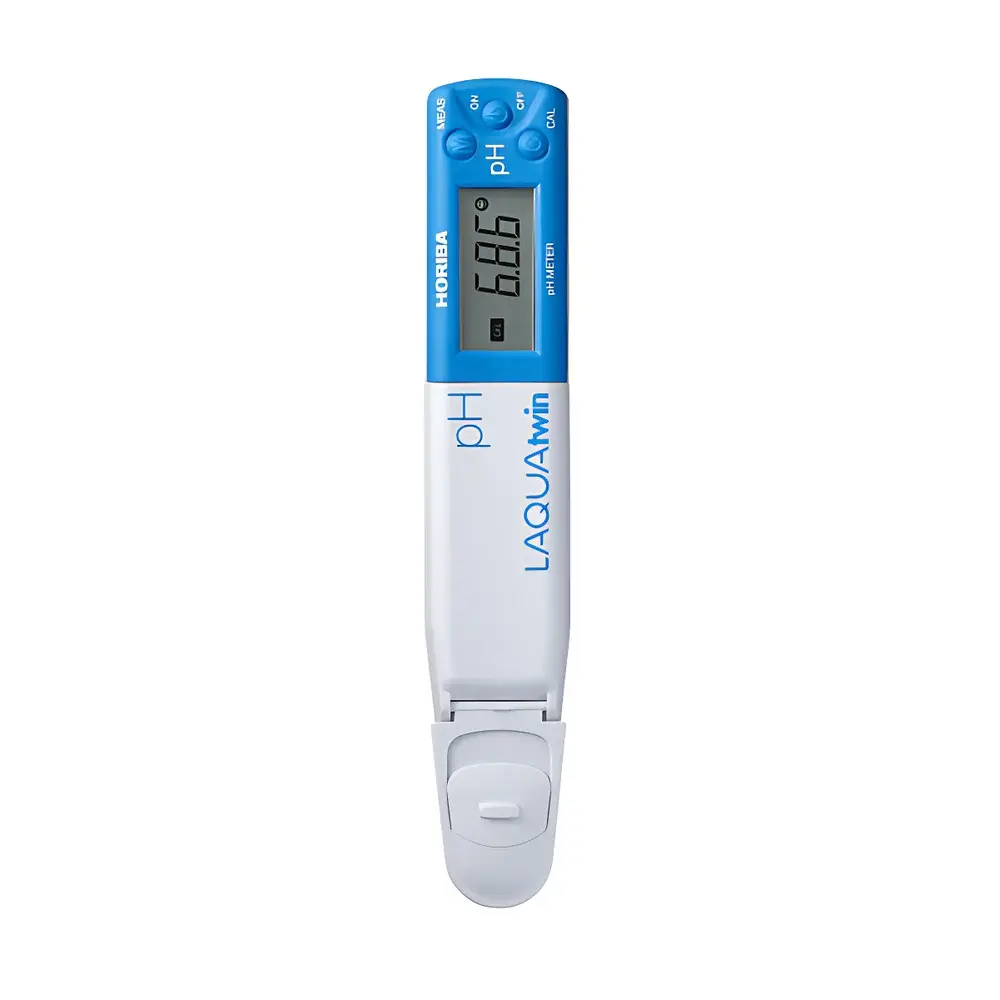
HORIBA LAQUAtwin B-711/B-712 Pocket pH Meter
| Brand | HORIBA |
|---|---|
| Origin | Japan |
| Model | B-711 (Single-Point Calibration) / B-712 (Two-Point Calibration) |
| Instrument Type | Pen-Style pH Meter |
| Parameter Type | Single-Parameter (pH) |
| Measurement Range | 2.0–12.0 pH |
| Resolution & Accuracy | ±0.1 pH |
| Minimum Sample Volume | 0.05 mL (with sampling film B) or ≥0.1 mL |
| Calibration Solutions | pH 4.01, 7.00, and 9.18 standard buffers |
| Temperature Compensation | Automatic (ATC), 5–40 °C operating range |
| Protection Rating | IP67 (submersible to 1 m for 30 min) |
| Power | Two CR2032 batteries |
| Dimensions | 164 × 29 × 20 mm (excl. protrusions) |
| Weight | ~50 g (instrument only, batteries excluded) |
Overview
The HORIBA LAQUAtwin B-711 and B-712 are compact, field-deployable pen-style pH meters engineered for rapid, reliable electrochemical measurement in resource-limited or mobile environments. Based on the proven glass electrode principle—where a pH-sensitive glass membrane generates a potential difference proportional to hydrogen ion activity—the instruments deliver traceable, NIST-traceable pH readings across a functional range of 2.0 to 12.0 pH. Unlike conventional benchtop meters requiring bulk sample volumes and complex setup, the B-711/B-712 utilize HORIBA’s proprietary planar glass electrode architecture, enabling stable potentiometric response from as little as 0.05 mL of sample when used with optional sampling film B. This design eliminates air bubble interference and minimizes contamination risk—critical for high-value, low-volume samples such as micro-droplets from plant sap, fermentation broths, or environmental seepage water. The devices comply with ISO 3696 (Grade 3 water specifications for calibration), and their measurement stability meets ASTM D1293-22 requirements for field pH determination in natural waters.
Key Features
- Planar glass electrode with optimized surface geometry for fast response (<5 seconds) and reduced drift in non-stirred or static samples
- IP67-rated enclosure: fully dust-tight and submersible to 1 m for 30 minutes—validated per IEC 60529; suitable for humid laboratories, outdoor monitoring, and industrial washdown zones
- One-touch operation: single-button activation for both calibration and measurement; visual confirmation via smiley-face icon on LCD display
- Automatic temperature compensation (ATC) using integrated thermistor; compensates across 5–40 °C at 0.02 pH/°C coefficient
- Auto-hold function freezes stable reading upon signal convergence (±0.02 pH over 2 sec), reducing operator dependency
- Low-power architecture: two CR2032 coin cells provide >2,000 measurements per set under typical usage (ISO 8655-5 duty cycle)
Sample Compatibility & Compliance
The B-711/B-712 accept aqueous and mildly buffered solutions—including drinking water, wastewater effluents, hydroponic nutrient solutions, and food extracts—provided particulate content is removed using supplied filtration membranes (e.g., 0.45 µm cellulose acetate). Samples containing >500 ppm suspended solids, viscous oils, or strong oxidizers (e.g., hypochlorite >10 ppm) require pre-filtration or dilution to prevent electrode fouling. For regulatory workflows, the meters support GLP-compliant documentation when paired with HORIBA’s optional LAQUA Connect software (v3.2+), enabling timestamped calibration logs, user ID tagging, and audit-ready export to CSV/PDF. Device firmware adheres to IEC 61000-4-2 (ESD immunity) and IEC 61000-4-3 (radiated RF immunity), ensuring robustness in electromagnetically noisy industrial settings.
Software & Data Management
While the B-711/B-712 operate autonomously without connectivity, they integrate seamlessly into digital QA/QC ecosystems via optional Bluetooth-enabled LAQUA Connect software (Windows/macOS). This application captures calibration history (including date/time, buffer IDs, slope/mV offset), stores up to 100 measurement records per session with GPS metadata (when used with compatible mobile hardware), and exports data compliant with FDA 21 CFR Part 11 requirements—including electronic signatures, audit trails, and immutable record archiving. All calibration events generate tamper-evident checksums, and firmware updates are digitally signed to prevent unauthorized modification.
Applications
- Field-based environmental monitoring: stream pH profiling, soil leachate analysis, and wetland acidification assessment
- Food & beverage QC: spot-checking fruit juice acidity, dairy fermentation pH endpoints, and brewing mash stability
- Aquaculture & hydroponics: real-time nutrient solution pH tracking to maintain optimal ion availability (e.g., Fe²⁺ solubility below pH 5.5)
- Educational labs: student experiments requiring minimal consumables and intuitive interface design
- Pharmaceutical water systems: rapid verification of purified water (PW) and water-for-injection (WFI) distribution loop pH excursions
FAQ
What is the difference between the B-711 and B-712 models?
The B-711 supports single-point calibration (typically at pH 7.00), while the B-712 enables two-point calibration (e.g., pH 4.01 and 7.00) for improved accuracy across wider ranges—particularly critical for samples outside neutral pH.
Can the instrument measure samples below pH 2.0 or above pH 12.0?
No. The glass electrode’s linear Nernstian response is validated only between pH 2.0 and 12.0. Measurements outside this range exhibit increased asymmetry potential and reduced reproducibility.
Is the IP67 rating applicable during active measurement?
Yes—provided the sensor cap is fully seated and the unit is not operated underwater. Immersion testing was conducted with the device powered off and capped; continuous submerged use voids warranty.
How often should calibration be performed?
Daily calibration is recommended for regulated applications (e.g., EPA Method 150.1); for routine field screening, recalibration before each sampling session suffices if ambient temperature remains stable.
Does the meter store calibration data internally?
No—calibration parameters are not retained after power-off. Each startup requires fresh calibration unless using LAQUA Connect with auto-sync enabled.





