
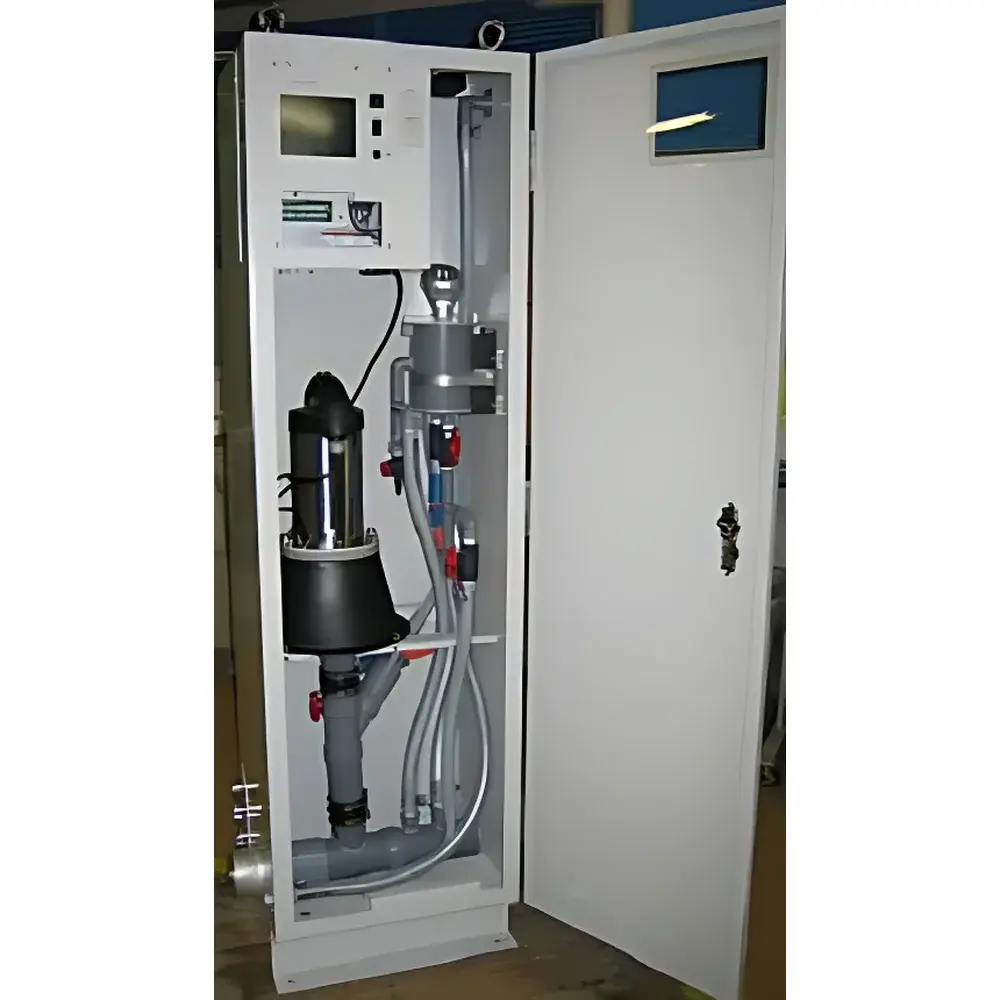
HORIBA OPSA-150 UV/VIS Absorption-Based Online COD Analyzer
| Brand | HORIBA |
|---|---|
| Origin | Japan |
| Model | OPSA-150 |
| Instrument Type | Online Analyzer |
| Measurement Principle | Dual-Wavelength UV/VIS Absorption Spectrophotometry |
| Measurement Wavelengths | UV: 253.7 nm, VIS: 546.1 nm |
| Measurement Range | 0–10 m⁻¹ SAC to 0–500 m⁻¹ SAC (0–0.1 Abs to 0–5.0 Abs) |
| Accuracy | ±2.0% F.S. |
| Repeatability | ±2.0% F.S. |
| Detection Limit | 0.01 m⁻¹ SAC |
| Resolution | 0.01 m⁻¹ SAC (0.0001 Abs) |
| Zero Drift Compensation | Rotating Cell-Length Adjustment System |
| Cleaning Method | Continuous Wiper-Based Optical Path Cleaning |
| Data Storage | Internal memory (1-year hourly data) + CF card export |
| Output | 3-channel isolated 4–20 mA analog outputs |
| Communication | RS-232C (19200 bps) |
| Sample Flow Rate | 2–20 L/min |
| Operating Temperature | 2–40 °C |
| Power Supply | AC 100–230 V ±10%, 50/60 Hz |
| Enclosure | Indoor-rated, IP54-equivalent housing |
| Weight | ~100 kg |
| Dimensions | 460 W × 380 D × 1600 H mm |
Overview
The HORIBA OPSA-150 is a high-stability, dual-wavelength online chemical oxygen demand (COD) analyzer engineered for continuous, unattended water quality monitoring in regulatory, municipal, and industrial applications. Unlike conventional COD analyzers relying on wet-chemistry oxidation (e.g., dichromate digestion), the OPSA-150 employs a non-invasive, reagent-free measurement principle based on ultraviolet and visible (UV/VIS) absorption spectrophotometry. It quantifies organic contamination by measuring absorbance at two discrete wavelengths—253.7 nm (UV) and 546.1 nm (VIS)—and applies empirically validated correlation algorithms to estimate COD concentration (mg/L O₂) from spectral attenuation. This approach eliminates consumables, reduces maintenance frequency, and avoids hazardous waste generation associated with classical methods. The instrument implements HORIBA’s proprietary rotating cell-length adjustment system, enabling dynamic optical path length modulation to maintain zero stability across wide concentration ranges without mechanical recalibration or manual intervention.
Key Features
- Rotating Cell-Length Adjustment System: A mechanically synchronized, motor-driven flow cell that continuously rotates to vary effective optical path length. This compensates for fouling-induced baseline drift by maintaining consistent zero-reference conditions—eliminating zero-point instability even under high-turbidity or biofouling-prone sampling environments.
- Dual-Wavelength Differential Absorption: Simultaneous measurement at 253.7 nm (high sensitivity to aromatic organics and conjugated double bonds) and 546.1 nm (reference wavelength for turbidity and particulate interference correction) enables robust compensation for suspended solids and color interferences.
- Extended Dynamic Range in a Single Unit: Achieves seamless coverage from low-concentration monitoring (0–0.1 Abs, ideal for source water intake or treated effluent compliance) to high-load industrial discharge (up to 5.0 Abs), configurable via software-defined cell-length segments without hardware modification.
- Continuous Optical Surface Cleaning: Integrated wiper mechanism operates synchronously with flow—cleaning the quartz optical windows without interrupting measurement or blocking light transmission. Unlike timed purge or air-blast systems, this ensures uninterrupted data continuity and prevents transient spikes caused by intermittent cleaning artifacts.
- Integrated Turbidity-COD Correlation Engine: Onboard calculation module converts raw UV/VIS absorbance into both COD-equivalent concentration (mg/L) and turbidity-corrected SAC units (m⁻¹), supporting cross-validation and regulatory reporting alignment per ISO 7027 and ASTM D6508.
- Comprehensive Data Integrity Architecture: Internal flash memory stores hourly averaged values for up to 12 months; data export via industrial-grade CF card supports audit-ready traceability. All stored records include timestamps, measurement status flags, and diagnostic metadata.
Sample Compatibility & Compliance
The OPSA-150 is designed for continuous analysis of raw surface water, wastewater effluents, industrial process streams, and potable water distribution points. It accommodates sample temperatures between 2–40 °C and requires a minimum flow rate of 2 L/min to ensure laminar, bubble-free passage through the optical cell. The wetted materials—SUS316 stainless steel, PTFE-sealed PVC, PP, CR rubber, and fused silica optical surfaces—are compliant with US EPA Method 410.4 and ISO 15705 for organic carbon estimation. While not a direct replacement for standardized COD titrimetric methods (e.g., ISO 6060, APHA 5220), the OPSA-150 meets performance criteria outlined in EN 14184 for online UV-absorbance-based surrogate monitoring when site-specific calibration models are established and maintained under GLP conditions. Its analog and digital outputs support integration into SCADA systems compliant with IEC 62443-3-3 and ISA-99 security frameworks.
Software & Data Management
Operation is managed via an integrated 320×240-pixel monochrome touchscreen interface with intuitive, context-sensitive menus—designed for minimal operator training and reduced misconfiguration risk. Calibration routines (zero and span) are executed using certified reference solutions and automatically synchronize UV/VIS channel gains. All calibration events, maintenance logs, alarm triggers (e.g., sample interruption, lamp degradation, wiper stall), and sensor diagnostics are time-stamped and retained locally. The RS-232C serial interface (19200 bps) supports Modbus RTU protocol for third-party integration and enables remote firmware updates. Data files exported to CF card follow a fixed-column ASCII format compatible with LIMS platforms and comply with FDA 21 CFR Part 11 requirements when deployed with external electronic signature and audit trail modules.
Applications
- Regulatory Effluent Monitoring: Real-time tracking of organic load at municipal wastewater treatment plant discharge points to demonstrate compliance with national discharge permits (e.g., EU Urban Wastewater Treatment Directive, US NPDES).
- Source Water Early Warning Systems: Deployment at reservoir intakes or river abstraction points to detect accidental spills or seasonal organic surges before they impact treatment processes.
- Industrial Process Control: Monitoring phenolic compounds, humic substances, or biodegradable organics in pulp/paper mill effluents, pharmaceutical manufacturing streams, or food processing wastewater.
- Water Reuse Verification: Supporting indirect potable reuse (IPR) schemes by providing rapid, continuous indication of organic breakthrough in advanced treatment trains (e.g., after ozone-BAC or membrane filtration).
- Research & Method Development: Serving as a stable, low-maintenance platform for developing site-specific UV-COD correlation models aligned with local matrix characteristics and regulatory acceptance protocols.
FAQ
Does the OPSA-150 replace laboratory COD testing?
No—it provides a real-time, surrogate indicator correlated to COD. Regulatory acceptance requires site-specific validation against standard methods (e.g., ISO 6060) and periodic verification.
How often does the instrument require calibration?
Zero and span calibration is recommended weekly for critical applications; monthly for stable environments. Automatic drift detection alerts operators when calibration tolerance exceeds ±2.0% F.S.
Can it operate in freezing conditions?
Sample temperature must remain above 2 °C. External trace heating or insulated sample line conditioning is required in sub-zero ambient installations.
Is the optical cell resistant to hydrogen sulfide or iron precipitation?
Yes—the fused silica windows and stainless-steel flow path resist chemical attack from common wastewater constituents; however, severe sulfide scaling may necessitate supplemental acid wash cycles outside normal wiper operation.
What maintenance tasks are required beyond wiper operation?
Annual lamp replacement (low-pressure mercury UV source), quarterly inspection of O-rings and flow seals, and biannual verification of analog output linearity using certified test signals.
Does it support MODBUS TCP or Ethernet/IP?
No—only RS-232C serial communication is natively supported. Protocol conversion to Ethernet-based fieldbus requires an external gateway device.







