
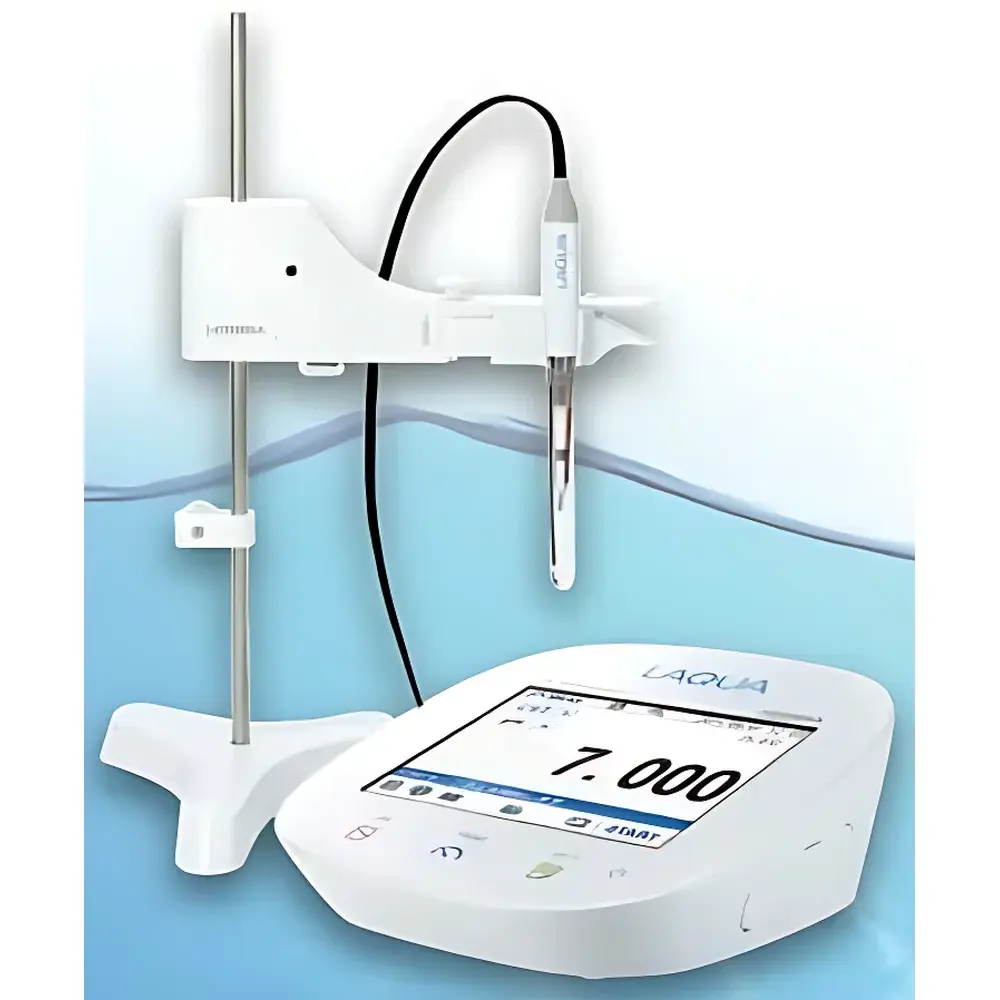
HORIBA F-74 Advanced Benchtop Multiparameter Water Quality Analyzer
| Brand | HORIBA |
|---|---|
| Origin | Japan |
| Model | F-74 |
| Instrument Type | Laboratory Water Quality Analyzer |
| Measured Parameters | pH, ORP, Ion Concentration, Conductivity, Resistivity, Salinity, TDS |
| Display | Dual-channel capacitive touchscreen |
| Data Storage | 2000 measurement records |
| Compliance | JIS, USP <645>, EP 2.2.38, JP/CP water quality standards |
| Language Support | English, Japanese, Korean, Chinese |
| Power Supply | AC 100–240 V, 50/60 Hz |
| Weight | 700 g |
Overview
The HORIBA F-74 is a high-precision, dual-channel benchtop multiparameter water quality analyzer engineered for rigorous laboratory applications in environmental monitoring, pharmaceutical water validation, academic research, and industrial process control. It integrates electrochemical and conductometric measurement principles—pH and ORP via glass and reference electrode systems; ion concentration using selective ion electrodes (ISE); and conductivity, resistivity, salinity, and total dissolved solids (TDS) via a 2-electrode AC conductivity cell with selectable cell constants (10, 100, and 1000 m⁻¹). All derived parameters (resistivity, salinity, TDS) are calculated in real time from conductivity measurements using NIST-traceable algorithms and temperature-compensated conversion models. Designed to meet the metrological demands of regulated environments, the F-74 delivers traceable accuracy, long-term stability, and full auditability—making it suitable for GLP, GMP, and ISO/IEC 17025-compliant laboratories.
Key Features
- Dual-channel simultaneous measurement capability: Channel 1 supports pH, ORP, and ion concentration; Channel 2 supports conductivity, resistivity, salinity, and TDS—enabling cross-parameter correlation without manual reconfiguration.
- Capacitive touchscreen interface (7-inch, high-resolution) with intuitive navigation, real-time status feedback, and on-screen troubleshooting guidance compliant with JIS Z 8401, USP , and EP 2.2.38 verification workflows.
- Advanced electrode diagnostics and calibration validation: Built-in electrode health assessment, slope/offset verification, and automatic drift detection aligned with pharmacopeial requirements for conductivity system suitability testing.
- GLP/GMP-ready data integrity architecture: Automatic timestamping, user ID logging, and editable measurement notes; supports direct USB connection to certified thermal printers and PCs for secure data export.
- Modular electrode compatibility: Accepts standardized BNC and DIN connectors for pH, ORP, ISE, and conductivity probes—including low-conductivity cells for purified water analysis per USP Stage 1–3 testing.
- Multi-language firmware (English, Japanese, Korean, Chinese) and configurable display units (e.g., µS/cm, mS/m, PPT, %, mg/L) to support global deployment and regulatory harmonization.
Sample Compatibility & Compliance
The F-74 is validated for aqueous samples across a broad physicochemical range: ultrapure water (18.2 MΩ·cm), process water, wastewater effluents, seawater analogs, and buffered pharmaceutical solutions. Its conductivity module meets USP requirements for Stage 1 (non-sterile water), Stage 2 (purified water), and Stage 3 (water for injection) testing—including automatic temperature compensation (ATC) using Pt1000 or built-in thermistor inputs. The pH and ORP modules comply with ISO 7888 and ASTM D1293 for environmental water analysis. All measurement protocols support 21 CFR Part 11–ready configurations when paired with HORIBA’s optional data management software (e.g., LabSolutions QA), enabling electronic signatures, audit trails, and role-based access control.
Software & Data Management
Data acquisition and reporting are managed through a native embedded OS supporting USB 2.0 host/device mode. Up to 2000 measurement records—including raw sensor outputs, calibration logs, operator IDs, timestamps, and environmental conditions—are stored internally with cyclic overwrite protection. Export formats include CSV and TXT for LIMS integration. Optional PC software provides advanced features: automated report generation (PDF/Excel), statistical process control (SPC) charts, calibration certificate templates compliant with ISO/IEC 17025, and electronic audit trail review per FDA 21 CFR Part 11. Firmware updates are delivered via USB flash drive with cryptographic signature verification to ensure integrity.
Applications
- Pharmaceutical water system qualification: Routine monitoring of PW, WFI, and pure steam condensate per USP , EP 2.2.38, and JP XVIII.
- Environmental compliance testing: Field-deployable lab verification of surface water, groundwater, and wastewater per EPA Method 120.1 (pH), 121.1 (conductivity), and ASTM D512 (chloride ISE).
- Academic and method development labs: Multi-parameter kinetic studies of corrosion inhibitors, membrane fouling, or ion exchange efficiency.
- Food & beverage QC: Monitoring rinse water conductivity, brine salinity, and process solution pH stability.
- Calibration laboratory services: Reference instrument for verifying portable meters and sensor arrays under ISO/IEC 17025 accreditation scopes.
FAQ
Does the F-74 support automatic temperature compensation for all measured parameters?
Yes—temperature is measured continuously via integrated Pt1000 or external probe input and applied dynamically to pH, ORP, conductivity, resistivity, salinity, and TDS calculations per IUPAC and ISO 7027 guidelines.
Can the F-74 validate conductivity sensors according to USP System Suitability Tests?
Yes—the instrument includes preconfigured SST routines (Stage 1–3), automatic cell constant verification, and pass/fail reporting aligned with USP acceptance criteria.
Is the internal data storage encrypted or password-protected?
While the onboard memory does not implement hardware encryption, access to data export, calibration editing, and configuration changes requires authenticated user login with role-defined permissions—supporting ALCOA+ data integrity principles.
What electrode certifications are required for GMP use?
No proprietary certification is mandated; however, HORIBA recommends using ISO 17025-accredited calibration services for electrodes and traceable NIST-standard buffers (e.g., pH 4.01, 7.00, 10.01 at 25 °C) to maintain compliance.
How frequently must the conductivity cell be recalibrated?
Recalibration frequency depends on usage intensity and matrix complexity; HORIBA recommends initial calibration before first use, daily verification for critical applications, and full recalibration after cleaning or exposure to high-fouling samples—documented per your site’s SOPs.







