
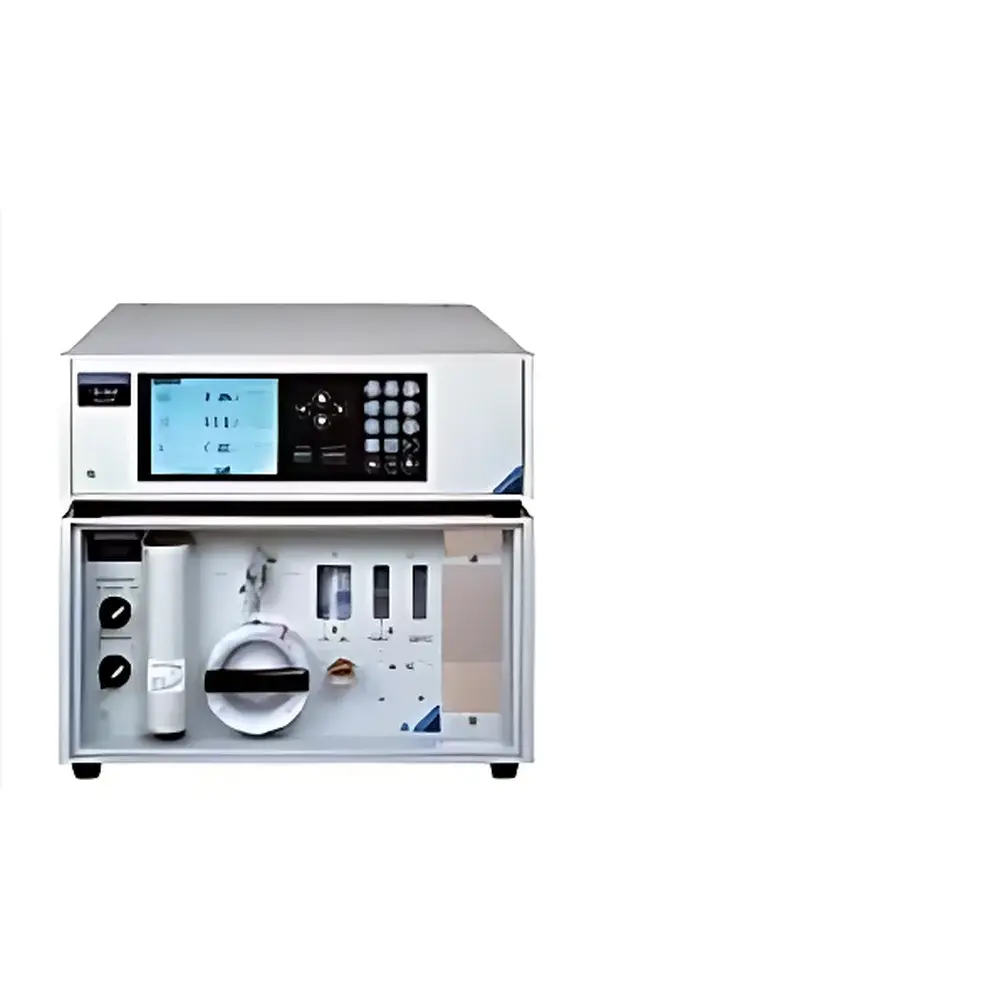
HORIBA VA-3000/VS-3000 Series NDIR & CLA Multi-Gas Continuous Emission Monitoring Analyzer
| Brand | HORIBA |
|---|---|
| Origin | Japan |
| Model | VA-3000 (Analyzer Unit) / VS-3000 (Sampling System) |
| Instrument Type | Online Gas Analyzer |
| Target Gases | CO, CO₂, NOₓ, SO₂, CH₄, N₂O, C₂H₄, O₂ |
| Minimum Detection Range | 1–5 ppm |
| Repeatability | ±0.5% of Full Scale |
| Resolution | 0.1 ppm |
| Response Time (T90) | ≤30 s |
| Zero Drift | ±2.0% of Full Scale per week |
Overview
The HORIBA VA-3000/VS-3000 Series is a modular, online multi-component gas analyzer engineered for continuous emission monitoring (CEM), environmental air quality assessment, and industrial process control. It employs dual optical and electrochemical detection principles: Non-Dispersive Infrared (NDIR) spectroscopy for CO, CO₂, CH₄, N₂O, and SO₂; Chemiluminescence Analysis (CLA) for NOₓ; Magnetic Pressure Analysis (MPA), electrochemical (galvanic cell), and zirconia-based potentiometric methods for O₂. This hybrid architecture enables simultaneous, independent quantification of up to three gas components within a single compact 19-inch rack-mount unit—without cross-interference or shared optical path limitations. Designed for regulatory-grade compliance, the system meets foundational requirements for long-term stability, traceability, and reproducibility in ambient and stack-gas applications under ISO 12039, EN 15267, and EPA Methods 6C, 7E, and 10.
Key Features
- Modular Sensor Architecture: Supports up to three independently configurable sensor modules (NDIR, CLA, MPA, electrochemical, or zirconia O₂) in one VA-3000 analyzer chassis—enabling application-specific gas combinations without hardware redesign.
- Wide Dynamic Range: Programmable multi-range capability: up to 10:1 standard range ratio (20:1 optional for NDIR); CLA achieves up to 100:1 via 8-step range selection—eliminating manual range switching during transient emissions events.
- High Metrological Performance: Repeatability ±0.5% FS, linearity ±1.0% FS (≤10× range), zero drift ±2.0% FS/week (NDIR/CLA/MPA/zirconia); O₂ electrochemical variant offers ±1.0% FS/day stability.
- Fast, Robust Response: T90 ≤ 30 seconds from sample inlet—validated per IEC 62453-3-2—ensuring real-time responsiveness for combustion optimization and alarm-triggered mitigation.
- Integrated Sampling Interface: VS-3000 series sampling units (VS-3001 to VS-3004) provide conditioned, dry, particle-free sample delivery at 0.5 L/min flow rate; compatible with heated, corrosion-resistant wet/dry extractive configurations using PTFE, PVDF, and SUS316L materials.
- Regulatory-Ready Outputs: Standard RS-232C serial interface and analog outputs (0–1 V DC or 4–20 mA, non-isolated); supports audit-trail-capable data logging when paired with HORIBA’s optional software suite compliant with FDA 21 CFR Part 11 Annex 11 requirements.
Sample Compatibility & Compliance
The VA-3000/VS-3000 system accommodates complex sample matrices typical of flue gas, biogas, landfill gas, and urban ambient air. Sample conditioning requires dew point ≤5 °C (for NDIR/CLA) or ≤60 °C (for VS-3000 variants), particulate loading 50 ppm SO₃, >6 ppm NO₂), explosive, or halogenated hydrocarbons. For reducing gas environments (CO, H₂, THC), zirconia O₂ sensors require co-presence of H₂O and O₂ satisfying the stoichiometric condition: [THC] + [CO] + [H₂] < [H₂O] + [O₂]; otherwise, sensor degradation and measurement bias occur. All configurations comply with CE marking directives (2014/30/EU EMC, 2014/35/EU LVD) and support GLP/GMP-aligned calibration protocols—including automated zero/span verification using RC1/8 threaded calibration gas inlets.
Software & Data Management
HORIBA provides dedicated PC-based configuration and data acquisition software supporting real-time waveform display, multi-channel trend logging, and customizable report generation (PDF/CSV). The software enforces role-based access control, electronic signature workflows, and full audit trails—including timestamped parameter changes, calibration events, and alarm acknowledgments—meeting ISO/IEC 17025 and EU GMP Annex 11 expectations. Raw analog outputs allow integration into DCS/SCADA systems (e.g., Siemens Desigo, Honeywell Experion) via standard 4–20 mA loops. Optional Ethernet gateway modules enable Modbus TCP or OPC UA communication for Industry 4.0 interoperability.
Applications
- Continuous emissions monitoring (CEMS) for thermal power plants, waste incinerators, and cement kilns per EU IED and US EPA 40 CFR Part 60 Subpart Da/Db.
- Biogas upgrading control—simultaneous CH₄, CO₂, H₂S (via optional sensor), and O₂ monitoring to ensure pipeline injection specifications (ISO 8573-1 Class 2).
- Indoor air quality (IAQ) and greenhouse gas flux studies requiring sub-ppm CO and CO₂ resolution in research-grade environmental chambers.
- Automotive exhaust R&D—transient NOₓ and CO profiling during WLTC and RDE testing cycles.
- Pharmaceutical cleanroom monitoring where O₂ inerting integrity and trace CO contamination must be verified continuously.
FAQ
Can the VA-3000 measure NH₃ or H₂S?
NH₃ and C₂H₄ are not supported by standard NDIR/CLA modules; custom sensor development or third-party electrochemical add-ons may be evaluated on a case-by-case basis.
What is the warm-up time for full accuracy?
NDIR and electrochemical O₂ modules achieve specification performance within 20 minutes; CLA and zirconia O₂ require ~60 minutes for thermal stabilization.
Is field calibration possible without external gas cylinders?
Zero calibration can be performed using certified zero air; span calibration requires certified span gases traceable to NIST or PTB standards—no internal gas generation is provided.
How does the system handle high-moisture or acidic flue gas?
The VS-3000 sampling system includes refrigerated or permeation dryers; for aggressive acid condensates, optional PTFE-coated filters and PVDF sample lines are recommended.
Does HORIBA offer validation support for regulatory submissions?
Yes—HORIBA provides factory acceptance test (FAT) documentation, uncertainty budgets per ISO/IEC 17025, and on-site performance qualification (PQ) assistance aligned with EN 14181 QAL2/QAL3 protocols.
Related Products







