
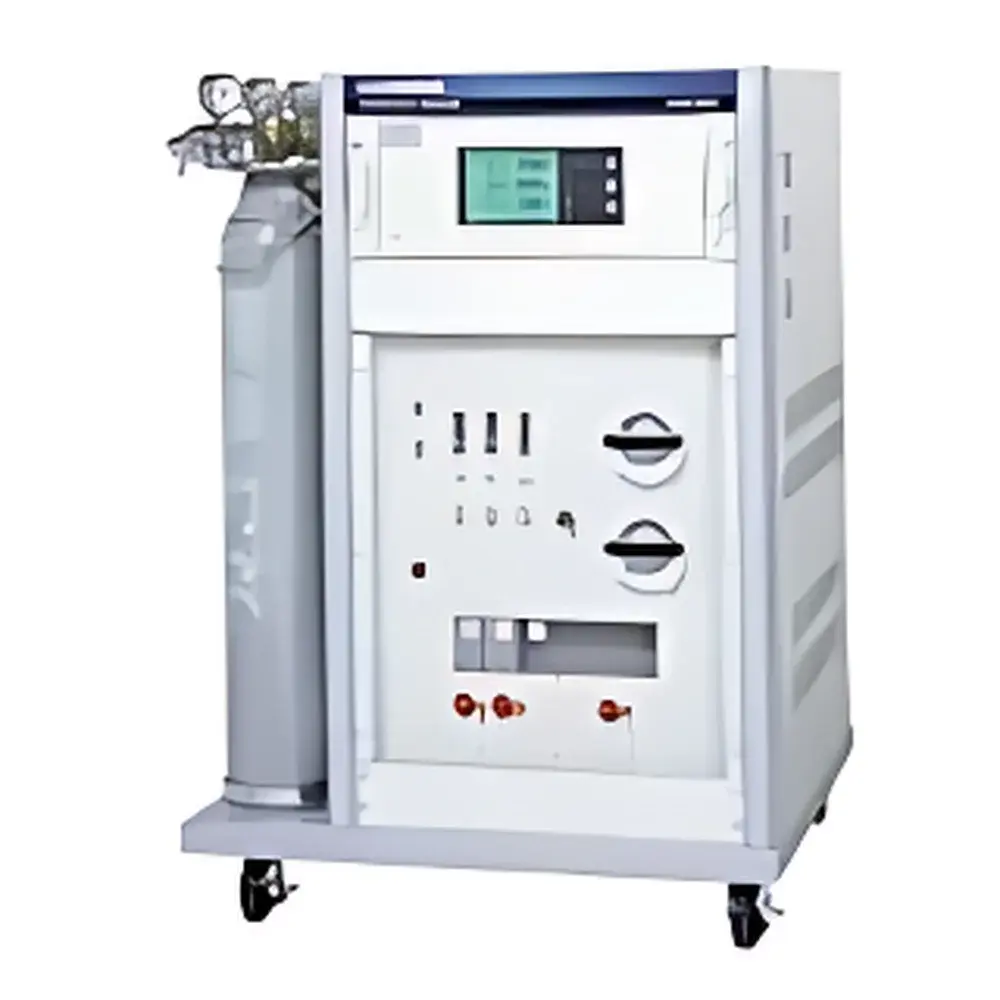
HORIBA COPA-3000 Combustion Appliance Flue Gas Analyzer
| Brand | HORIBA |
|---|---|
| Origin | Japan |
| Model | COPA-3000 |
| Detection Principles | CO – Alternating Flow Modulation NDIR |
| Measurement Range (Standard) | CO: 0–200/500 ppm or 0–500/1000 ppm |
| CO₂ | 0–5/25 vol% |
| O₂ | 0–5/25 vol% |
| Accuracy | ±0.5% FS (repeatability, full scale) |
| Zero Drift | ±0.5% FS/day |
| Span Drift | ±1.0% FS/day |
| Response Time | ≤20 s (TD + T90, 3.0 L/min sample flow) |
| Sample Flow Rate | 1.5–3.0 L/min |
| Cooling Dew Point | ~5 °C (electronic cooler) |
| Output | DC 0–1 V (non-isolated), RS-232C |
| Power Supply | AC 100 V ±10%, 50/60 Hz |
| Dimensions (W×H×D) | 750 × 1054 × 710 mm |
| Weight | ~120 kg (excl. O₂ cylinder & regulator) |
Overview
The HORIBA COPA-3000 is a dedicated flue gas analyzer engineered for precise, continuous monitoring of combustion appliance exhaust emissions—specifically targeting carbon monoxide (CO), carbon dioxide (CO₂), and oxygen (O₂). Designed for R&D laboratories, certification testing facilities, and regulatory compliance centers, the COPA-3000 implements three distinct, industry-validated analytical principles in a single integrated platform: alternating flow modulation non-dispersive infrared (NDIR) spectroscopy for CO; light source modulation NDIR for CO₂; and magnetic pressure-based detection for O₂. This multi-principle architecture eliminates cross-sensitivity artifacts common in single-technology systems and ensures robust performance under variable stack conditions—including fluctuating ambient pressure, temperature gradients, and transient flow dynamics. Unlike legacy analyzers reliant on mechanical rotary valves, the COPA-3000 employs solid-state electromagnetic switching for CO measurement, significantly extending service life and reducing maintenance intervals. Its certified metrological design complies with Japanese Industrial Standards (JIS) and supports traceable calibration protocols required for type approval under national combustion safety regulations.
Key Features
- Zero-drift-free CO detection via proprietary alternating flow modulation NDIR—eliminates baseline drift without periodic zeroing.
- CO₂ measurement immune to ambient atmospheric CO₂ interference due to active light source modulation.
- Enhanced long-term stability: zero drift ≤ ±0.5% FS/day; span drift ≤ ±1.0% FS/day—verified across full operating temperature range (15–35 °C).
- Integrated electronic cooling dehydrator maintains sample dew point at ~5 °C, enabling dry-gas analysis without external chillers or chemical desiccants.
- Intuitive backlit LCD interface with real-time concentration display, status indicators, and menu-driven calibration navigation.
- Modular dual-range configuration: user-selectable standard and optional ranges (e.g., CO: 0–50 ppm to 0–5 vol%; CO₂: 0–1 to 0–25 vol%), all constrained within ≤5:1 range ratio for optimal signal-to-noise fidelity.
- Complies with Japan’s Measurement Act (Metrology Law) as a certified Type-Approved instrument—valid for official emission verification reports.
Sample Compatibility & Compliance
The COPA-3000 accepts hot, humid flue gases directly from domestic and commercial combustion appliances—including gas-fired water heaters, boilers, room heaters, and cooking stoves—without requiring dilution or bypass sampling. Its 1.5–3.0 L/min volumetric flow control compensates for minor suction fluctuations, while the cooled sampling line prevents condensation-induced sensor fouling. The system meets JIS B 7982 (2019) for flue gas analyzers used in combustion efficiency and safety testing. Optional auto-calibration functionality supports GLP-aligned workflows by logging calibration events with timestamps, operator ID, and gas lot numbers—enabling audit-ready traceability per ISO/IEC 17025 requirements. Although not FDA 21 CFR Part 11-certified out-of-the-box, its RS-232C interface permits integration with validated LIMS platforms supporting electronic record integrity controls.
Software & Data Management
Data output is provided via analog DC 0–1 V signals (non-isolated, scalable per component) and bidirectional RS-232C serial communication. The built-in firmware supports ASCII command protocol for remote parameter readout, alarm threshold setting, and manual zero/span execution. While the COPA-3000 does not include embedded PC software, its standardized output format enables seamless ingestion into third-party SCADA, LabVIEW, or custom Python-based acquisition systems. All calibration records—including date, gas concentrations, and deviation values—are stored in non-volatile memory and retrievable via serial query. For regulated environments, users may implement external timestamped data logging compliant with ISO 14001 environmental management system documentation requirements.
Applications
- Development and validation of low-emission residential combustion appliances per JIS S 2101 and ENERGY STAR® draft criteria.
- Conformance testing for national safety certifications (e.g., PSE Mark, JET certification) requiring quantitative CO, CO₂, and O₂ reporting.
- Field diagnostics of combustion inefficiency, air-fuel ratio imbalance, and heat exchanger leakage in installed heating systems.
- Research into burner optimization, flame stabilization, and catalytic aftertreatment performance under dynamic load conditions.
- Reference-grade verification of portable flue gas meters used in routine maintenance inspections.
FAQ
What calibration gases are required for routine operation?
Zero gas: high-purity nitrogen (N₂ ≥ 99.999%). Span gases: certified mixtures in N₂ balance—CO (e.g., 100 ppm), CO₂ (e.g., 10 vol%), O₂ (e.g., 10 vol%), or dual-component blends (e.g., CO + CO₂). Calibration frequency follows JIS guidelines: daily zero check, weekly span verification.
Is the COPA-3000 suitable for measuring flue gases from biomass or oil-fired appliances?
Yes—the NDIR and magnetic pressure technologies are unaffected by particulate-laden or sulfur-containing streams when used with the standard electronic cooler and particulate filter (optional accessory). However, extended exposure to heavy tars or unburned hydrocarbons requires periodic optical path inspection.
Can the instrument operate continuously for 24/7 monitoring?
Designed for unattended operation up to 72 hours; thermal management and valve actuation cycles are rated for >10,000 hours MTBF. Long-term stability specifications assume ambient temperature variation ≤ ±5 °C and stable line voltage.
Does the COPA-3000 support digital output protocols like Modbus or Ethernet/IP?
No—only analog DC 0–1 V and RS-232C are natively supported. Protocol conversion requires external hardware gateways compatible with ASCII serial framing.
What maintenance intervals are recommended?
Cooler condensate drain: daily. Optical window inspection: monthly. NDIR source/detector alignment: annually (factory-recommended; no user adjustment required). Electromagnetic valve functional test: semiannually.
Related Products







