
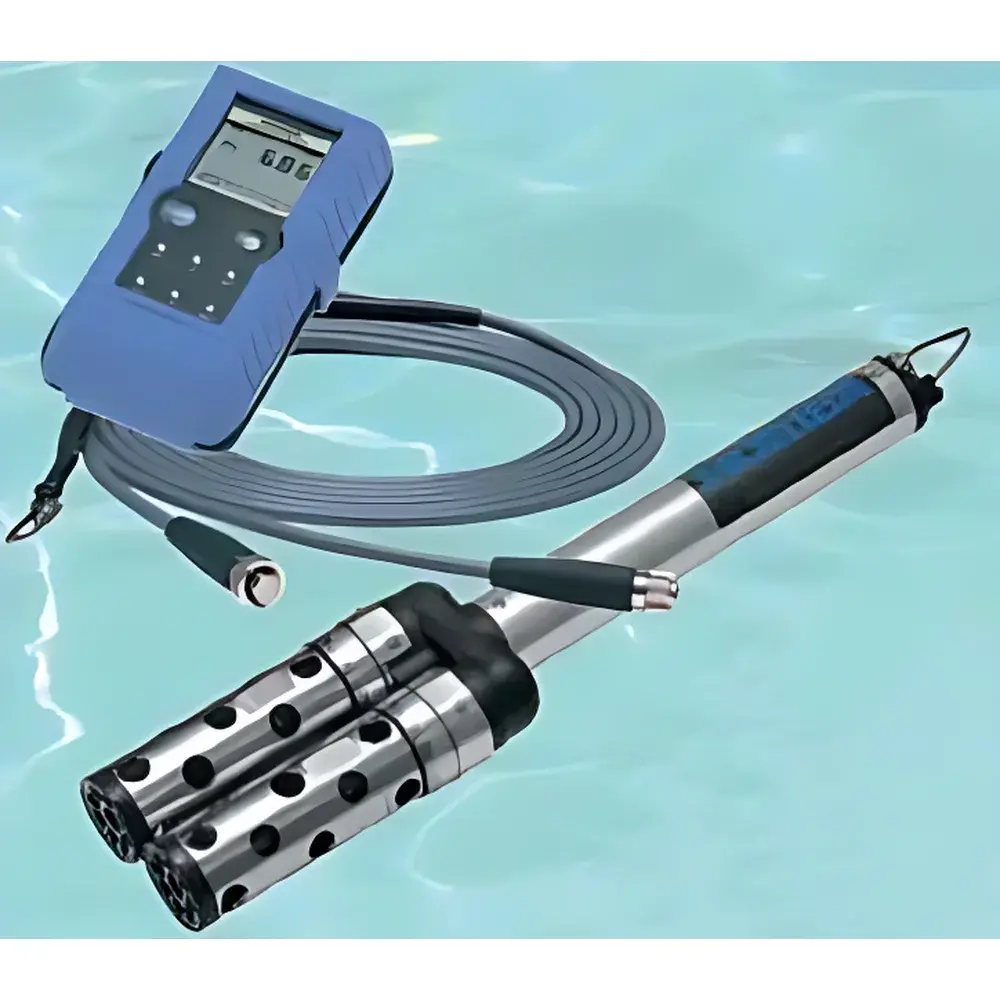
HORIBA W-20xD Series Multi-Parameter Water Quality Analyzer
| Brand | HORIBA |
|---|---|
| Origin | Japan |
| Model | W-20xD |
| Instrument Type | Portable/Handheld Water Quality Analyzer |
| IP Rating | IP67 (Control Unit) |
| Operating Depth | Up to 100 m |
| Continuous Logging Duration | 30 days (2880 data points at 15-min intervals) |
| Simultaneous Parameters | Up to 13 (pH, Dissolved Oxygen, Conductivity, Salinity, TDS, Seawater Specific Gravity, Turbidity, Depth, Temperature, ORP, and Select Ions) |
| Measurement Principles | Glass Electrode (pH), Membrane-Based Galvanic Cell (DO), AC 4-Electrode (Conductivity), Pressure Transducer (Depth), Thermistor (Temperature), Nephelometric/Transmittance (Turbidity), Platinum Electrode (ORP), Ion-Selective Electrodes (NO₃⁻, Cl⁻, Ca²⁺, F⁻, K⁺, NH₃) |
Overview
The HORIBA W-20xD Series is a rugged, submersible multi-parameter water quality analyzer engineered for long-term, unattended in-situ monitoring of natural and anthropogenic aquatic environments. Designed around a modular architecture with interchangeable sensor cartridges and an integrated data logger, the system operates autonomously for up to 30 days at depths of 100 meters—without external power or cabling—making it ideal for remote deployment in rivers, lakes, reservoirs, coastal zones, groundwater wells, wastewater outfalls, aquaculture systems, and agricultural runoff channels. Its measurement foundation integrates standardized electrochemical, optical, and physical principles aligned with ISO 5814 (DO), ISO 7888 (conductivity), ISO 7027 (turbidity), and ASTM D1293 (pH), ensuring traceable, field-deployable data compliant with environmental monitoring protocols under EPA Method 120.1, USGS NWIS, and EU WFD reporting frameworks.
Key Features
- Submersible probe rated for continuous operation at 100 m depth, featuring pressure-compensated housing and corrosion-resistant titanium/sapphire sensor interfaces
- Onboard memory stores 2880 data records (30 days at 15-minute intervals); data export via USB or optional wireless telemetry (LTE-M/NB-IoT)
- IP67-rated control unit with backlit graphical display, intuitive menu navigation, and real-time parameter visualization
- Auto-calibration capability for pH (2-point) and conductivity (single-point); temperature compensation applied per parameter using built-in thermistor (0–55 °C, ±1.0 °C accuracy)
- Multi-electrode platform supporting simultaneous acquisition of up to 13 parameters—including pH, DO, conductivity, salinity, TDS, seawater specific gravity (δt), turbidity (NTU), depth (pressure-based), temperature, ORP, and six ion-selective measurements (NO₃⁻, Cl⁻, Ca²⁺, F⁻, K⁺, NH₃)
- Field-replaceable sensor modules with serialized calibration certificates; each cartridge includes embedded EEPROM storing calibration history and sensor-specific coefficients
Sample Compatibility & Compliance
The W-20xD series accommodates diverse aqueous matrices including freshwater, brackish water, seawater (up to 40 ppt salinity), wastewater effluents, and high-turbidity agricultural runoff. All electrochemical sensors comply with ISO/IEC 17025-accredited calibration practices. The system supports GLP-compliant data integrity through time-stamped, tamper-evident logging and optional 21 CFR Part 11–enabled software (via HORIBA’s LabSolutions AQ suite). Sensor response characteristics meet or exceed requirements specified in ISO 10523 (pH), ISO 5814 (DO), and ISO 7888 (conductivity), with documented repeatability and accuracy across operational temperature (0–55 °C) and pressure (0–1 MPa) ranges.
Software & Data Management
Data retrieval and configuration are managed via HORIBA’s LabSolutions AQ desktop application (Windows), which provides secure import, spectral visualization, statistical analysis (min/max/avg/std dev), and automated report generation in PDF or CSV formats. The software enforces audit trails for all user actions—including calibration events, parameter edits, and data exports—and supports configurable alarm thresholds with email/SMS notification via gateway integration. For enterprise deployments, the system interfaces with SCADA platforms via Modbus RTU or ASCII serial protocol, enabling seamless ingestion into centralized environmental data management systems (EDMS) compliant with ISO 14001 and ISO 50001 infrastructure standards.
Applications
- Long-term ecological monitoring of eutrophication indicators (DO, pH, nutrients) in stratified lakes and reservoirs
- Regulatory compliance tracking for municipal wastewater discharge permits (NPDES, UK EA, German LAWA)
- Real-time aquaculture pond management—optimizing feed cycles based on dissolved oxygen and ammonia trends
- Baseline characterization and impact assessment during hydroelectric dam operations or dredging activities
- Groundwater quality surveillance near landfills, industrial sites, or agricultural zones (Cl⁻, NO₃⁻, F⁻, Ca²⁺)
- Coastal zone observing systems (CZOS) requiring salinity, temperature, and turbidity co-location with tidal depth profiling
FAQ
What is the maximum deployment duration without battery replacement?
The W-20xD probe operates continuously for 30 days on a single charge when configured for 15-minute measurement intervals.
Can the system measure in highly turbid or biofouling-prone waters?
Yes—the optical turbidity sensor employs dual-beam compensation, and all wetted surfaces feature anti-fouling coatings compatible with quarterly maintenance cycles in estuarine environments.
Is calibration traceable to national metrology institutes?
All factory calibrations are performed against NIST-traceable reference standards; calibration certificates include uncertainty budgets per ISO/IEC 17025 Annex A.
How is data security ensured during wireless transmission?
Optional LTE-M/NB-IoT modules utilize TLS 1.2 encryption and mutual authentication; local storage uses AES-256 encrypted flash memory.
Which ions can be measured simultaneously with standard configurations?
The W-23xD variant supports concurrent detection of NO₃⁻, Cl⁻, Ca²⁺, F⁻, K⁺, and NH₃; ion module selection is determined by site-specific water chemistry and pH constraints.
Related Products







