
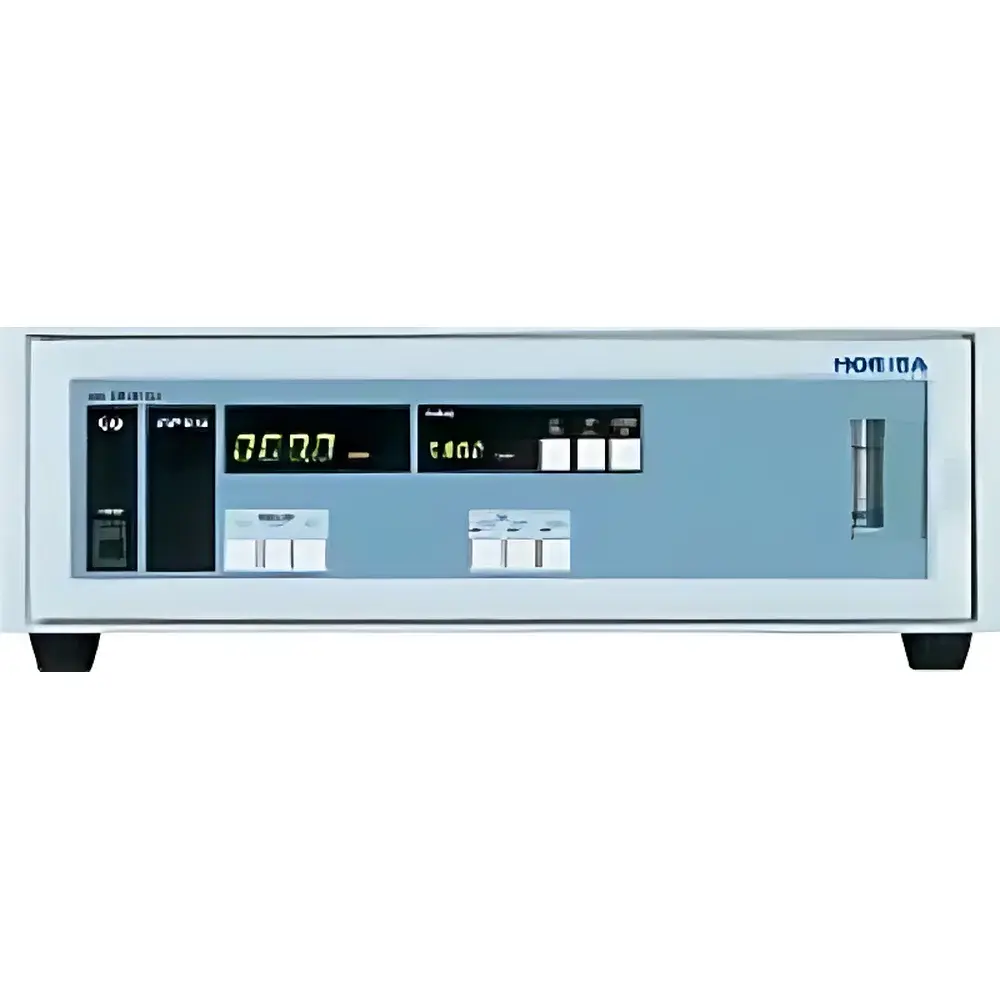
HORIBA FIA-510 Total Hydrocarbon Analyzer
| Brand | HORIBA |
|---|---|
| Origin | Japan |
| Model | FIA-510 |
| Instrument Type | Flue Gas Analyzer for Total Hydrocarbons (THC) |
| Measurement Principle | Sub-atmospheric Hydrogen Flame Ionization Detection (FID) |
| THC Range | 0–50 ppmC (low-sensitivity mode) to 0–30,000 ppmC (high-range mode) |
| Accuracy | ±3% of reading |
| Repeatability | ±0.5% FS (standard range), ±1% FS (high-sensitivity range) |
| Drift | ±1% FS/day (standard range), ±2% FS/day (high-sensitivity range) |
| Response Time (T90) | ≤10 s |
| Operating Temperature | 0–40 °C |
| Relative Humidity | ≤90% RH (non-condensing) |
| Dimensions (W×D×H) | 430 × 550 × 132 mm |
| Weight | 20 kg |
| Dynamic Range | 4-step programmable range (standard) |
| optional 20 | 1 extended ratio |
| Calibration | Single-touch zero/span adjustment |
| Self-Diagnosis | Integrated CPU with real-time status monitoring |
| Compliance | Designed for continuous emission monitoring (CEM) in accordance with ISO 8712, JIS B 7982, and EPA Method 25A equivalents |
Overview
The HORIBA FIA-510 Total Hydrocarbon Analyzer is a benchtop flue gas analyzer engineered for high-precision, continuous measurement of total hydrocarbons (THC) in industrial exhaust streams, combustion emissions, and laboratory test benches. It employs sub-atmospheric hydrogen flame ionization detection (FID), a well-established and highly selective technique for quantifying organic carbon-containing compounds. Unlike catalytic or infrared-based methods, FID responds linearly across a broad concentration range and exhibits minimal interference from water vapor, CO₂, or nitrogen oxides—making it particularly suitable for stack gas monitoring where matrix complexity and moisture content are variable. The instrument operates at reduced pressure within the detector chamber, enhancing signal-to-noise ratio and improving baseline stability during long-term unattended operation. Its design conforms to international standards for continuous emission monitoring systems (CEMS), including functional requirements aligned with ISO 8712 (petrol engine exhaust analysis) and JIS B 7982 (gas analyzers for combustion gases), and supports method validation consistent with U.S. EPA Method 25A for THC determination.
Key Features
- Sub-atmospheric FID detection architecture optimized for low-drift, high-reproducibility THC quantification across wide dynamic ranges.
- Seven user-selectable measurement ranges (0–10 ppmC to 0–30,000 ppmC), configurable via front-panel interface or remote command; standard 4-range switching with optional 20:1 extended ratio capability.
- Integrated microprocessor control enabling real-time self-diagnosis, automatic leak detection, and status logging for GLP/GMP traceability.
- Modular hardware layout: sampling unit and analyzer module are physically decoupled, allowing flexible installation in 19-inch rack cabinets or mobile laboratory configurations.
- Single-touch zero and span calibration with digital confirmation; no manual potentiometer adjustments required.
- Adjustable electrical response time (T90) via DIP switch selection—supports fast transient capture (e.g., engine cold-start cycles) or smoothed averaging for steady-state CEMS applications.
- Robust mechanical construction (20 kg, aluminum chassis) rated for industrial environments; operating temperature range 0–40 °C with humidity tolerance up to 90% RH non-condensing.
Sample Compatibility & Compliance
The FIA-510 is validated for direct analysis of heated, filtered flue gas samples containing saturated and unsaturated aliphatic/aromatic hydrocarbons (e.g., methane, propane, benzene, toluene). It is not intended for use with halogenated, sulfur-containing, or oxygenated VOCs without prior validation. Sample conditioning—typically involving particulate filtration (≤1 µm), moisture removal (chilled mirror or permeation dryer), and optional heated line maintenance (up to 180 °C)—must comply with ISO 16911 and EN 15267-3 pre-treatment guidelines. The analyzer meets electromagnetic compatibility (EMC) requirements per IEC 61326-1 and safety standards under IEC 61010-1. Its firmware architecture supports audit-trail-enabled calibration logs and event history storage—facilitating compliance with FDA 21 CFR Part 11 when deployed in regulated R&D or quality control settings.
Software & Data Management
The FIA-510 features an embedded ARM-based controller running deterministic real-time firmware. Analog outputs (4–20 mA, 0–10 V) and digital interfaces (RS-232, optional RS-485/Modbus RTU) enable seamless integration into SCADA, DCS, or custom data acquisition platforms. HORIBA’s optional WinFIA software provides configuration, trend visualization, alarm management, and report generation (PDF/CSV export) compliant with ISO/IEC 17025 documentation requirements. All calibration events, system errors, and sensor diagnostics are timestamped and stored locally for ≥30 days—supporting internal audits and regulatory inspections. No cloud dependency or proprietary runtime licenses are required for basic operation.
Applications
- Continuous emission monitoring (CEM) of THC from stationary sources: gas-fired boilers, incinerators, thermal oxidizers, and cement kilns.
- Automotive R&D: exhaust testing on chassis dynamometers, engine test cells, and evaporative emission canister evaluation per SAE J1711 and ISO 8712.
- Environmental laboratories: method development and verification for EPA Method 25A, ISO 12913, and national regulatory protocols.
- Process optimization: real-time feedback for combustion efficiency tuning, catalyst performance assessment, and fugitive emission detection.
- Mobile monitoring: deployment in trailer-mounted CEMS or field-deployable test rigs due to compact footprint and rack-mount compatibility.
FAQ
What detection principle does the FIA-510 use, and why is it preferred for THC measurement?
It uses sub-atmospheric hydrogen flame ionization detection (FID), which offers superior selectivity for organic carbon compounds, linear response over six orders of magnitude, and immunity to common flue gas interferents such as CO₂ and NOₓ.
Can the FIA-510 measure individual hydrocarbons like methane or benzene separately?
No—it reports total hydrocarbon concentration as ppmC (carbon-equivalent), not speciated VOCs. For compound-specific analysis, GC-FID or GC-MS systems are required.
Is the instrument suitable for wet-stack applications?
Only when paired with appropriate sample conditioning: heated sampling lines, thermoelectric chillers, and hydrophobic membrane filters to prevent condensate ingress into the detector.
Does the FIA-510 support automated calibration gas sequencing?
Not natively—but its analog/digital I/O allows integration with external gas-dilution systems and solenoid valve manifolds for unattended multi-point calibration routines.
What maintenance intervals are recommended for routine operation?
Detector cleaning and FID jet inspection every 3–6 months; hydrogen supply filter replacement quarterly; annual full system verification per ISO/IEC 17025 procedures.







