
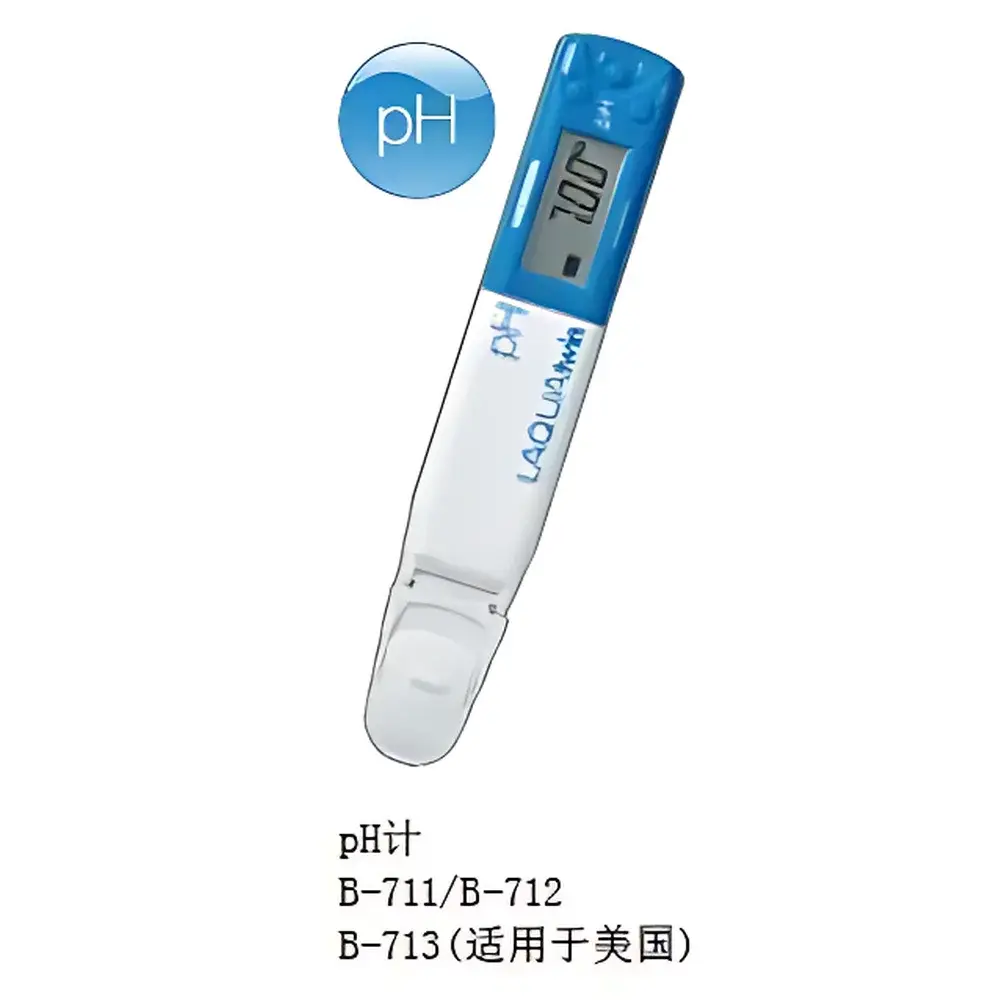
HORIBA LAQUAtwin B-711/B-712 Pocket pH Meter
| Brand | HORIBA |
|---|---|
| Origin | Japan |
| Model | LAQUAtwin B-711 (single-point calibration) / B-712 (dual-point calibration) |
| Instrument Type | Pocket-style pH meter |
| Parameter Type | Single-parameter (pH) |
| Measurement Range | pH 2.0–12.0 |
| Resolution & Accuracy | ±0.1 pH |
| Minimum Sample Volume | 0.05 mL (with sampling film) or ≥0.1 mL |
| Calibration Solutions | pH 4.01, 7.00, and 9.18 standard buffers |
| Temperature Compensation | Automatic (ATC), 5–40 °C operating range |
| Protection Rating | IP67 (submersible to 1 m for 30 min) |
| Power | Two CR2032 lithium coin cells |
| Dimensions | 164 × 29 × 20 mm (excl. protrusions) |
| Weight | ~50 g (instrument only, batteries excluded) |
Overview
The HORIBA LAQUAtwin B-711 and B-712 are compact, handheld pH meters engineered for rapid, field-deployable electrochemical measurement in environmental monitoring, aquaculture, food safety screening, and educational laboratories. Based on the proven glass electrode principle—where hydrogen ion activity generates a Nernstian potential across a pH-sensitive hydrated silica membrane—the instruments deliver traceable, reproducible pH data with minimal operator intervention. Unlike conventional benchtop or pen-style meters requiring bulk sample immersion, the LAQUAtwin series employs a proprietary flat-surface pH electrode integrated into a sealed, ergonomic probe tip. This design enables reliable measurement from microvolumes (as low as 0.05 mL when used with optional sampling film), eliminating dilution errors and cross-contamination risks associated with traditional dip-type electrodes. The B-712 model extends functionality with selectable one- or two-point calibration routines, supporting rigorous method validation under ISO 8655-5 and ASTM D1293 protocols for water quality analysis.
Key Features
- Flat-surface glass electrode architecture optimized for microsample contact measurement (0.05–0.1 mL), reducing reagent consumption and enabling spot-checks on viscous, particulate-laden, or surface-bound samples
- Intuitive single-button operation: Press once to initiate auto-calibration or measurement; visual confirmation via built-in LCD smiley icon ensures correct electrode wetting and stable signal acquisition
- IP67-rated enclosure certified to IEC 60529: fully dust-tight and submersible to 1 m for ≥30 minutes—suitable for humid outdoor environments, rinse stations, and splash-prone workbenches
- Integrated automatic temperature compensation (ATC) using a precision NTC thermistor, referenced to the standard 25 °C baseline per ISO 10523 and USP
- Auto-hold function freezes the stabilized reading after signal convergence (typically within 3–5 seconds), minimizing parallax error during field recording
- Low-power architecture powered by two replaceable CR2032 lithium batteries, delivering >2,000 measurements per set under typical usage conditions
Sample Compatibility & Compliance
The LAQUAtwin B-711/B-712 is validated for aqueous and mildly buffered solutions across pH 2.0–12.0. For samples containing suspended solids or turbidity, use of the optional filtration membrane (HORIBA Part No. 9510-10D) is recommended prior to measurement to prevent electrode fouling and ensure Nernstian response. The instrument complies with electromagnetic compatibility requirements per IEC 61326-1 (industrial environment) and meets RoHS 2011/65/EU directive for hazardous substance restrictions. While not intended for GMP-regulated final product release testing, its calibration traceability to NIST-traceable pH standards (e.g., NIST SRM 186, 4699) supports GLP-aligned QC checks in environmental labs adhering to EPA Method 150.1 and ISO 10523.
Software & Data Management
These pocket meters operate as standalone devices without onboard memory or Bluetooth connectivity. All calibration and measurement data are displayed in real time on the monochrome LCD and must be manually recorded. However, the consistent ±0.1 pH accuracy—verified post-calibration against certified buffer solutions—and repeatable endpoint detection support audit-ready documentation when paired with laboratory notebooks compliant with 21 CFR Part 11 Annex 11 principles (e.g., dated, signed entries). For institutions requiring electronic data capture, HORIBA recommends pairing the B-712 with external logging systems via analog output adapters (sold separately), enabling integration into LIMS platforms under controlled SOPs.
Applications
- On-site verification of drinking water pH compliance per WHO Guidelines for Drinking-water Quality (4th ed.) and EU Directive 98/83/EC
- Rapid assessment of nutrient solution pH in hydroponic and greenhouse cultivation systems
- Pre-screening of wastewater effluent prior to discharge permitting (EPA NPDES Phase II)
- Classroom demonstrations of acid-base equilibria and buffer capacity with minimal consumables
- Field validation of pH drift in portable bioreactors or fermentation vessels during maintenance cycles
- Quality assurance checks on cleaning-in-place (CIP) rinse water in pharmaceutical manufacturing facilities
FAQ
What calibration standards are required for daily use?
Standard pH 4.01 and 7.00 buffers are mandatory for two-point calibration (B-712); pH 9.18 is optional for alkaline-range verification. Buffers must be certified to ISO 3696 Grade 3 purity and stored at 25 °C.
Can the B-711 perform two-point calibration?
No—the B-711 is hardware-limited to single-point calibration at pH 7.00. For applications requiring slope verification or extended range confidence, the B-712 is the appropriate model.
Is the IP67 rating valid after battery replacement?
Yes, provided the battery compartment O-ring remains intact, clean, and correctly seated during reassembly per HORIBA Service Manual Rev. 4.2.
How often should the electrode be cleaned?
Rinse with deionized water after each measurement. For proteinaceous or oily residues, soak the tip in 0.1 M HCl for 2 minutes, then rinse thoroughly. Electrode performance should be verified weekly using fresh buffer standards.
Does the instrument meet FDA requirements for food contact surface monitoring?
While not FDA-cleared as a medical device, its measurement uncertainty and design conform to FDA’s Guidance for Industry: Acidified and Low-Acid Canned Foods (2022), supporting pH-based process control in thermal processing validation.





