
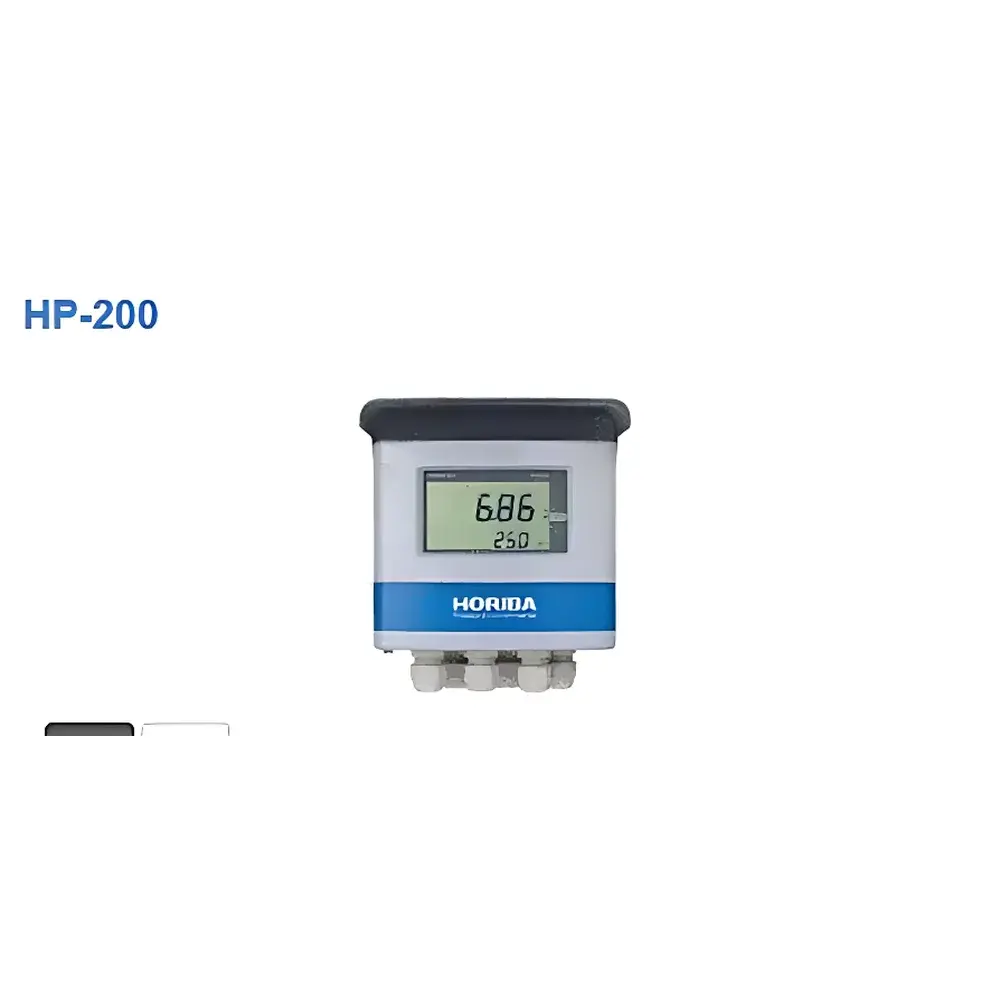
HORIBA HP-200 Industrial Online pH Meter
| Brand | HORIBA |
|---|---|
| Origin | Japan |
| Model | HP-200 |
| IP Rating | IP65 |
| Measurement Principle | Glass Electrode Method |
| pH Range | 0–14 |
| pH Resolution | 0.01 |
| pH Repeatability | ±0.03 |
| Temperature Range | 0–100 °C |
| Temperature Resolution | 0.1 °C |
| Temperature Accuracy | ±0.3 °C (equivalent input) |
| Output | Two isolated 4–20 mA DC outputs (max load: 900 Ω) |
| Relay Outputs | 5 SPDT (1c) contacts, configurable for alarm/control |
| Input | Dry-contact hold input for electrode cleaning/operation status |
| Communication | RS-485 (2-wire, input/output isolated) |
| Power Supply | 90–264 V AC, 50/60 Hz, ≤15 W |
| Enclosure Material | Aluminum alloy |
| Mounting | Pole (Ø50 mm) or wall-mount |
| Ambient Operating Temperature | −20 to +55 °C |
| Weight | ~4.5 kg |
| Compliance | CE, FCC, RoHS, WEEE |
Overview
The HORIBA HP-200 is an industrial-grade, outdoor-rated online pH meter engineered for continuous, reliable measurement in demanding water quality monitoring applications. It employs the conventional glass electrode potentiometric principle—measuring the potential difference between a pH-sensitive glass membrane and a stable reference electrode—to deliver traceable, NIST-compatible pH quantification across the full aqueous scale (0–14 pH). Designed as part of HORIBA’s H-1 series of field-deployable analyzers, the HP-200 integrates robust environmental protection (IP65-rated aluminum housing), wide-temperature operation (−20 to +55 °C ambient), and dual-channel analog output capability into a single compact unit. Its architecture supports long-term stability in municipal wastewater effluent, industrial process streams, cooling tower circuits, and pre-treatment basins—environments where mechanical durability, electrical noise immunity, and resistance to condensation or dust ingress are non-negotiable. The device does not require recalibration at every temperature shift; instead, it implements automatic temperature compensation (ATC) using user-selectable thermistor elements (Pt1000, 500 Ω, 6.8 kΩ, or 10 kΩ at 25 °C), ensuring consistent accuracy across variable thermal conditions without manual intervention.
Key Features
- IP65-rated aluminum enclosure with corrosion-resistant SUS304 mounting hardware—certified for outdoor installation under rain, dust, and temperature cycling
- Large, high-contrast LCD display with simultaneous pH and temperature readouts, enabling rapid visual verification without local PC access
- Integrated self-diagnostic system that continuously monitors electrode response slope, asymmetry potential, and internal converter integrity—flagging calibration drift, junction clogging, or sensor failure before data integrity degrades
- Configurable relay logic (5 SPDT contacts) supporting upstream/downstream alarm thresholds, ON/OFF control, time-proportional dosing actuation, and fault signaling per IEC 61508 functional safety conventions
- Isolated 4–20 mA analog outputs compatible with PLCs, DCS systems, and SCADA architectures—each output independently assignable to pH, temperature, or diagnostic status
- RS-485 Modbus RTU interface (two-wire, galvanically isolated) for centralized configuration, real-time data polling, and firmware updates across multi-sensor networks
- Secure terminal block design with captive screw terminals—eliminating risk of loose connections in high-vibration environments
Sample Compatibility & Compliance
The HP-200 is validated for use with aqueous samples exhibiting conductivity ≥50 µS/cm and suspended solids <5% v/v. It accommodates standard combination pH electrodes (e.g., HORIBA 9201-10D, 9202-10D) with liquid-filled or gel-filled reference systems and is compatible with optional temperature-compensated flow cells for inline pipe mounting. Regulatory compliance includes CE marking per Directive 2014/30/EU (EMC), Directive 2014/35/EU (LVD), and Directive 2011/65/EU (RoHS); FCC Part 15 Class B emissions certification; and adherence to WEEE recycling requirements. While not intrinsically safe, its design meets general-purpose industrial installation standards referenced in ISO 14644-1 (cleanroom compatibility), EN 61326-1 (electromagnetic immunity), and ASTM D1293 (standard test method for pH of water).
Software & Data Management
Configuration and diagnostics are performed via front-panel keypad navigation or remotely through HORIBA’s proprietary WinCT software (Windows-based, USB-to-RS485 adapter required). All calibration events—including date/time stamp, buffer values used, slope (%), offset (mV), and temperature—are stored in non-volatile memory with a minimum retention of 1,000 entries. Audit trails comply with GLP/GMP documentation expectations: no record can be edited or deleted; only appended. Data export supports CSV format for integration with LIMS or historian platforms. Though the HP-200 itself lacks onboard data logging, its RS-485 interface enables synchronized timestamped acquisition by external controllers compliant with Modbus function codes 03 (read holding registers) and 06 (preset single register).
Applications
- Municipal wastewater treatment: continuous monitoring of influent, aeration basin, and final effluent pH for regulatory reporting (e.g., EPA NPDES permits)
- Industrial process control: neutralization tank feedback in chemical manufacturing, pulp & paper bleaching stages, and semiconductor rinse water management
- Cooling water systems: real-time pH tracking to prevent scaling (high pH) or corrosion (low pH), integrated with biocide dosing logic
- Food & beverage production: monitoring of CIP (clean-in-place) solution concentration and post-rinse neutrality verification
- Environmental compliance stations: fixed-site deployment in river intake points, stormwater outfalls, and landfill leachate collection systems
FAQ
What electrode types are supported by the HP-200?
The HP-200 accepts industry-standard BNC or DIN-type combination pH electrodes with integrated temperature sensors (Pt1000 or thermistor). HORIBA recommends its 9200-series electrodes for optimal long-term stability in high-TDS or sulfide-rich matrices.
Does the HP-200 support automatic temperature compensation?
Yes—it supports ATC using four selectable temperature sensing elements: Pt1000 (IEC 60751), 500 Ω, 6.8 kΩ, or 10 kΩ thermistors—all calibrated per NIST-traceable reference tables.
Can the relay outputs perform proportional-integral (PI) control?
No—the relays are binary (ON/OFF) or time-proportioned (duty-cycle modulated), but lack built-in PID algorithms. External controllers must handle closed-loop regulation.
Is the 4–20 mA output intrinsically safe?
No—the outputs are isolated but not energy-limited; they require appropriate barrier modules if installed in hazardous areas classified under ATEX or IECEx.
How often should calibration be performed?
Calibration frequency depends on sample matrix and regulatory requirements; typical intervals range from daily (critical processes) to weekly (stable municipal effluent). The self-diagnostic log provides objective slope degradation metrics to guide maintenance scheduling.







