
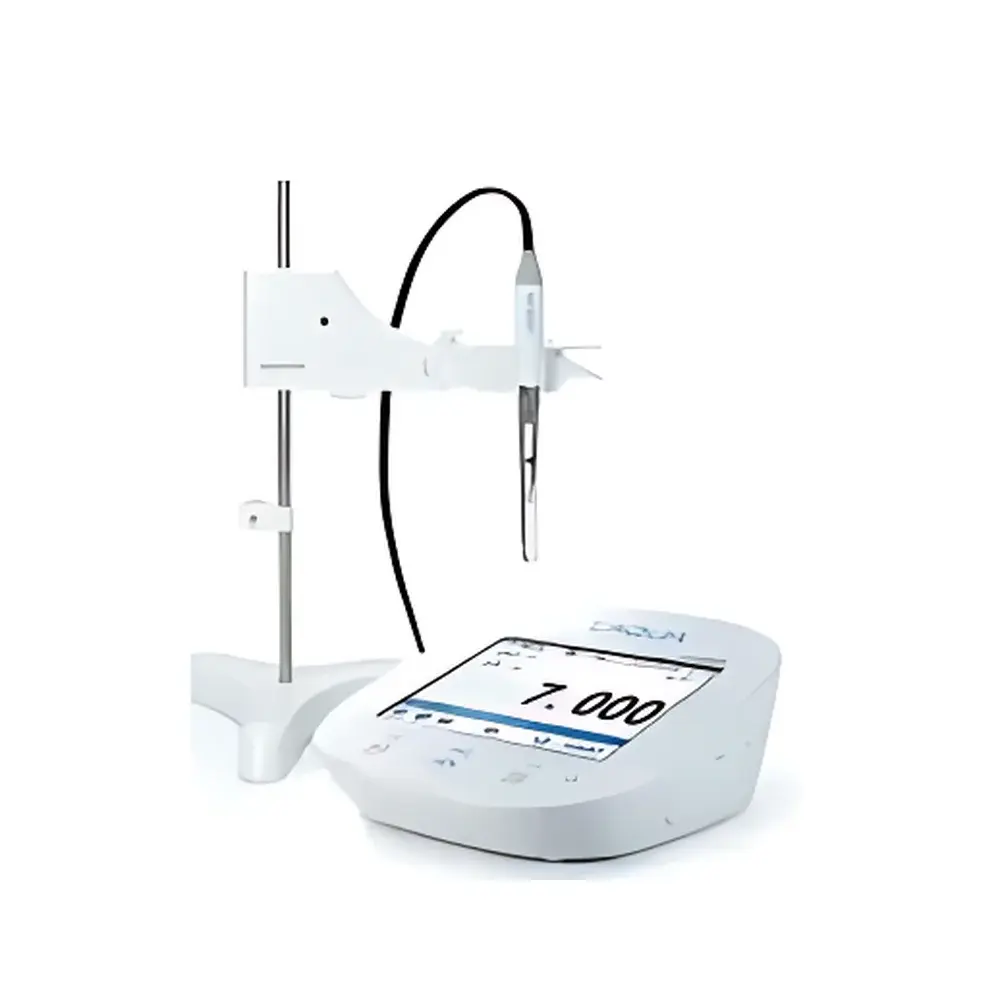
HORIBA F-73 Dual-Channel Benchtop Water Quality Analyzer
| Brand | HORIBA |
|---|---|
| Origin | Japan |
| Model | F-73 |
| Instrument Type | Laboratory Water Quality Analyzer |
| Measurable Parameters | pH, ORP, Ion Concentration, Temperature |
| Display | Dual-channel touchscreen |
| Data Storage | 2000 sets |
| Compliance | JIS, USP, EP, JP, CP |
| Language Support | English, Japanese, Korean, Chinese |
| Power Supply | AC 100–240 V, 50/60 Hz |
| Power Consumption | ~9.8 VA |
| Weight | ~700 g |
| Included Accessories | Electrode stand, operation manual, AC adapter |
Overview
The HORIBA F-73 Dual-Channel Benchtop Water Quality Analyzer is a precision-engineered laboratory instrument designed for simultaneous, high-accuracy measurement of pH, oxidation-reduction potential (ORP), ion concentration, and temperature across two independent channels. Built upon HORIBA’s legacy in electrochemical sensing and metrological traceability, the F-73 employs standardized potentiometric principles: pH and ORP are determined via glass and noble-metal reference electrodes following ISO 3696 and ASTM D1293; ion concentration is quantified using selective ion electrodes (e.g., fluoride, nitrate, ammonium) calibrated per ISE performance guidelines (ISO 10523, EN 27877). Its dual-channel architecture enables comparative analysis—such as monitoring pH drift during titration while tracking ion activity—or parallel validation of sample replicates under identical environmental conditions. The instrument is engineered for routine compliance testing in pharmaceutical water systems (Purified Water, Water for Injection), environmental labs, and industrial process control where regulatory-grade reproducibility and audit-ready data integrity are mandatory.
Key Features
- Dual-channel independent measurement capability: Channel 1 supports pH/ORP/ion/temperature; Channel 2 supports pH/ORP/ion/temperature—enabling concurrent or cross-referenced analysis without channel switching.
- High-resolution capacitive touchscreen interface (7-inch, full-graphic display) with intuitive navigation, real-time parameter visualization, and contextual on-screen guidance for calibration, maintenance, and troubleshooting.
- GLP/GMP-compliant operational framework: Automatic timestamping, user ID logging, calibration history retention, and editable measurement notes—fully compatible with FDA 21 CFR Part 11 requirements when paired with validated software workflows.
- Electrode health diagnostics and guided calibration: Integrated electrode impedance monitoring, slope/offset verification, and step-by-step calibration wizards aligned with JIS Z 8401, USP , EP 2.2.3, and JP General Tests 2.05.
- Modular electrode compatibility: Supports standard BNC and DIN connectors for glass pH electrodes, ORP redox electrodes, and solid-state or liquid-filled ion-selective electrodes—including low-volume micro-electrodes for limited sample volumes.
- Robust power architecture: Universal AC input (100–240 V, 50/60 Hz), low thermal drift design, and stable analog signal conditioning ensure measurement continuity in variable lab environments.
Sample Compatibility & Compliance
The F-73 is validated for aqueous matrices including purified water, wastewater effluents, surface water, groundwater, and process streams across pH 0.000–14.000, temperature −30.0 to +130.0 °C, and ion concentrations spanning 0.00 µg/L to 999 g/L (expressed as mol/L or mass concentration). It meets critical regulatory benchmarks: USP for conductivity and TOC correlation in pharmaceutical water systems; EP 2.2.38 for pH measurement uncertainty control; and JIS K 0107 for environmental water analysis. All measurements adhere to ISO/IEC 17025 traceability requirements when used with NIST-traceable calibration standards and documented uncertainty budgets. The instrument’s firmware includes preconfigured method templates for pharmacopeial water testing (e.g., conductivity vs. temperature compensation curves per USP Stage 1–3), eliminating manual calculation errors.
Software & Data Management
Data acquisition, storage, and export are managed through HORIBA’s proprietary LabSolution software (Windows-compatible, USB-connected). The F-73 stores up to 2000 measurement records locally—with timestamps, operator IDs, electrode serial numbers, calibration parameters, and raw sensor outputs. Export formats include CSV and PDF reports compliant with ALCOA+ principles (Attributable, Legible, Contemporaneous, Original, Accurate). USB mass storage mode allows direct transfer of datasets to external drives without host PC dependency. Audit trail functionality logs all configuration changes, calibration events, and data deletions—supporting inspection readiness for FDA, EMA, or PMDA audits. Optional integration with LIMS via ASCII protocol ensures seamless workflow alignment in regulated laboratories.
Applications
- Pharmaceutical water system qualification: Routine monitoring of Purified Water (PW) and Water for Injection (WFI) per USP , including simultaneous pH and conductivity trending with temperature compensation.
- Environmental compliance testing: Field-deployable lab validation of surface water, effluent discharge, and drinking water per EPA Method 150.1 (pH), 150.2 (conductivity), and 300.0 (ion chromatography correlation).
- Academic and research laboratories: Teaching potentiometric fundamentals, developing ISE calibration models, or conducting long-term stability studies on reference electrodes.
- Industrial process control: Monitoring rinse bath chemistry in semiconductor cleaning lines, electroplating baths, or boiler feedwater treatment—where dual-channel redundancy enhances measurement confidence.
- Regulatory method validation: Supporting method transfer and verification activities required under ICH Q2(R2) for analytical procedure validation in QC environments.
FAQ
Does the F-73 support automatic temperature compensation (ATC) for all measured parameters?
Yes—ATC is applied in real time to pH, ORP, and ion concentration measurements using integrated Pt1000 or NTC thermistors, with configurable compensation algorithms per ISO 7027 and ASTM D1129.
Can the F-73 be used for Good Manufacturing Practice (GMP) environments?
Yes—the instrument supports electronic signatures, audit trails, and calibration lockout features when configured with LabSolution v3.2+ and validated computerized system protocols.
What electrode types are certified for use with the F-73?
HORIBA-certified electrodes include the 9615S-10D pH electrode, 9678S-10D ORP electrode, and 9652S series ion-selective electrodes (e.g., F⁻, Cl⁻, NO₃⁻); third-party electrodes with standard BNC/DIN interfaces may be used but require individual performance verification.
Is firmware upgrade supported in the field?
Yes—firmware updates are delivered via USB drive and installed through the instrument’s maintenance menu, with version rollback capability and checksum validation to ensure integrity.
How is measurement uncertainty estimated for pH readings?
Uncertainty is calculated per GUM (JCGM 100:2018) incorporating contributions from electrode slope deviation (±0.001 pH), temperature sensor error (±0.1 °C), calibration standard uncertainty (±0.002 pH), and repeatability (±0.001 pH), yielding typical expanded uncertainty (k=2) of ±0.005 pH at 25 °C.







