
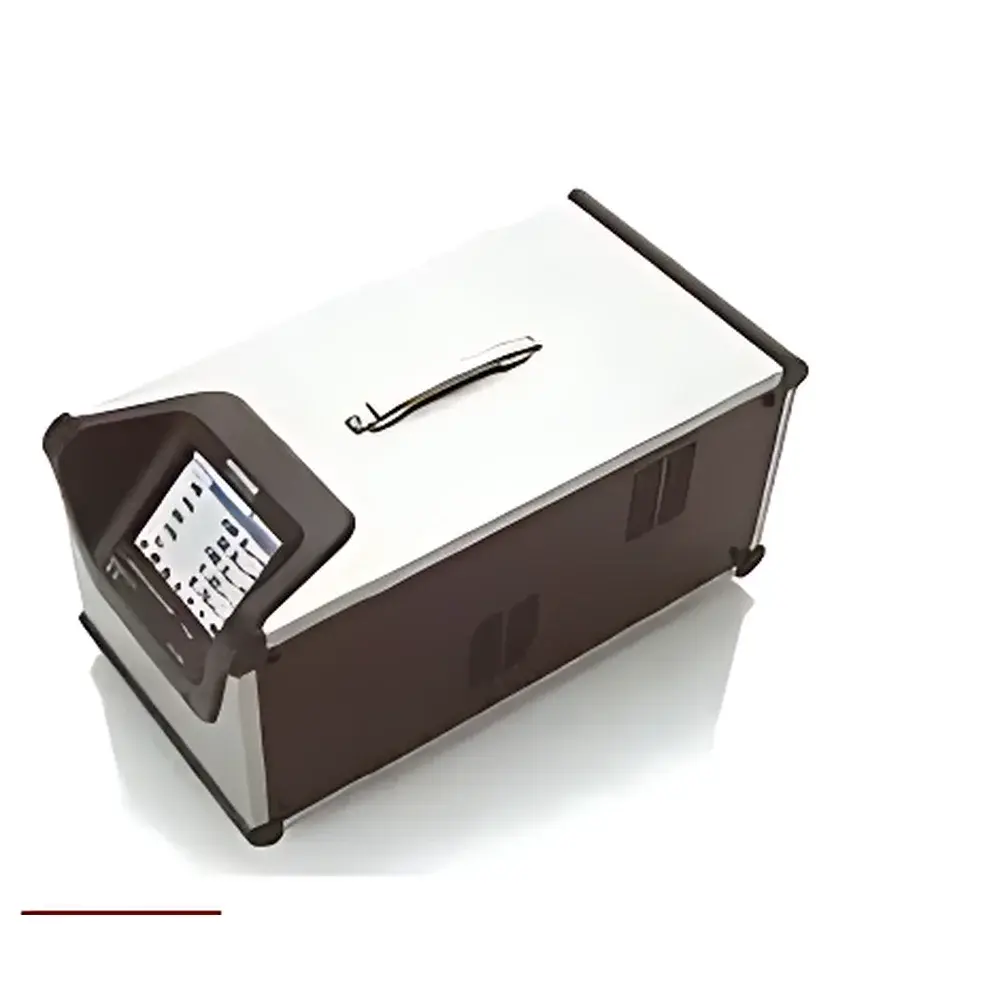
HORIBA PG-350 Portable Multi-Gas Emission Analyzer
| Brand | HORIBA |
|---|---|
| Origin | Japan |
| Model | PG-350 |
| Instrument Type | Portable |
| Measured Gases | NOx, SO₂, CO, CO₂, O₂ |
| Range Options | 0–5/10/25 vol% (O₂, CO₂) |
| Repeatability | ±1.0% F.S. |
| Response Time (T90) | ≤45 s (all gases except SO₂) |
| Drift | ±1.0% F.S./day (SO₂: ±2.0% F.S./day) |
| Linearity | ±2.0% F.S. |
| Sample Flow Rate | ~0.5 L/min |
| Display | Color TFT Touchscreen with Real-Time Trend Plotting |
| Data Storage | SD Card (User-Configurable Interval) |
| Output Interfaces | 4–20 mA DC, Ethernet |
| Warm-up Time | 30 min |
| Operating Environment | 5–40 °C, ≤85% RH |
| Dimensions | 226 × 265 × 510 mm (W×H×D) |
| Weight | ~14 kg |
| Certifications | TÜV (EU), MCERTS (UK), GOST-R (Russia), ETV (USA), CNAS/CMA (China), KOLAS (Korea), JIS (Japan) |
Overview
The HORIBA PG-350 Portable Multi-Gas Emission Analyzer is an engineered field-deployable solution for real-time, quantitative measurement of five critical flue gas components—NOx, SO2, CO, CO2, and O2—with laboratory-grade accuracy and traceability. Designed for regulatory-compliant stack monitoring, combustion optimization, and R&D applications, the PG-350 employs a hybrid optical and electrochemical detection architecture: alternating-flow modulated non-dispersive infrared (NDIR) spectroscopy for CO, CO2, and CH4; alternating-flow modulated chemiluminescence detection (CLD) for NOx; dual-beam NDIR for SO2; and galvanic cell technology for O2. This multi-principle approach ensures minimal cross-sensitivity, high selectivity under variable matrix conditions (e.g., high moisture or particulate load), and long-term stability without frequent recalibration. The analyzer meets ISO 12039, EN 15267-3, and EPA Method 6C/7E/10 requirements for continuous emission monitoring systems (CEMS) verification and serves as a certified backup or portable reference instrument in compliance with MCERTS, TÜV, and China’s HJ 76–2017 technical specifications.
Key Features
- Integrated alternating-flow modulation architecture to suppress baseline drift and enhance signal-to-noise ratio across all optical channels
- Color TFT capacitive touchscreen interface with intuitive menu navigation, on-screen step-by-step operation guidance, and real-time multi-gas trend visualization
- Onboard electronic condensate management system with automatic and manual drainage, plus programmable purge cycles to maintain sample line integrity
- Full-system calibration capability—including heated sampling probe, filter, and analyzer—traceable to NIST-certified standard gases
- SD card-based data logging with user-defined time intervals (1 s to 60 min), timestamped event markers (calibration, alarm, power cycle), and CSV export compatibility
- Robust mechanical design: IP54-rated enclosure, shock-absorbing housing, and vibration-damped internal optics optimized for mobile deployment on vehicles, barges, or rooftop stacks
- Extended operational autonomy via dual AC input (100–120 V / 200–240 V, 50/60 Hz) and optional external DC power interface
Sample Compatibility & Compliance
The PG-350 accepts raw or conditioned flue gas samples within a temperature range of 5–40 °C and relative humidity up to 85% RH (non-condensing). It supports direct connection to heated sampling lines (up to 180 °C inlet temperature with optional pre-conditioner) and accommodates typical industrial stack matrices containing up to 20% H2O, <50 mg/m³ particulates, and trace halogens. All measurement modules are independently validated per international standards: CLD module conforms to EN 14792 for NOx; NDIR modules comply with EN 14791 (SO2) and EN 15058 (CO/CO2); O2 sensor satisfies EN 14789. The system carries full third-party type approval from TÜV Rheinland (EU), MCERTS (UK Environment Agency), ETV (US EPA), and national metrology institutes in Japan (NMIJ), Korea (KRISS), Russia (GOST-R), and China (CNAS-accredited CMA labs).
Software & Data Management
Data acquisition and configuration are managed via embedded firmware supporting Modbus TCP and HTTP API protocols over Ethernet. Raw concentration values, diagnostic status codes (e.g., flow fault, sensor saturation, heater failure), and calibration history are logged with millisecond timestamps. The SD card archive includes metadata such as operator ID, location tag, ambient pressure, and dew point—enabling full audit trail reconstruction per GLP/GMP and FDA 21 CFR Part 11 requirements when paired with controlled user access and electronic signature modules. Remote diagnostics are supported through secure SSH tunneling; firmware updates are performed offline via encrypted .bin files to preserve system integrity during field operation.
Applications
- Regulatory stack testing and CEMS performance audits under EPA PS-1/PS-2, EN 14181, or HJ 75–2017
- Combustion efficiency analysis in boilers, incinerators, and gas turbines
- Catalyst evaluation and deactivation studies in lab-scale reactors and pilot plants
- Fuel cell exhaust characterization (H2, CO, CO2, O2 balance)
- Emission factor validation for IPCC Tier 2/3 reporting
- Academic research in atmospheric chemistry, carbon capture process development, and low-carbon fuel combustion kinetics
FAQ
What gas components does the PG-350 measure by default?
The standard PG-350 configuration measures NOx, SO2, CO, CO2, and O2 simultaneously. CH4 detection is available as an optional module.
Is the PG-350 suitable for hot/wet stack sampling?
Yes—when used with HORIBA’s optional heated sampling probe and condensate trap, the PG-350 supports direct hot/wet measurement at temperatures up to 180 °C and moisture content up to 20% v/v.
How is calibration traceability maintained in the field?
Each unit ships with a factory calibration certificate referencing NIST-traceable gas standards. On-site span and zero checks can be performed using certified calibration gases; all calibration events—including date, gas lot number, and deviation values—are automatically stored on the SD card.
Does the PG-350 support automated data upload to cloud platforms?
Via its Ethernet port and configurable Modbus TCP server, the PG-350 integrates with SCADA systems, LIMS, or custom cloud ingestion pipelines. No proprietary middleware is required.
What maintenance intervals are recommended?
Optical windows should be inspected quarterly; galvanic O2 sensors require replacement every 18–24 months under continuous operation. Full system verification against reference gases is advised every 90 days per EN 14181 QAL2 requirements.







