
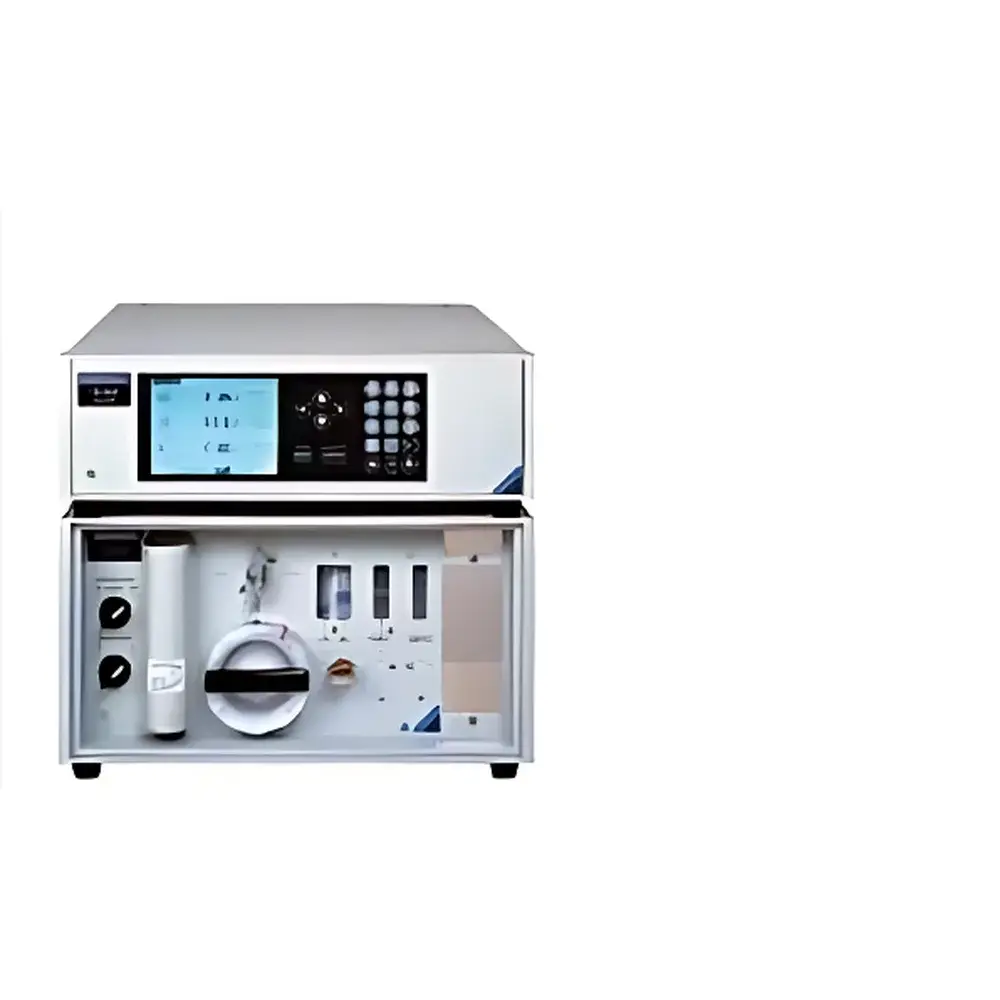
HORIBA VA-3000/VS-3000 Series Multi-Gas Infrared Analyzer
| Brand | HORIBA |
|---|---|
| Origin | Japan |
| Model | VA-3000 / VS-3000 |
| Instrument Type | Online Gas Analyzer |
| Detection Principle | NDIR (CO, CO₂, CH₄, N₂O, SO₂), CLA (NOₓ), MPA (O₂), Electrochemical (O₂), Zirconia (O₂) |
| Repeatability | ±0.5% F.S. |
| Response Time (T90) | ≤30 s |
| Zero & Span Drift | ±2.0% F.S./week |
| Linearity | ±1.0% F.S. |
| Analog Output | 0–1 V DC / 4–20 mA DC |
| Communication Interface | RS-232C |
| Operating Temperature | 0–40 °C |
| Power Supply | AC 100–240 V, 50/60 Hz |
| Weight (VA-3000) | ~20 kg |
| Enclosure | 19-inch rack-mount (430 × 132 × 550 mm) |
Overview
The HORIBA VA-3000/VS-3000 Series is an online multi-component infrared gas analyzer engineered for high-precision, real-time monitoring of industrial emissions, environmental air quality, and process control applications. Utilizing non-dispersive infrared (NDIR) spectroscopy for CO, CO₂, CH₄, N₂O, and SO₂; chemiluminescence analysis (CLA) for NOₓ; magnetic pressure analysis (MPA), electrochemical cells, and zirconia-based sensing for O₂ — the system delivers trace-level quantification across a broad dynamic concentration range. Its modular architecture supports up to three sensor modules within a single 19-inch analyzer unit (VA-3000), enabling flexible configuration for simultaneous measurement of up to six gases without cross-interference. Designed for compliance with international ambient air and stack emission standards, the VA-3000/VS-3000 series integrates seamlessly into continuous emission monitoring systems (CEMS) and laboratory-grade environmental research platforms.
Key Features
- Modular sensor architecture: Supports NDIR, CLA, MPA, electrochemical, and zirconia O₂ modules in one chassis — configurable for up to three simultaneous gas measurements.
- Wide dynamic range: Programmable multi-range capability — up to 10:1 standard, 20:1 optional for NDIR; up to 100:1 for CLA — eliminating need for manual range switching or duplicate analyzers.
- High metrological stability: ±0.5% F.S. repeatability, ±1.0% F.S. linearity (≤10× span), and ±2.0% F.S./week zero/span drift ensure long-term calibration integrity under unattended operation.
- Rapid response: T90 ≤30 seconds from sample inlet — optimized for fast transient detection in combustion control and fugitive emission surveys.
- Robust sampling interface: VS-3000 series sampling units (VS-3001 to VS-3004) provide conditioned, dry, particle-free sample delivery at 0.5 L/min flow rate; compatible with corrosive, high-moisture, or low-pressure flue gas streams via material options including SUS, PTFE, PVDF, and FKM.
- Standardized connectivity: RS-232C serial interface and analog outputs (0–1 V DC / 4–20 mA DC) enable direct integration with PLCs, SCADA systems, and data acquisition hardware compliant with IEC 61131-3 and Modbus RTU protocols.
Sample Compatibility & Compliance
The VA-3000/VS-3000 system accommodates diverse sample matrices typical of regulatory and industrial environments. Sample gas must be free of particulates (50 ppm, NO₂ >6 ppm). For zirconia O₂ measurement, coexistence of H₂O and O₂ is required to prevent sensor degradation when reducing gases (CO, H₂, THC) are present — governed by the stoichiometric constraint: [THC] + [CO] + [H₂] < [H₂O] + [O₂]. The analyzer meets design requirements aligned with ISO 12039 (CO/CO₂ in flue gas), EN 15267-3 (CEMS performance certification), and EPA Method 10/3A/7E for stationary source compliance testing. Optional configurations support GLP/GMP audit trails when paired with HORIBA’s certified data logging software.
Software & Data Management
HORIBA provides dedicated PC-based configuration and data handling software supporting instrument setup, calibration scheduling, alarm threshold definition, and trend visualization. Raw analog outputs and RS-232C ASCII data streams are fully compatible with third-party SCADA platforms and LIMS environments. The software enforces secure user access levels (operator, engineer, administrator) and records full audit logs — including calibration events, parameter changes, and maintenance interventions — satisfying FDA 21 CFR Part 11 electronic record requirements when deployed in regulated pharmaceutical or bioprocess settings. Data export is supported in CSV, Excel, and PDF formats; time-stamped datasets include temperature, pressure, and flow metadata where interfaced with external sensors.
Applications
- Continuous Emission Monitoring Systems (CEMS) for thermal power plants, cement kilns, and waste incinerators.
- Urban air quality networks measuring ambient CO, NOₓ, and CH₄ near traffic corridors and industrial zones.
- Biogas upgrading facilities tracking CO₂ removal efficiency and CH₄ purity in real time.
- Automotive R&D labs performing exhaust gas analysis during engine dynamometer testing.
- Greenhouse gas flux studies requiring high-sensitivity N₂O and CO₂ quantification in eddy covariance setups.
- Industrial safety monitoring for confined-space O₂ deficiency and CO accumulation in boiler rooms or chemical storage areas.
FAQ
What detection principles are used for each gas?
NDIR for CO, CO₂, CH₄, N₂O, and SO₂; chemiluminescence (CLA) for NOₓ; magnetic pressure analysis (MPA), electrochemical, or zirconia for O₂ — selected per application requirements.
Can the VA-3000 measure NH₃ or C₂H₄?
NH₃ and C₂H₄ are not supported by standard modules; custom sensor development or external pre-concentration interfaces may be evaluated upon technical consultation.
Is automatic zero/span calibration supported?
Yes — programmable auto-calibration sequences using external zero air and span gas sources can be scheduled via RS-232C or front-panel menu; requires optional solenoid valve manifold kit.
What is the warm-up time for full specification accuracy?
NDIR and MPA modules achieve specified performance within 20 minutes; CLA and electrochemical O₂ require ~60 minutes; zirconia O₂ stabilizes in ~40 minutes.
How does the system handle interference from water vapor or CO in N₂O measurement?
When CO >10 ppm coexists with N₂O, a catalytic converter module must be installed upstream to oxidize CO and prevent spectral overlap in the NDIR cell.
Related Products







