
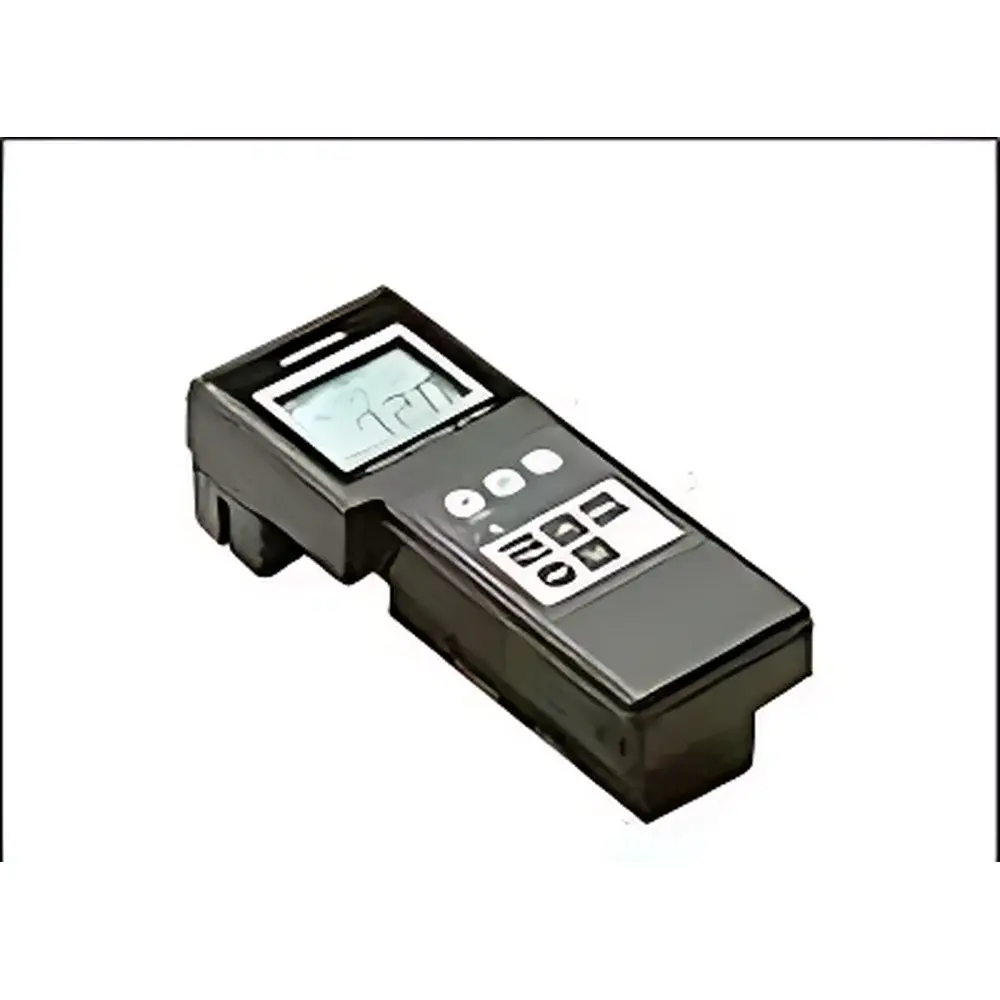
HORIBA IG-320 Portable 60° Gloss Meter
| Brand | HORIBA |
|---|---|
| Origin | Japan |
| Model | IG-320 |
| Measurement Angle | 60° |
| Gloss Range | 0–100 GU |
| Resolution | 0.1 GU |
| Accuracy | ±0.5% F.S. ±1 digit |
| Spot Size | 16 × 12 mm |
| Repeatability (Haze) | 0.2% |
| Repeatability (Transmittance) | 0.5% |
| Haze Range | 0–30% |
| Transmittance Range | 0–100% |
| Power Supply | 9 V DC battery |
| Dimensions (W × H × D) | 78 × 189 × 58 mm |
| Display | LED digital |
| Calibration | Auto-calibration with detachable sensor head |
| Data Memory | Stores up to 99 readings with statistical functions (mean, standard deviation) |
Overview
The HORIBA IG-320 is a portable, precision-engineered 60° gloss meter designed for rapid, repeatable surface gloss evaluation in industrial quality control and maintenance applications. Based on the principle of specular reflectance measurement—where incident light at a defined 60° angle is reflected from a sample surface and quantified by a calibrated photodetector—the IG-320 delivers traceable, objective gloss values in Gloss Units (GU). Its optical architecture complies with ISO 2813, ASTM D523, ASTM C584, DIN 67530, and GB/T 9754, ensuring cross-laboratory comparability and regulatory alignment for coatings, plastics, ceramics, stone, and architectural finishes. Unlike subjective visual assessment—which exhibits high inter-observer variability and poor recall fidelity—the IG-320 converts perceptual gloss into metrologically sound numerical data, enabling consistent pass/fail decisions across production shifts, supplier audits, and facility upkeep workflows.
Key Features
- True 60° geometry optimized for medium-gloss surfaces (e.g., automotive clearcoats, decorative laminates, polished marble, and industrial paints), balancing sensitivity and dynamic range.
- Detachable sensor head with integrated optical path—enables access to confined or curved surfaces without compromising alignment stability or stray-light rejection.
- Auto-calibration system with built-in reference standard; eliminates manual zeroing and reduces operator-induced drift between measurements.
- High-resolution LED display showing real-time GU values with 0.1 GU resolution and ±0.5% full-scale accuracy—meeting ISO 2813 repeatability requirements for Class II instruments.
- Battery-powered operation (single 9 V DC) with low-power circuitry ensures >10,000 measurements per charge; no warm-up time required for immediate field deployment.
- Onboard memory stores 99 sequential readings with embedded statistical processing—calculates mean, standard deviation, min/max, and coefficient of variation for process capability analysis (Cp/Cpk).
Sample Compatibility & Compliance
The IG-320 is validated for non-destructive, contact-based gloss assessment of flat and gently curved substrates with surface roughness < 1 µm Ra. It supports routine testing of solvent-based and waterborne coatings, thermoplastic and thermoset polymers, glazed ceramics, polished granite/marble, anodized aluminum, and printed packaging films. All measurement protocols adhere to ISO/IEC 17025 traceability frameworks when used with NIST-traceable calibration standards. The instrument satisfies documentation requirements for ISO 9001 quality management systems and supports GLP-compliant recordkeeping through exportable CSV logs (via optional USB interface adapter). Its 60° configuration aligns with ASTM D2457 for plastic film gloss and JIS Z 8741 for Japanese industrial standards.
Software & Data Management
While the IG-320 operates as a standalone field instrument, its memory module interfaces with HORIBA’s optional PC-based DataLink software (v3.2+), enabling automated report generation compliant with FDA 21 CFR Part 11 Annex 11 requirements—including electronic signatures, audit trails, and user-access controls. Raw datasets retain timestamp, operator ID, and environmental metadata (if logged externally). Statistical summaries are exportable to Excel-compatible formats for SPC charting (X̄-R, CUSUM) and integration into MES/QMS platforms such as SAP QM or ETQ Reliance. Firmware updates preserve calibration coefficients and maintain measurement integrity across version cycles.
Applications
- Automotive OEM and Tier-1 suppliers: In-line verification of basecoat/clearcoat gloss uniformity pre- and post-baking.
- Architectural coating manufacturers: Batch release testing per ASTM D523 for interior/exterior wall paints and anti-graffiti coatings.
- Ceramic tile producers: Monitoring glaze consistency across kiln runs using GB/T 9966.2-compliant protocols.
- Flooring maintenance contractors: Quantifying gloss recovery after burnishing or crystallization treatments on terrazzo and polished concrete.
- Printing and packaging QA labs: Evaluating varnish and lamination gloss on folding cartons per ISO 8254-1.
- R&D laboratories: Correlating gloss metrics with surface topography (AFM, profilometry) and chemical composition (FTIR, XPS).
FAQ
What standards does the IG-320 comply with for gloss measurement?
The IG-320 conforms to ISO 2813, ASTM D523, DIN 67530, JIS Z 8741, and GB/T 9754 for 60° specular gloss, with optical design validated against CIE Publication No. 116.
Can the IG-320 measure both gloss and haze in a single instrument?
No—the IG-320 is dedicated to gloss measurement only. Haze and transmittance specifications cited in legacy marketing materials refer to separate HORIBA instruments (e.g., LA-450 series); the IG-320 does not incorporate integrating sphere optics.
Is the calibration certificate NIST-traceable?
Yes—each unit ships with a factory calibration certificate referencing NIST SRM 1920a (gloss standard), with uncertainty budgets reported per ISO/IEC 17025 Annex A.
How is measurement repeatability verified during routine use?
Users perform daily verification using the included ceramic reference tile (100 GU nominal); deviation exceeding ±0.5 GU triggers recalibration per HORIBA Technical Bulletin TB-IG-004.
Does the IG-320 support GLP-compliant data archiving?
When paired with DataLink software and configured with role-based authentication, it meets ALCOA+ principles (Attributable, Legible, Contemporaneous, Original, Accurate) and supports 21 CFR Part 11 audit trails.




