
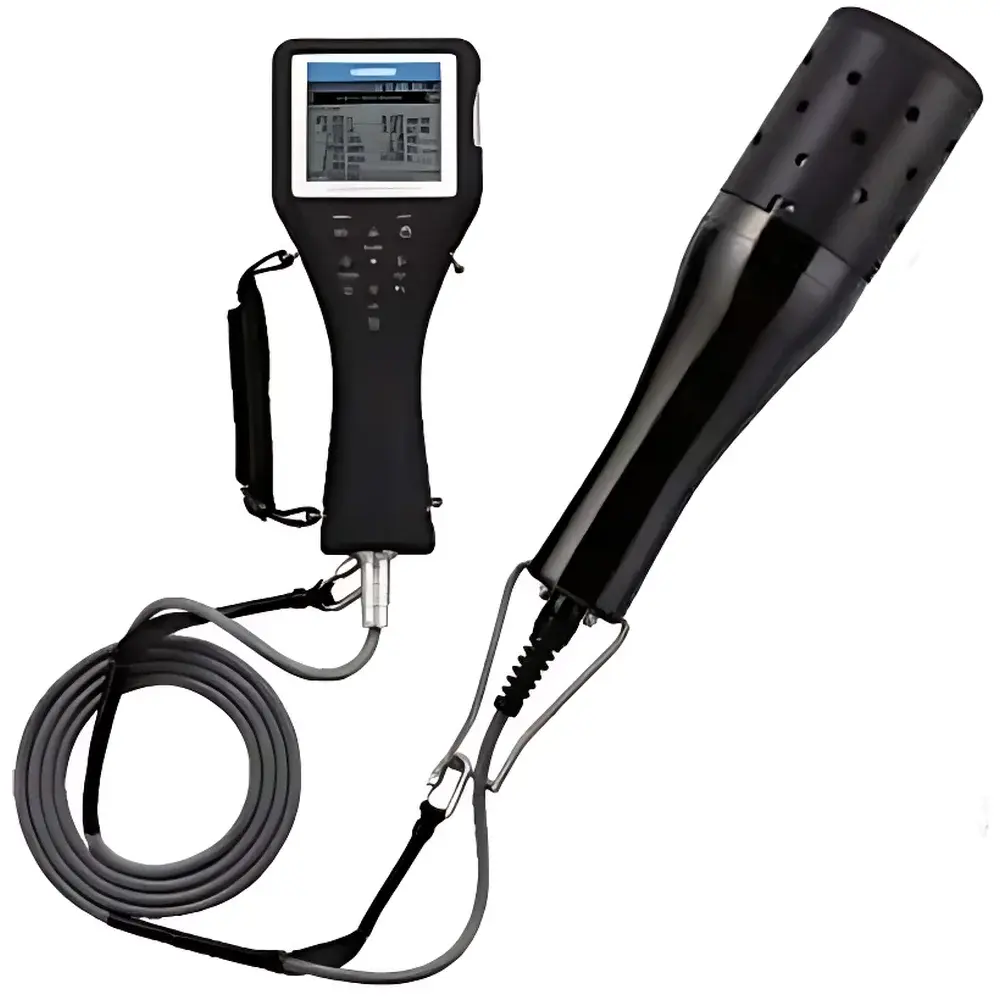
HORIBA U-50 Series Portable Multiparameter Water Quality Analyzer
| Brand | HORIBA |
|---|---|
| Origin | Japan |
| Model | U-50 Series |
| Instrument Type | Portable / Handheld Water Quality Analyzer |
| Measured Parameters | pH, ORP, EC, DO, TDS, Salinity, Specific Gravity, Temperature, Turbidity (NTU), Depth, GPS Positioning |
| Turbidity Standards | U-53 complies with US EPA Method |
| Turbidity Resolution | 0.01 NTU |
| Operating Temperature Range | −10 to 55 °C |
| Depth Measurement Range | up to 30 m |
| IP Rating | IP68 (JIS Protection Class 8 for probe |
| Battery Life | up to 70 h (alkaline AA × 4, backlight off) |
| Data Storage | 10,000 measurement sets |
| Communication Interface | USB |
| Display | 320 × 240 monochrome LCD with backlight |
Overview
The HORIBA U-50 Series is a rugged, field-deployable multiparameter water quality analyzer engineered for high-reliability environmental monitoring in diverse aquatic environments—including rivers, lakes, groundwater wells, wastewater treatment plants, and coastal zones. Based on electrochemical, optical, and pressure-based sensing principles, the U-50 platform integrates calibrated glass electrode (pH), platinum redox (ORP), Clark-type polarographic (DO), four-electrode AC conductivity (EC), and nephelometric turbidity detection (LED or tungsten lamp, depending on model) into a single handheld system. Its modular probe architecture allows configuration-specific deployment—U-53 models implement EPA-compliant forward-scatter turbidity (90° LED), while U-54 variants adhere to EN ISO 7027-compliant 90° tungsten-lamp nephelometry—ensuring regulatory traceability for compliance reporting. The integrated GPS module (available on G-series models) geotags each measurement, enabling spatially referenced data collection essential for watershed mapping, regulatory audits, and long-term trend analysis under ISO 14001 or EPA Clean Water Act frameworks.
Key Features
- Ruggedized construction using PPS, PEEK, SUS316L stainless steel, titanium, FKM elastomers, and FEP membranes—certified to JIS Protection Class 8 (IP68) for submersion up to 30 m.
- Simultaneous real-time display of up to 11 parameters: pH, pH(mV), ORP, dissolved oxygen (DO), electrical conductivity (EC), salinity (ppt), total dissolved solids (TDS), seawater specific gravity (δt), temperature, turbidity (NTU), and depth (m).
- Multi-language interface supporting English, Japanese, Russian, Spanish, and Portuguese—facilitating international field teams and multilingual regulatory documentation.
- Self-cleaning turbidity probes (U-53G/U-54G) equipped with motorized brush mechanisms to minimize biofouling during extended deployments in eutrophic or suspended-sediment-rich waters.
- Optimized polarographic DO sensor with accelerated response time (t90 ≤ 30 s) and simplified membrane/electrolyte maintenance—reducing calibration drift and field downtime.
- Auto-ranging EC measurement with automatic temperature compensation to 25 °C and configurable TDS conversion factors (0.4–1.0), supporting both freshwater and brackish applications.
- Integrated GPS receiver (12-channel L1 band) on G-series models, delivering horizontal accuracy ≤ 3 m (CEP) and enabling GIS-integrated data export compliant with ISO/IEC 17025 metadata requirements.
Sample Compatibility & Compliance
The U-50 Series is validated for use across natural surface waters (rivers, reservoirs), groundwater (well screens, piezometers), municipal and industrial effluents, and marine/estuarine systems. Probe materials meet NSF/ANSI Standard 61 for potable water contact, and all electrochemical sensors conform to ASTM D1293 (pH), D3370 (DO), and D5391 (conductivity) test protocols. Turbidity modules satisfy jurisdiction-specific regulatory equivalence: U-53 meets U.S. EPA Method 180.1 for drinking water and ambient monitoring; U-54 fulfills EN ISO 7027:2016 for European environmental reporting. Depth transducers are calibrated per IEC 61000-6-2 (EMC) and ISO 9001-certified manufacturing processes. The instrument supports GLP-compliant operation through timestamped, user-ID-tagged data logging and optional audit-trail-enabled firmware (compatible with 21 CFR Part 11–ready data management software).
Software & Data Management
Measurements are stored onboard in non-volatile memory (10,000 records) with full parameter arrays, GPS coordinates, date/time stamps, and operator IDs. Data export occurs via USB 2.0 to HORIBA’s proprietary U-50 Data Manager software (Windows-compatible), which generates CSV, PDF, and Excel reports formatted for regulatory submission (e.g., EPA Form 3330-1, Environment Agency WFD templates). The software enables batch calibration curve management, statistical outlier detection (Dixon’s Q-test), and automated QA/QC flagging per ISO 5725-2 precision criteria. Firmware updates maintain alignment with evolving metrological standards—including NIST-traceable calibration certificate integration and digital signature validation for data integrity assurance.
Applications
- Regulatory ambient water quality monitoring (EPA NPDES, EU WFD, China MEP HJ/T 91)
- Wastewater treatment plant influent/effluent compliance verification (BOD/COD surrogate tracking via DO–EC–turbidity correlations)
- Groundwater contamination plume delineation (redox zoning via simultaneous pH–ORP–DO profiling)
- Marine aquaculture site selection and health assessment (salinity–DO–temperature–turbidity coupling)
- Post-disaster rapid response (floodwater pathogen risk screening via turbidity–EC–temperature anomalies)
- Academic limnology and hydrogeology field campaigns requiring georeferenced, multi-depth vertical profiling
FAQ
What turbidity standards does the U-50 support?
U-53 models comply with U.S. EPA Method 180.1 (forward-scatter LED); U-54 models comply with EN ISO 7027:2016 (90° tungsten-lamp nephelometry). Both achieve 0.01 NTU resolution.
Is depth measurement available on all U-50 models?
Depth sensing is standard on U-52G, U-53G, and U-54G models (0–30 m range, ±0.3 m accuracy); it is not available on U-51, U-52, or U-54 base models.
How is temperature compensation handled for conductivity measurements?
EC readings are automatically compensated to 25 °C using built-in Pt1000 thermistor data and user-selectable linear or nonlinear (non-ASTM) algorithms.
Can the U-50 perform two-point pH calibration in the field?
Yes—all models support manual or automatic two-point calibration using NIST-traceable pH 4.01 and 7.00 (or 10.01) buffers, with slope and offset diagnostics logged per measurement.
What battery type and life can be expected during continuous field use?
Four AA alkaline batteries provide up to 70 hours of operation (backlight off, 20 °C ambient); lithium AA batteries extend service life in sub-zero conditions down to −10 °C.
Related Products







