
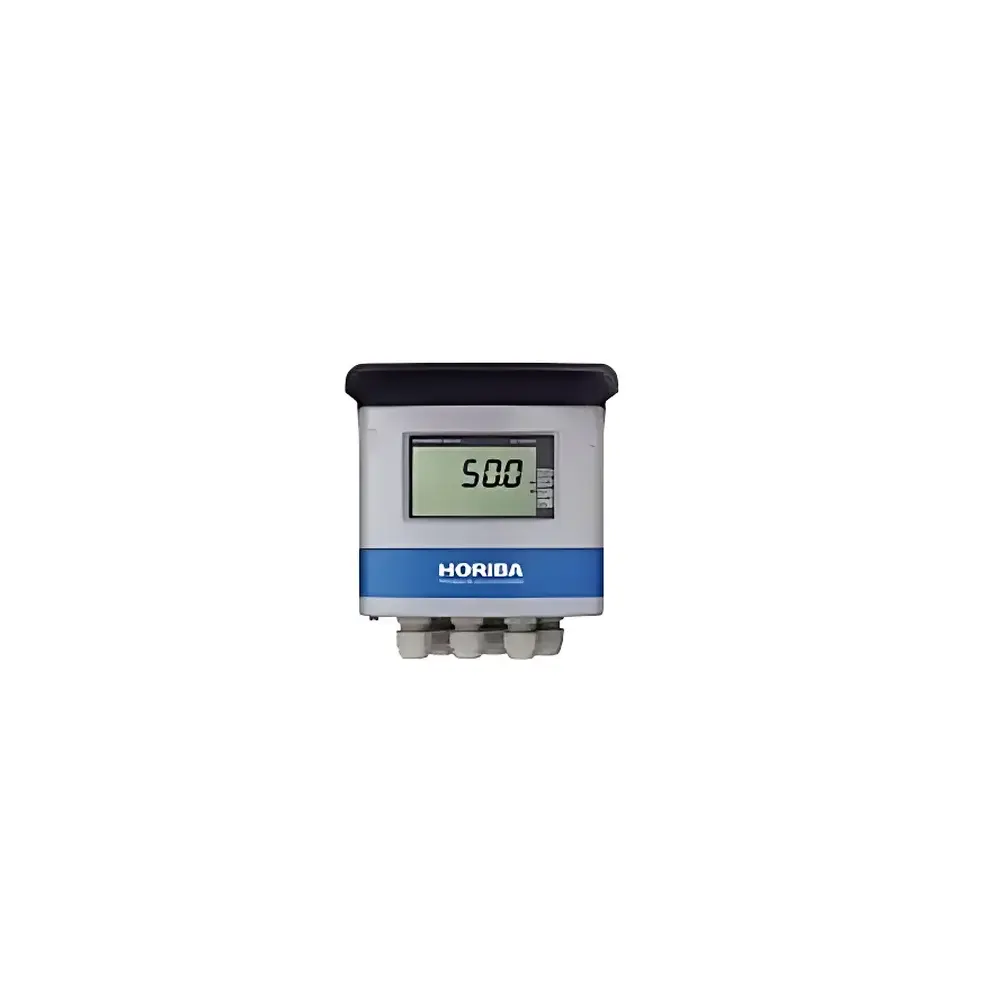
HORIBA HU-200TB Industrial Online Turbidity Monitor
| Brand | HORIBA |
|---|---|
| Origin | Japan |
| Model | HU-200TB |
| Measurement Principle | Dual-source 90° light scattering |
| Turbidity Range (Formazin) | 0–1000 NTU |
| Resolution | 0.1 NTU (10–100 NTU range) |
| Repeatability | ±2% or ±0.04 NTU (whichever is greater) |
| Linearity Deviation | ±2% or ±0.04 NTU at mid-range calibration point |
| Output | Isolated 4–20 mA DC (max load 900 Ω) |
| Relay Outputs | 3 SPDT dry contacts (configurable for alarm, cleaning activation, or fault indication) |
| Digital Interface | RS-485 (2-wire, input/output isolated) |
| Enclosure Rating | IP65 |
| Compliance | CE, FCC, RoHS, WEEE |
| Operating Temperature | 0–55 °C |
| Power Supply | 90–264 V AC, 50/60 Hz, ≤35 VA |
| Weight | ~4.5 kg |
| Housing Material | Aluminum alloy |
| Mounting | Pole-mounted (50A pipe) or wall-mount |
| Cleaning System | Motor-driven wiper (integrated, converter-triggered) |
Overview
The HORIBA HU-200TB is an industrial-grade, outdoor-rated online turbidity monitor engineered for continuous, real-time water quality surveillance in demanding process and environmental applications. It employs dual-source 90° light scattering—a method standardized under ISO 7027 and ASTM D6508—to deliver stable, interference-resistant turbidity measurements across a wide dynamic range (0–1000 NTU, calibrated with Formazin standards). Unlike single-beam systems, the dual-light-source architecture minimizes signal drift caused by lamp aging or window fouling, enhancing long-term measurement stability without requiring frequent recalibration. Designed as part of HORIBA’s H-1 series of ruggedized analyzers, the HU-200TB integrates seamlessly into centralized SCADA or DCS environments via analog and digital interfaces, supporting unattended operation in wastewater treatment plants, industrial effluent discharge points, cooling water circuits, and potable water distribution networks.
Key Features
- Rugged IP65 aluminum housing rated for outdoor deployment—resistant to dust ingress, rain, and temperature fluctuations (0–55 °C operational range).
- Dual-source 90° scattered-light detection system optimized for high reproducibility and reduced sensitivity to color, bubble, or particle settling effects.
- Configurable relay outputs (3 × SPDT) supporting programmable alarm logic—including upper/lower limit alerts, cleaning cycle activation, and system fault indication.
- Integrated motor-driven wiper mechanism synchronized with the transmitter, enabling autonomous optical window cleaning without manual intervention or external controllers.
- Self-diagnostic capability covering sensor contamination status, temperature electrode integrity, internal electronics health, and calibration validity—each logged with timestamped event codes.
- Large-format LED display with simultaneous readout of turbidity value, temperature compensation status, and operational mode—designed for rapid visual verification in field conditions.
- Compliance with electromagnetic compatibility (EMC) and safety directives: CE marking per EN 61326-1 (industrial environment), FCC Part 15 Subpart B, RoHS Directive 2011/65/EU, and WEEE Directive 2012/19/EU.
Sample Compatibility & Compliance
The HU-200TB is validated for use with natural waters, municipal and industrial wastewaters, process streams, and treated effluents exhibiting moderate to high suspended solids concentrations. Its optical design accommodates samples containing non-absorbing particulates (e.g., silt, clay, activated sludge) while maintaining linearity across the full 0–1000 NTU range when calibrated with NIST-traceable Formazin standards. The instrument supports multi-parameter expansion within the H-1 platform—allowing co-installation of pH, ORP, conductivity, dissolved oxygen, free chlorine, and fluoride sensors on shared mounting hardware. All firmware and configuration data adhere to GLP-aligned audit trail requirements; event logs—including calibration timestamps, relay state changes, and diagnostic flags—are retained internally for traceability. While not inherently 21 CFR Part 11 compliant out-of-the-box, the device supports integration with validated LIMS or historian systems that implement electronic signature and audit trail controls.
Software & Data Management
Data acquisition and configuration are managed via front-panel navigation or remote communication using Modbus RTU over RS-485. The protocol stack supports standard function codes (03h, 06h, 10h) for reading measured values, setting alarm thresholds, initiating cleaning cycles, and retrieving diagnostic registers. Analog output (4–20 mA) is fully scalable and linearized per user-defined span—enabling direct connection to PLCs, chart recorders, or legacy control panels without signal conditioning. Calibration history—including date, operator ID (if entered), standard used, and deviation from reference—is stored in non-volatile memory for ≥100 entries. No proprietary software is required for basic operation; however, HORIBA’s optional “HORIBA Lab Manager” suite provides advanced trending, alarm correlation, and export-to-CSV functionality for regulatory reporting.
Applications
- Real-time monitoring of final effluent turbidity prior to discharge—ensuring compliance with local regulatory limits (e.g., EPA NPDES permits, EU Urban Wastewater Treatment Directive).
- Process control in drinking water treatment plants—tracking coagulation/flocculation efficiency and filter backwash endpoints.
- Monitoring clarifier overflow or sedimentation basin performance in activated sludge systems.
- Quality assurance in semiconductor rinse water loops and pharmaceutical purified water (PW) distribution systems where low-level turbidity deviations may indicate membrane integrity loss.
- Early warning detection of upstream contamination events in raw water intakes or reservoir outlets.
FAQ
What turbidity standards are supported for calibration?
The HU-200TB accepts Formazin (FTU/NTU), Starch (for legacy municipal references), and PSL microsphere suspensions. Calibration is performed using two-point or multi-point protocols traceable to national metrology institutes.
Is temperature compensation automatic?
Yes—integrated Pt1000 RTD measures sample temperature in real time and applies ISO 7027-compliant compensation curves to correct for refractive index variation.
Can the wiper be triggered manually?
Yes—via front-panel button press, digital input signal, or Modbus command (Function Code 06h, register address 40021).
Does the unit support HART communication?
No—the HU-200TB uses RS-485 Modbus RTU only; HART is not implemented in this model.
What maintenance intervals are recommended?
Optical window inspection every 3 months; wiper blade replacement annually; full calibration verification semiannually or after any mechanical impact or exposure to abrasive slurry.







