
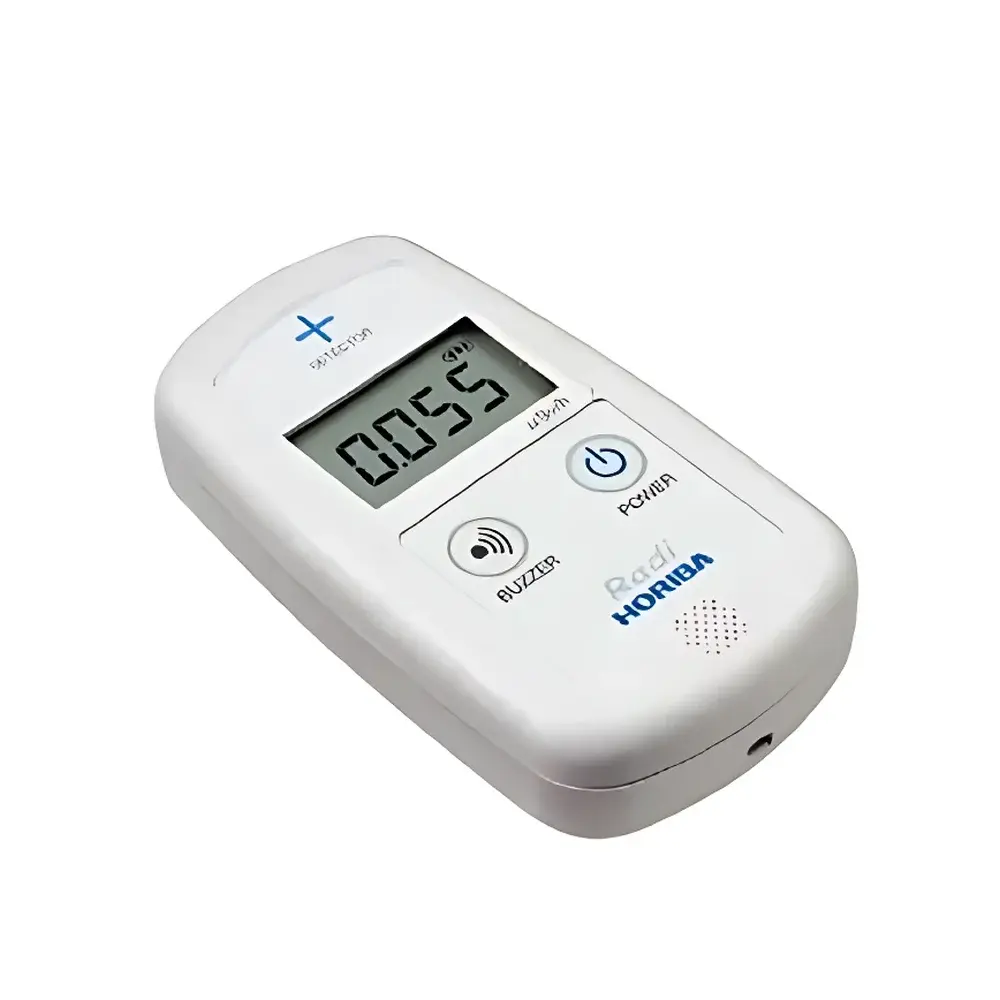
HORIBA PA-1000 Portable Environmental Radiation Spectrometer
| Brand | HORIBA |
|---|---|
| Origin | Japan |
| Model | PA-1000 |
| Instrument Type | Gamma Spectrometer |
| Measurement Range | 0.001–9.999 µSv/h |
| Sampling Time | 60 s |
| Accuracy | ±10% |
| Dimensions | 68 × 28 × 121 mm (W×D×H) |
| Weight | 175 g (without batteries) |
| IP Rating | IP40 |
Overview
The HORIBA PA-1000 Portable Environmental Radiation Spectrometer is a compact, handheld gamma-ray spectrometer engineered for rapid, field-deployable environmental radiation monitoring. Utilizing a high-sensitivity scintillation detector coupled with embedded pulse-height analysis firmware, the PA-1000 performs real-time energy discrimination to deliver dose rate measurements traceable to calibrated gamma-emitting nuclides (e.g., 137Cs, 60Co). Unlike basic Geiger-Müller counters, the PA-1000 implements spectral processing logic to suppress background fluctuations and improve measurement stability—critical for low-dose-rate environments such as post-incident soil surveys, routine nuclear facility perimeters, or public infrastructure screening. Its design prioritizes operational simplicity without compromising metrological integrity: intuitive one-button operation, auto-ranging detection, and immediate µSv/h readout eliminate dependency on operator radiological training while maintaining compliance with IEC 60846-1:2014 requirements for portable ambient dose equivalent rate meters.
Key Features
- Ultra-compact form factor (68 × 28 × 121 mm) and lightweight construction (175 g without batteries) enable extended handheld use during site inspections, emergency response, or mobile survey campaigns.
- IP40-rated enclosure provides protection against solid objects ≥1 mm and limited ingress of vertically falling water—suitable for outdoor deployment in light rain or dusty conditions typical of field-based environmental sampling.
- Fixed 60-second integration period ensures statistically robust counting statistics across the full 0.001–9.999 µSv/h range, balancing measurement speed with uncertainty control per ISO 4037-3:2019 guidance on reference radiation fields.
- On-device display with backlight supports daylight-readable operation; numerical readout includes real-time dose rate, accumulated dose, and status indicators for battery level and measurement completion.
- Low-power CMOS-based electronics extend operational runtime using standard AA alkaline cells—no proprietary battery packs required—reducing logistical overhead in remote or austere settings.
Sample Compatibility & Compliance
The PA-1000 is optimized for ambient gamma radiation measurement in unshielded environmental matrices—including soil surfaces, concrete structures, air-exposed equipment, and open-area ground scans. It does not require sample preparation, physical contact, or external calibration sources during routine operation. The instrument complies with international standards governing portable radiation monitoring devices: IEC 60846-1:2014 (performance requirements for ambient and directional dose equivalent rate meters), IEC 62327:2017 (handheld instruments for detection and identification of radionuclides), and JIS Z 4333:2019 (Japanese Industrial Standard for portable radiation survey meters). While not intended for alpha/beta particle detection or neutron monitoring, its spectral response is validated against 137Cs (662 keV) and 60Co (1.17/1.33 MeV) reference fields, supporting traceability to national metrology institutes (e.g., NMIJ/AIST in Japan).
Software & Data Management
Data export is supported via USB interface to host PC running HORIBA-supplied configuration and reporting software (Windows-compatible). The software enables firmware updates, user-defined alarm thresholds (e.g., configurable dose rate alerts), and generation of time-stamped CSV logs compliant with ALARA documentation protocols. Audit trail functionality records operator ID, measurement timestamp, GPS coordinates (when paired with optional Bluetooth GNSS module), and instrument serial number—facilitating adherence to ISO/IEC 17025:2017 documentation requirements and internal quality assurance procedures. No cloud connectivity or proprietary subscription services are embedded; all data remains under direct user control and conforms to GDPR and HIPAA-compliant storage practices when deployed in regulated environments.
Applications
- Routine environmental surveillance around nuclear power plants, research reactors, and radioactive waste storage facilities.
- Post-accident radiological mapping following incidents involving orphan sources or transportation breaches.
- Verification of decontamination efficacy in remediated land or building interiors prior to reoccupation.
- Regulatory compliance checks for local municipalities conducting public space radiation baseline studies.
- Educational use in university health physics laboratories for hands-on demonstration of gamma spectroscopy fundamentals and dose rate concepts.
FAQ
Does the PA-1000 identify specific radionuclides?
No—the PA-1000 is a spectrally enhanced dose rate meter, not a full-resolution gamma spectrometer. It uses coarse energy binning to improve accuracy over GM-based instruments but does not provide nuclide-specific identification or isotopic quantification.
Is annual recalibration required?
Yes. HORIBA recommends traceable recalibration every 12 months at an accredited laboratory using certified 137Cs and 60Co sources to maintain stated ±10% accuracy and ensure continuity with national standards.
Can the device operate in extreme temperatures?
The specified operating range is 0 °C to +40 °C. Performance outside this range is not characterized, and condensation or thermal drift may affect long-term stability.
What battery life can be expected during continuous use?
With two AA alkaline cells, typical continuous operation exceeds 20 hours at room temperature. Battery depletion is indicated visually and audibly prior to shutdown.
Is the PA-1000 suitable for personal dosimetry?
No—it measures ambient dose equivalent rate (H*(10)), not personal dose equivalent (Hp(10)). It is not worn on the body and does not meet IEC 61526:2010 requirements for personal electronic dosimeters.







