
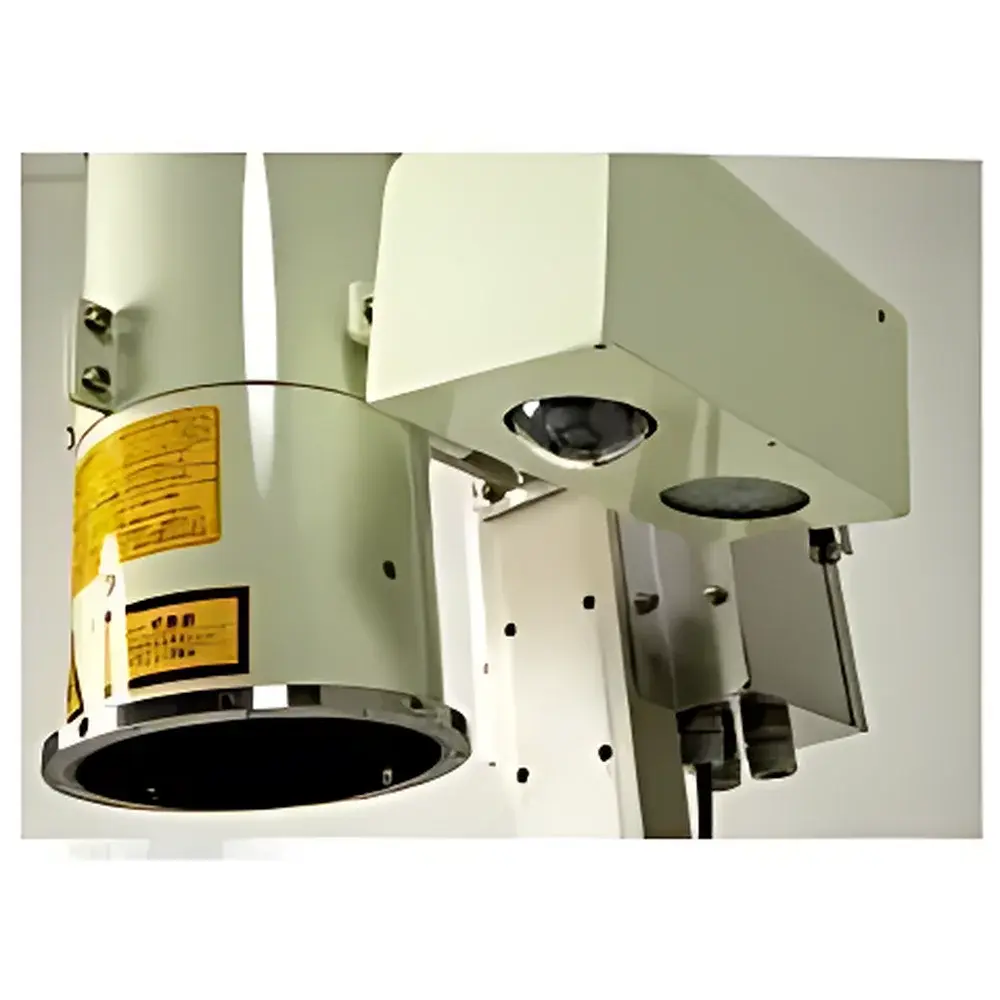
HORIBA LO-300 Online Oil Film Monitor
| Brand | HORIBA |
|---|---|
| Origin | Japan |
| Model | LO-300 |
| Detection Principle | Laser Circular Area Scanning Reflectometry |
| Detection Range | 0.3–4.0 m (up to 6.0 m on still water) |
| Protection Rating | IP66 |
| Power Supply | AC 100 V ±10%, 50/60 Hz, ≤100 VA |
| Operating Temperature | −10 to +50 °C |
| Dimensions | Ø185 × 547 mm (H) |
| Weight | ~11 kg |
| Output | 4–20 mA analog (reflected light intensity), 2 dry contact alarms (oil film presence, system fault) |
| Display | Color touchscreen showing oil coverage (%), threshold level, real-time signal level, and status indicators |
| Optional Video Recording | MP4 format, up to 3 fps, 6 MB per event (pre- and post-alarm), LED-illuminated night operation, LAN-enabled remote monitoring |
Overview
The HORIBA LO-300 Online Oil Film Monitor is an industrial-grade, non-contact optical sensing system engineered for continuous, real-time detection of hydrocarbon-based oil films on water surfaces or flat industrial substrates. Unlike conventional fluorescence- or infrared-based analyzers, the LO-300 employs a Class 2 semiconductor laser (≤1 mW) in a rotating circular scanning configuration to project a uniform annular beam across the target area. The system analyzes spatially resolved reflectance patterns—specifically changes in specular and diffuse reflection signatures induced by thin oil layers—to quantify surface coverage percentage without physical sampling or reagents. Its design targets high-reliability deployment in wastewater treatment outfalls, refinery effluent channels, stormwater retention basins, and marine terminal berths where regulatory compliance (e.g., ISO 9377-2, ASTM D7066) mandates early leak detection and forensic traceability. The instrument operates independently of water turbidity, suspended solids, or dissolved organics—key limitations of absorption- or UV-based methods—making it uniquely suited for harsh, unfiltered discharge environments.
Key Features
- Laser-based circular area scanning eliminates wave-induced false positives by integrating reflection data over a 360° azimuthal profile—ensuring stable detection even under moderate surface agitation.
- Auto-vertical alignment mechanism simplifies field installation; optical axis self-calibration compensates for minor mounting deviations (±3° tolerance).
- Extended detection range: 0.3–4.0 m standard; up to 6.0 m on calm, non-turbulent water surfaces—reducing infrastructure requirements for elevated mounting structures.
- Configurable multi-parameter alarm logic: users define threshold coverage (%), minimum persistence duration (e.g., ≥5 seconds), and hysteresis to suppress transient artifacts.
- IP66-rated sealed enclosure enables direct outdoor installation without climate-controlled housings; corrosion-resistant aluminum housing withstands coastal and industrial atmospheres.
- Integrated color touchscreen interface supports multilingual menu navigation, real-time visualization of reflectance intensity (4–20 mA), and dynamic oil coverage bar graphs with user-defined scaling.
Sample Compatibility & Compliance
The LO-300 detects floating or adherent hydrocarbon films—including gasoline, kerosene, diesel, heavy fuel oil, insulating oil, and lubricants—with sensitivity to monolayer-thick films (sub-micron equivalent). It does not respond to water-soluble oils (e.g., emulsified cutting fluids) or surfactant-laden effluents, ensuring specificity in complex discharge matrices. Regulatory alignment includes support for EPA Method 1664B (oil & grease) verification workflows, ISO 9377-2 Annex A (surface film monitoring), and EU Water Framework Directive (WFD) reporting thresholds. When equipped with the optional surveillance camera module, video capture meets GLP documentation standards: time-stamped MP4 files (H.264 encoding), embedded metadata (UTC timestamp, system ID, alarm trigger context), and secure LAN-based retrieval for audit trails.
Software & Data Management
The LO-300 operates autonomously but integrates seamlessly into plant-wide SCADA and DCS networks via isolated 4–20 mA analog output and two programmable relay contacts. Optional Ethernet connectivity enables remote configuration, firmware updates, and live video streaming through standard HTTP/RTSP protocols. Local storage retains up to 100 alarm-triggered video clips (6 MB each, 3 fps, 10-second pre/post window); clips are automatically timestamped and indexed. All operational logs—including calibration events, alarm acknowledgments, and power cycle history—are stored internally with configurable retention periods (default: 30 days). Data export supports CSV-formatted trend logs for third-party LIMS or environmental reporting platforms.
Applications
- Real-time monitoring of final effluent discharge points at municipal wastewater treatment plants to prevent non-compliant oil releases.
- Continuous surveillance of cooling water return channels in thermal power stations and petrochemical facilities.
- Early warning detection at refinery tank farm bund walls and loading rack containment areas.
- Compliance verification for MARPOL Annex I discharge monitoring on offshore platforms and vessel bilge management systems.
- Leak detection in underground storage tank (UST) secondary containment sumps where visual inspection is impractical.
FAQ
Does the LO-300 require routine optical cleaning or consumables?
No—its non-contact design eliminates immersion probes, filters, or reagent cartridges. Periodic lens inspection (every 6–12 months) is recommended in high-dust or salt-laden environments.
Can it distinguish between oil and other surface contaminants like algae or foam?
Yes—the laser reflectance signature of hydrocarbon films differs spectrally and spatially from biological scums or detergent foams. Multi-point scanning and persistence logic further reduce misclassification.
Is the system compatible with explosion-proof zones?
The base LO-300 is rated for general industrial use (IP66). For Zone 1/21 hazardous locations, consult HORIBA’s certified ATEX/IECEx variants (e.g., LO-300-EX series), which incorporate intrinsic safety barriers and encapsulated optics.
How is calibration performed?
Field calibration uses reference oil films of known thickness applied to test panels; factory calibration is traceable to NIST-standard reflectance standards. No daily recalibration is required—drift is <±0.5% FS/year.
What cybersecurity measures are implemented for LAN-connected units?
Firmware v2.1+ supports TLS 1.2 encryption, role-based access control (admin/operator/guest), and disabled default credentials—meeting IEC 62443-3-3 SL2 baseline requirements for industrial networked devices.







