
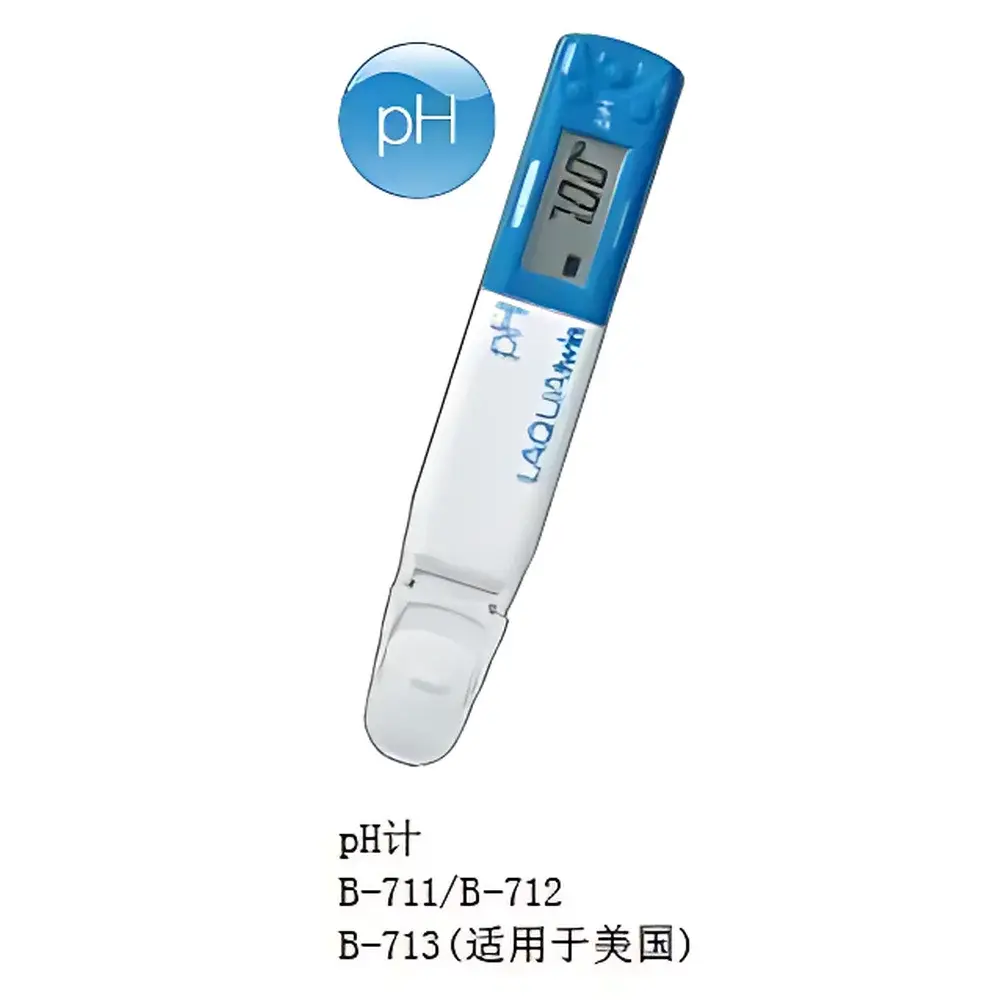
HORIBA LAQUAtwin B-711/B-712 Portable Pocket pH Meter
| Brand | HORIBA |
|---|---|
| Origin | Japan |
| Model | B-711 / B-712 |
| Portability | Pen-type |
| Measurement Principle | Glass electrode method |
| pH Range | 2.0–12.0 |
| Calibration | B-711 — single-point |
| Accuracy | ±0.1 pH (after calibration, repeatability in standard buffer) |
| Resolution | 0.1 pH |
| Temperature Range | 5–40 °C |
| Temperature Compensation | Automatic (NTC thermistor) |
| IP Rating | IP67 (dust-tight |
| Sample Volume | ≥0.05 mL (with optional sampling film B) or ≥0.1 mL (standard) |
| Power | Two CR2032 lithium batteries |
| Dimensions (L×W×H) | 164 × 29 × 20 mm (excl. protrusions) |
| Weight | ~50 g (instrument only, excl. batteries) |
Overview
The HORIBA LAQUAtwin B-711 and B-712 are compact, handheld pocket pH meters engineered for rapid, field-deployable, and laboratory-adjacent pH measurement under resource-constrained or high-throughput conditions. Based on the proven glass electrode measurement principle—compliant with ISO 3696, ASTM D1293, and USP —these instruments deliver traceable, reproducible pH data without requiring bulky benchtop infrastructure. Unlike conventional combination electrodes, the LAQUAtwin series integrates a planar glass sensing surface optimized for micro-volume analysis, enabling reliable readings from as little as 0.05 mL of sample when used with the optional sampling film B. This design eliminates air bubble entrapment and minimizes junction potential drift, supporting consistent performance across diverse aqueous matrices—including viscous, particulate-laden, or low-ionic-strength solutions—provided appropriate filtration (e.g., 0.45 µm membrane) is applied prior to measurement. The devices operate within a validated ambient temperature range of 5–40 °C and incorporate automatic temperature compensation using an integrated NTC thermistor, referenced to the standard 25 °C pH scale.
Key Features
- Micro-sample capability: Measures accurately from ≥0.05 mL (with sampling film B) or ≥0.1 mL (standard mode), reducing reagent consumption and waste generation.
- Intuitive one-touch operation: Single-button activation initiates calibration or measurement; visual confirmation via smiley-face icon ensures readiness before data capture.
- Ruggedized industrial design: IP67-rated enclosure provides full protection against dust ingress and transient water immersion (1 m depth, 30 min), meeting IEC 60529 requirements for harsh or outdoor environments.
- Optimized electrode architecture: Flat-surface glass electrode minimizes surface contamination, improves response time (<15 s to 95% stability), and enhances long-term drift stability compared to conventional bulb-type sensors.
- Low-power, maintenance-free operation: Powered by two replaceable CR2032 coin-cell batteries with typical service life exceeding 5,000 measurements per set.
- Ergonomic form factor: Cylindrical pen-style housing (164 × 29 × 20 mm, ~50 g) enables single-hand use, pocket storage, and integration into mobile QA/QC workflows.
Sample Compatibility & Compliance
The B-711/B-712 supports measurement of clear, filtered aqueous samples with conductivity >50 µS/cm. For turbid, colloidal, or suspended-solid-containing samples, pre-filtration through a 0.45 µm hydrophilic membrane is required to prevent clogging and ensure junction integrity. These meters are not intended for non-aqueous solvents, highly viscous oils, or strongly oxidizing media (e.g., >10% HNO₃). Regulatory alignment includes support for GLP-compliant documentation via external logging (no onboard memory), adherence to ISO/IEC 17025 traceability frameworks when paired with NIST-traceable buffers, and compatibility with routine audit requirements under FDA 21 CFR Part 11 when used in conjunction with validated third-party data capture systems.
Software & Data Management
The LAQUAtwin B-711/B-712 operates as a standalone instrument with no embedded memory, USB interface, or Bluetooth connectivity. All measurements are displayed in real time on a high-contrast LCD screen with automatic hold function—freezing the stabilized reading upon signal convergence. While the device itself does not store historical data, its deterministic output format (pH value + temperature) facilitates manual transcription into LIMS or ELN platforms. For automated traceability, users may integrate these meters into validated workflows using external barcode-scanned buffer identification and timestamped manual entry, satisfying basic ALCOA+ (Attributable, Legible, Contemporaneous, Original, Accurate) principles under GxP environments.
Applications
- Field-based environmental monitoring: Rapid pH screening of freshwater streams, wastewater effluents, and soil leachates during site assessments.
- Food & beverage QC: Spot-checking pH of sauces, dairy products, fruit juices, and brines where minimal sample volume and portability are critical.
- Hydroponics & agriculture: On-site nutrient solution monitoring to maintain optimal root-zone pH (5.5–6.5) for crop yield consistency.
- Educational laboratories: Student experiments requiring robust, low-cost, and intuitive instrumentation for fundamental electrochemical concepts.
- Pharmaceutical manufacturing: In-process checks of buffer preparations and cleaning validation rinse waters per USP and EP 2.2.3.
FAQ
What is the minimum sample volume required for accurate measurement?
With the optional sampling film B installed and the light-shield cap closed, the instrument achieves reliable results from ≥0.05 mL. Without the film, ≥0.1 mL is required.
Can the B-711/B-712 be calibrated in the field without dedicated equipment?
Yes—both models support manual single-point (B-711) or selectable single/dual-point (B-712) calibration using standard pH 4.01, 7.00, and/or 10.01 NIST-traceable buffer solutions at ambient temperature.
Is temperature compensation adjustable or fixed?
Automatic temperature compensation is fixed at the standard 2 °C⁻¹ coefficient per pH unit, conforming to DIN 19263 and ISO 10523 for general-purpose aqueous measurements.
Does the IP67 rating permit underwater operation?
No—the IP67 rating certifies resistance to temporary submersion (1 m, 30 min), but active measurement underwater is prohibited due to electrical safety and sensor hydration constraints.
How often should the electrode be cleaned or regenerated?
Routine cleaning with deionized water after each use is sufficient; for protein- or lipid-fouled samples, soak the tip in 0.1 M HCl for 5 min followed by thorough rinsing. Electrode lifespan typically exceeds 12 months under proper storage (in 3 M KCl solution) and usage conditions.





