
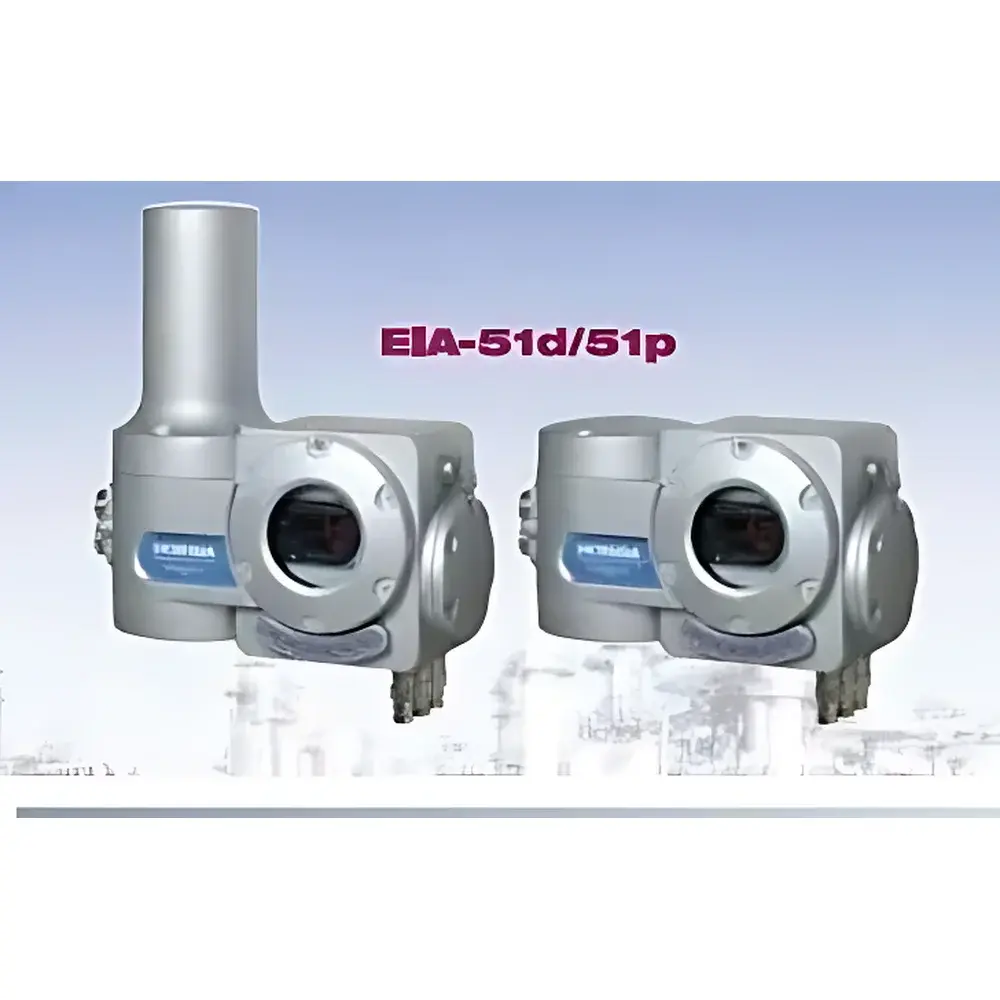
HORIBA EIA-51d / EIA-51p Explosion-Proof NDIR Gas Analyzer
| Brand | HORIBA |
|---|---|
| Origin | Japan |
| Model | EIA-51d / EIA-51p |
| Explosion Protection | Ex d IIB+H2 T4 (EIA-51d) / Ex p II T4X (EIA-51p) |
| Measurement Principle | Interference-Corrected Non-Dispersive Infrared (NDIR) Absorption |
| Measurands | CO, CO₂, CH₄ (configurable per application) |
| Range Options | 0–0.11 vol% to 0–100 vol% (CO/CO₂), 0–50 ppm to 0–2000 ppm (CH₄) |
| Repeatability | ±0.5% F.S. (standard range) |
| Linearity | ±1.0% F.S. |
| Zero & Span Drift | ±2.0% F.S./week |
| Response Time (T90) | ≤20 s (standard), ≤40 s (extended range) |
| Sample Flow | 500 mL/min |
| Sample Pressure | ≥1.98 kPa |
| Operating Ambient | –5 to 40 °C, ≤90% RH |
| Analog Output | Isolated 4–20 mA (DC), optional 0–10 V / Modbus-RTU over RS-485 |
| Wetted Materials | SUS304, SUS316, FKM, CaF₂, Au |
| Purge Gas | N₂, 196–690 kPa, 0.5–10 L/min |
Overview
The HORIBA EIA-51d and EIA-51p are certified explosion-proof gas analyzers engineered for continuous, reliable measurement of combustible gases—including carbon monoxide (CO), carbon dioxide (CO₂), and methane (CH₄)—in hazardous areas classified under IEC 60079 standards. These instruments employ interference-corrected non-dispersive infrared (NDIR) absorption spectroscopy, a robust optical technique that mitigates spectral interference from co-existing gases, optical drift, and mechanical disturbances. Unlike conventional single-detector NDIR systems, the interference-corrected architecture integrates parallel measurement and reference detectors within a shared optical path—enabling real-time compensation for background absorption, source aging, cell contamination, and vibration-induced signal fluctuation. This design ensures metrological stability in demanding industrial process environments where safety integrity and analytical fidelity are non-negotiable. The EIA-51d conforms to Ex d IIB+H₂ T4 protection (flameproof enclosure), while the EIA-51p implements Ex p II T4X pressurized protection—both rated for use in Zone 1 and Zone 2 hazardous locations outside mining applications.
Key Features
- IEC 60079-compliant explosion protection: Ex d IIB+H₂ T4 (EIA-51d) and Ex p II T4X (EIA-51p), certified for operation in flammable gas atmospheres including H₂ and ethylene-class environments
- Interference-corrected NDIR optics with dual-detector configuration—minimizes cross-sensitivity to water vapor, hydrocarbons, and other IR-active interferents
- High-stability measurement performance: repeatability ±0.5% F.S., linearity ±1.0% F.S., zero/span drift ≤±2.0% F.S./week
- Fast response time: T90 ≤20 seconds for standard ranges; configurable extended ranges (T90 ≤40 s) for ultra-low or high-concentration monitoring
- Chemically resistant wetted materials: SUS304/SUS316 stainless steel, gold-coated optical surfaces, FKM seals, and calcium fluoride (CaF₂) windows for long-term corrosion resistance
- Flexible analog output: isolated 4–20 mA current loop (standard), with optional voltage outputs (0–1 V, 0–5 V, 1–5 V, 0–10 V) and programmable alarm thresholds (–10% to +110% of full scale)
- Modbus-RTU communication via RS-485 interface (optional), supporting baud rates from 1200 to 19200 bps for integration into DCS, SCADA, or PLC-based control systems
Sample Compatibility & Compliance
The EIA-51d and EIA-51p are designed for continuous analysis of dry, dust-free sample streams with oxygen concentration ≤21% (v/v) and pressure ≥1.98 kPa. Sample flow is maintained at 500 mL/min, and inlet temperature must remain within ambient operating limits (–5 to 40 °C). Both models comply with international hazardous area certification requirements: IEC 60079-1 (flameproof “d”) and IEC 60079-2 (pressurized “p”), as well as ATEX 2014/34/EU directives. They meet functional safety expectations for SIL 2-capable systems when deployed with appropriate safety instrumented systems (SIS), and support traceability under ISO/IEC 17025-accredited calibration protocols. All electrical interfaces—including analog outputs and optional digital communications—are galvanically isolated to prevent ground-loop interference and ensure EMC compliance per IEC 61326-1.
Software & Data Management
While the EIA-51d/51p operate as standalone hardware analyzers without embedded graphical software, their analog and digital interfaces enable seamless integration into enterprise-level data infrastructure. The 4–20 mA output supports direct connection to distributed control systems (DCS) or programmable logic controllers (PLC) with built-in linearization and alarm handling. Optional Modbus-RTU communication allows remote parameter configuration, real-time concentration readouts, diagnostic status reporting (e.g., lamp health, detector signal-to-noise ratio), and event logging—including zero/span calibration timestamps and fault codes. When integrated with validated data acquisition platforms compliant with FDA 21 CFR Part 11, the system supports audit trails, electronic signatures, and secure data archiving—meeting GLP and GMP documentation requirements for regulated manufacturing environments such as pharmaceutical cleanrooms or chemical production facilities.
Applications
These analyzers serve critical safety and process optimization roles across multiple sectors. In petrochemical refineries and natural gas processing plants, they monitor flare gas composition, syngas ratios, and vent stack emissions—ensuring compliance with EPA Method 21 and ISO 14064-1 greenhouse gas reporting. In biogas upgrading facilities, the EIA-51p tracks CH₄ purity post-membrane separation, while the EIA-51d verifies CO₂ removal efficiency in amine scrubbers. Semiconductor fabrication fabs deploy them for inert purge gas monitoring (e.g., N₂ lines containing trace CO), and hydrogen fueling stations utilize their H₂-compatible IIB+H₂ rating for leak detection in compression and storage zones. Additional use cases include landfill gas recovery, fermentation off-gas analysis in bioethanol plants, and combustion efficiency tuning in industrial boilers—where precise, intrinsically safe CO/CO₂ feedback enables dynamic air-fuel ratio control.
FAQ
What explosion protection categories do the EIA-51d and EIA-51p support?
The EIA-51d is certified Ex d IIB+H₂ T4 (flameproof), suitable for Group IIB gases (e.g., acetone, ethylene) and hydrogen. The EIA-51p carries Ex p II T4X (pressurized), approved for general-purpose Zone 1/2 areas with T4 temperature class.
Can the analyzer measure multiple gases simultaneously?
No—each unit is configured for a single target gas (CO, CO₂, or CH₄) at time of order. Multi-component capability requires separate analyzers or a custom multi-channel system.
Is automatic zero/span calibration available?
Manual calibration is standard; automatic calibration is offered as an optional module requiring external solenoid valves and certified span gas cylinders.
What sample conditioning is required upstream of the analyzer?
A dedicated sample probe, particulate filter, moisture trap (e.g., Nafion dryer), and pressure regulator are mandatory. HORIBA recommends using nitrogen purge gas (0.5–10 L/min) to maintain positive internal pressure in pressurized enclosures.
Does the analyzer support FDA 21 CFR Part 11 compliance?
The hardware itself does not implement Part 11 controls; however, its Modbus-RTU output and analog signals can be ingested by validated third-party software platforms that provide electronic signature, audit trail, and role-based access management.
Related Products







