
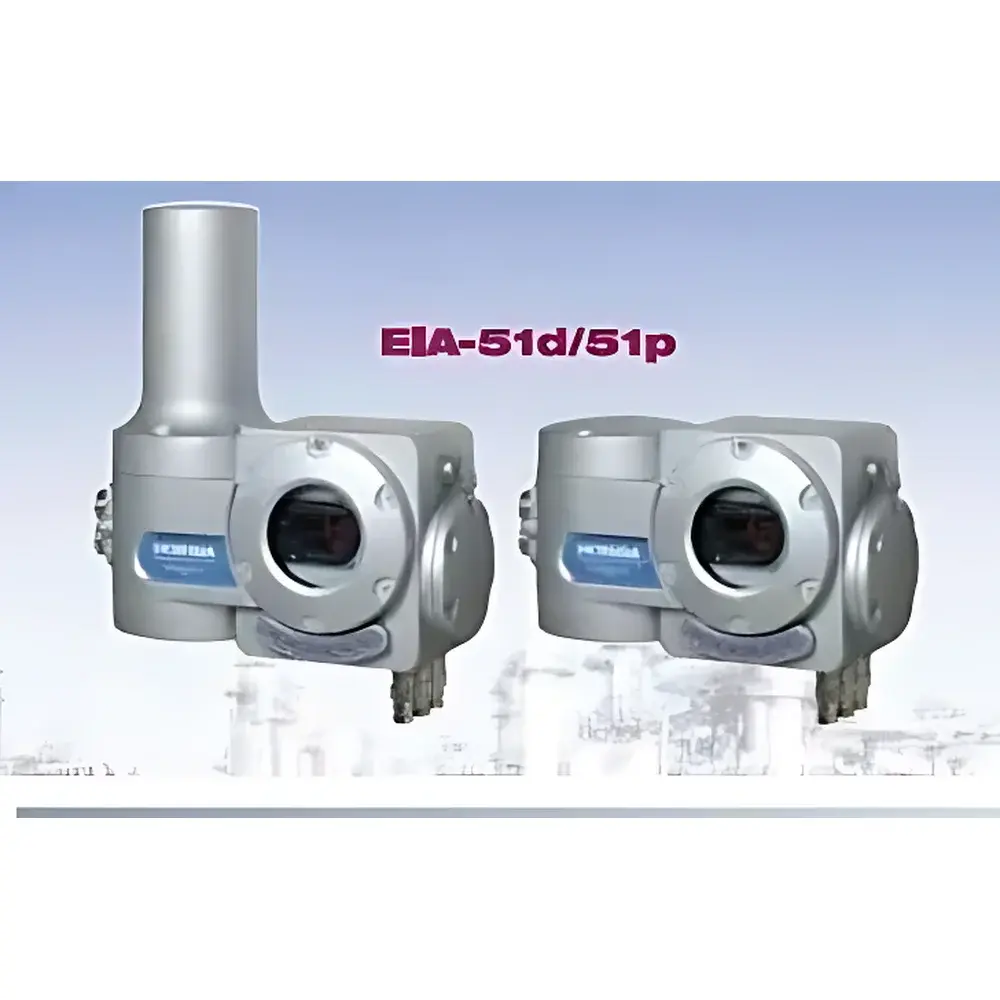
HORIBA EIA-51d & EIA-51p Explosion-Proof Infrared Gas Analyzers
| Brand | HORIBA |
|---|---|
| Origin | Japan |
| Model | EIA-51d, EIA-51p |
| Explosion Protection | Ex d IIB+H2 T4 (EIA-51d) / Ex p II T4X (EIA-51p) |
| Measurement Principle | Non-Dispersive Infrared (NDIR) with Interference Compensation |
| Detectable Gases | CO, CO₂, CH₄ (configurable) |
| Range | 0–0.11 vol% to 0–100 vol% (gas-dependent) |
| Minimum Detection Limit | 0–50 ppm (gas-dependent) |
| Repeatability | ±0.5% FS (standard range) |
| Linearity | ±1.0% FS |
| Zero/Scale Drift | ±2.0% FS/week |
| Response Time (T90) | ≤20 s (standard), ≤40 s (optional ranges) |
| Sample Flow | 500 mL/min |
| Sample Pressure | ≥1.98 kPa |
| Operating Ambient | –5 to +40 °C, RH ≤90%, vibration ≤0.3 m/s² @ 100 Hz |
| Analog Output | Isolated 4–20 mA (DC), optional 0–10 V / 1–5 V |
| Communication | RS-485, Modbus RTU (selectable baud rates: 1200–19200 bps) |
| Sample Contact Materials | SUS304, SUS316, FKM, CaF₂, Au |
| Purge Gas | N₂, 196–690 kPa, 0.5 L/min (operational), 10 L/min (purge) |
Overview
The HORIBA EIA-51d and EIA-51p are certified explosion-proof infrared gas analyzers engineered for continuous, reliable measurement of combustible gases—including carbon monoxide (CO), carbon dioxide (CO₂), and methane (CH₄)—in hazardous industrial environments. Based on non-dispersive infrared (NDIR) spectroscopy with proprietary interference compensation technology, these analyzers deliver high selectivity and stability even in complex sample matrices containing interfering background gases (e.g., water vapor, hydrocarbons, or other IR-active species). Unlike conventional single-detector NDIR systems, the EIA-51 series employs a dual-detector optical architecture: one detector measures target gas absorption at the characteristic wavelength, while the second—positioned within the same optical path—monitors spectral interference and system drift in real time. This design actively corrects for signal artifacts induced by optical aging, mechanical vibration, thermal fluctuation, and cross-sensitivity, ensuring long-term measurement integrity without frequent recalibration.
Key Features
- Two certified explosion-protection variants: EIA-51d (flameproof / Ex d IIB+H2 T4) for zone 1/21 applications; EIA-51p (pressurized enclosure / Ex p II T4X) for zone 1/21 and zone 2/22 installations requiring higher operational flexibility.
- Interference-compensated NDIR optics providing enhanced accuracy in mixed-gas streams where conventional analyzers suffer from spectral overlap or baseline instability.
- Ruggedized sample interface with corrosion-resistant wetted materials (SUS304/SUS316 stainless steel, gold-coated optical components, FKM seals, and CaF₂ windows) suitable for aggressive process environments.
- Configurable analog output (4–20 mA standard; optional 0–10 V, 1–5 V) with programmable alarm thresholds spanning –10% to +110% of full scale.
- RS-485 digital interface supporting Modbus RTU protocol with selectable baud rates (1200–19200 bps) for integration into DCS, SCADA, or centralized asset monitoring platforms.
- Manual zero/span calibration standard; optional automatic calibration module available for unattended operation in remote or high-risk locations.
Sample Compatibility & Compliance
The EIA-51d and EIA-51p are validated for use with dry, dust-free sample streams containing ≤21% oxygen and no condensable moisture. Sample pressure must exceed 1.98 kPa (absolute), with a nominal flow rate of 500 mL/min. For optimal performance and sensor longevity, nitrogen purge gas (196–690 kPa, 0.5 L/min during operation; 10 L/min during purging) is recommended. Both models comply with IEC 60079-0 (general requirements for explosive atmospheres) and IEC 60079-1 (flameproof enclosures) or IEC 60079-2 (pressurized enclosures), meeting international certification requirements for Group IIB+H2 (EIA-51d) and Group II (EIA-51p) equipment. Temperature class T4 ensures surface temperatures remain below 135 °C under worst-case operating conditions. The instruments support audit-ready operation when paired with external data loggers compliant with FDA 21 CFR Part 11 and GLP/GMP traceability frameworks.
Software & Data Management
While the EIA-51 series operates as a standalone hardware analyzer without embedded software, its Modbus RTU interface enables seamless integration with third-party supervisory systems. All analog and digital outputs include timestamped, linearized concentration values referenced to user-defined engineering units (e.g., % vol, ppm). The 4–20 mA output incorporates built-in fault detection (e.g., open-circuit, over-range) and supports HART-compatible smart diagnostics when interfaced via compatible I/O modules. Optional configuration tools allow users to define alarm hysteresis, response delay filters, and range switching logic—all stored in non-volatile memory. No firmware updates require physical access; configuration changes are performed remotely via Modbus register writes, reducing downtime and enhancing safety during maintenance cycles.
Applications
These analyzers are deployed across industries where personnel safety, regulatory compliance, and process continuity are critical: biogas upgrading facilities (CH₄/CO₂ ratio control), syngas monitoring in chemical synthesis reactors, landfill gas flare management, hydrogen production units (H₂/CO monitoring), coal mine ventilation shafts (CO detection), and solvent recovery systems handling volatile organic compounds. Their certified protection type makes them suitable for installation directly on pipelines, ducts, or reactor exhaust stacks in Zone 1 (gas) and Zone 21 (dust) classified areas per IEC 60079-10-1 and IEC 60079-10-2. The interference compensation capability is especially valuable in applications involving flue gas recirculation, catalytic converter effluent, or fermentation off-gas containing variable water vapor and ethanol concentrations.
FAQ
What explosion protection certifications do the EIA-51d and EIA-51p hold?
The EIA-51d complies with Ex d IIB+H2 T4 per IEC 60079-1; the EIA-51p meets Ex p II T4X per IEC 60079-2. Both are approved for use in Zone 1 and Zone 21 hazardous areas.
Can the analyzer measure multiple gases simultaneously?
No—the EIA-51 series is a single-channel analyzer configured for one target gas per unit. Multi-gas analysis requires parallel installation of dedicated analyzers or selection of HORIBA’s TIA-51 series with multi-cell optical modules.
Is automatic calibration supported?
Manual calibration is standard. An optional automatic calibration module (with solenoid valves and reference gas ports) is available for scheduled zero/span verification without manual intervention.
What is the minimum detectable concentration for CO?
The lowest configurable range is 0–50 ppm CO, with repeatability of ±0.5% FS and linearity of ±1.0% FS.
Does the instrument require carrier gas for operation?
Yes—a nitrogen purge gas supply (196–690 kPa, 0.5 L/min) is mandatory to maintain optical path integrity and prevent contamination of the measurement cell.
How is data traceability ensured for regulatory audits?
When integrated with a validated SCADA or historian system supporting electronic signatures and audit trails, the EIA-51’s analog and Modbus outputs meet GLP, GMP, and 21 CFR Part 11 requirements for raw data integrity and change control.







