
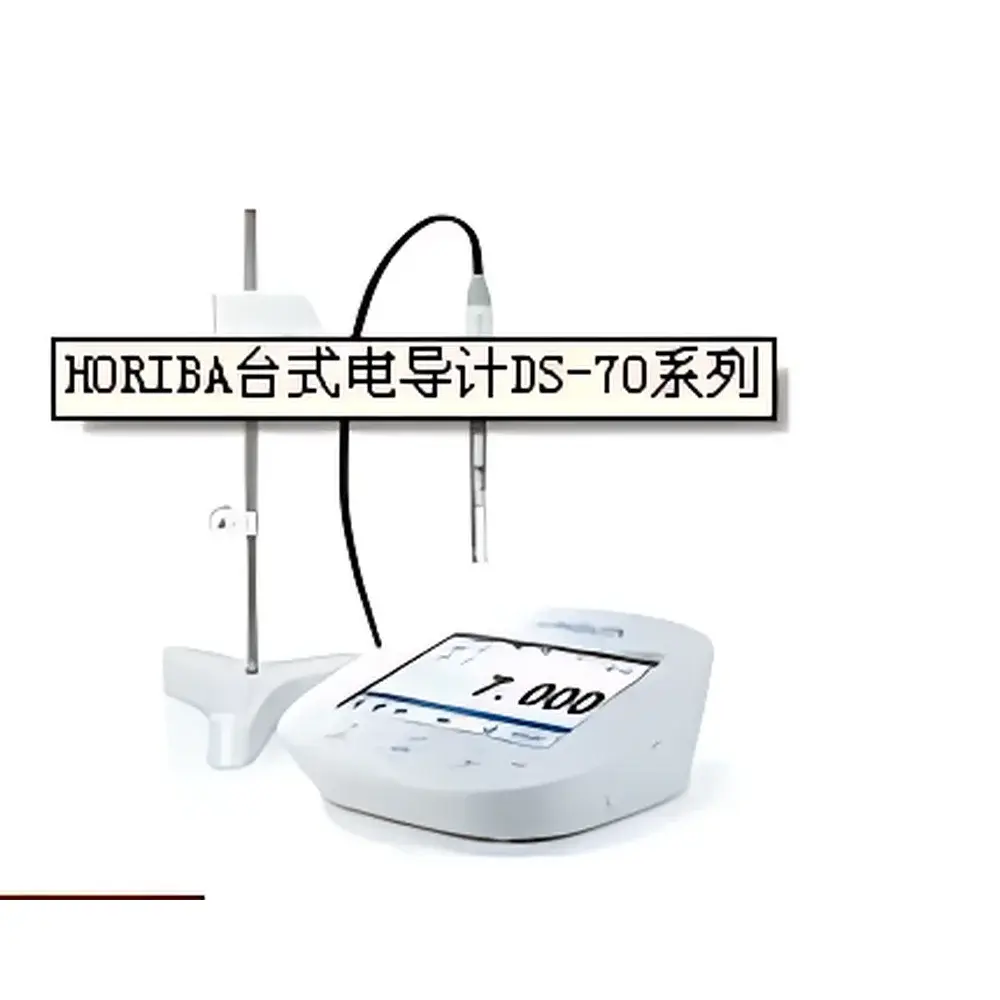
HORIBA DS-72 Benchtop Multi-Parameter Conductivity Meter with Capacitive Touchscreen
| Brand | HORIBA |
|---|---|
| Origin | Japan |
| Model | DS-72 |
| Form Factor | Benchtop |
| Conductivity Range | 0.0 µS/m – 1.999 S/m |
| TDS Range | 0.01 mg/L – 1000 g/L |
| Resistivity Range | 0.0 Ω·m – 1.999 MΩ·m |
| Salinity Range | 0.00 – 80.00 ppt |
| Temperature Range | 0.0 – 100.0 °C (extended to −30.0 – 130.0 °C) |
| Accuracy | ±0.05% F.S. |
| Resolution | 0.001 (unit-dependent) |
| Data Storage | 2000 sets |
| Compliance | JIS, USP <645>, EP 2.2.38, JP XVIII, ChP |
| Language Support | English, Japanese, Chinese, Korean |
| Power Supply | AC adapter 100–240 V, 50/60 Hz |
| Power Consumption | ~9.8 VA |
| Weight | ~700 g |
Overview
The HORIBA DS-72 is a precision-engineered benchtop multi-parameter conductivity meter designed for regulated laboratory and quality control environments where traceable, repeatable electrochemical measurements are critical. It operates on the principle of two-electrode alternating current (AC) conductometry—eliminating polarization effects and enabling stable, low-drift measurements across an exceptionally wide dynamic range. Unlike single-frequency or DC-based systems, the DS-72 applies optimized AC excitation frequencies matched to cell constant (10, 100, or 1000 m⁻¹), ensuring accurate quantification from ultrapure water (sub-µS/m) to highly conductive industrial brines (up to 1.999 S/m). Its measurement architecture supports real-time conversion of raw conductance into resistivity, salinity (in ppt), and total dissolved solids (TDS) using configurable algorithms compliant with ASTM D1125, ISO 7888, and pharmacopeial standards. The instrument is purpose-built for applications demanding adherence to Good Laboratory Practice (GLP) and Good Manufacturing Practice (GMP), including pharmaceutical water system validation, environmental monitoring, and process water qualification.
Key Features
- Capacitive touchscreen interface (4.3-inch WVGA) with intuitive, icon-driven navigation—enabling full parameter configuration, calibration guidance, and diagnostic support without external software.
- Integrated electrode health monitoring and guided calibration wizard compliant with JIS Z 8401, USP , EP 2.2.38, and JP XVIII—automatically validating cell constant, temperature compensation, and linearity prior to measurement.
- Real-time fault diagnostics with on-screen troubleshooting pathways—identifying issues such as electrode fouling, air bubbles, or temperature sensor drift and recommending corrective actions per SOP.
- Configurable measurement modes: continuous, single-shot, and timed interval logging—with auto-hold triggered by stability criteria (±0.1% over 3 sec).
- Modular electrode compatibility: supports interchangeable 2-electrode and 4-electrode cells (e.g., 9551-10D, 9552-10D) with automatic cell constant recognition via RFID or manual entry.
- Robust data integrity architecture: timestamped records include operator ID, electrode serial number, calibration history, ambient temperature, and measurement uncertainty estimates.
Sample Compatibility & Compliance
The DS-72 is validated for aqueous samples across diverse matrices—including purified water (PW), water for injection (WFI), clean-in-place (CIP) rinse solutions, wastewater effluents, and seawater analogs. Its temperature-compensated conductivity algorithm implements the DIN EN 27888 reference function (25 °C), with optional linear or non-linear (CaCl₂/NH₄Cl) compensation curves. Regulatory alignment includes full traceability to NIST-traceable conductivity standards and built-in audit trail functionality satisfying FDA 21 CFR Part 11 requirements when paired with HORIBA’s optional secure data export module. Instrument qualification documentation (IQ/OQ/PQ templates) and calibration certificates conforming to ISO/IEC 17025 are available upon request. All firmware updates undergo version-controlled release validation in accordance with ICH Q9 principles.
Software & Data Management
Data acquisition and reporting are managed via embedded firmware supporting USB 2.0 host/device connectivity. Raw datasets (CSV format) export directly to USB flash drives or Windows/macOS computers without proprietary drivers. Each stored record contains 12 metadata fields: date/time stamp, measured parameter(s), temperature, cell constant, calibration date, operator code, sample ID, electrode ID, stability flag, measurement mode, unit, and uncertainty value. Optional PC software (HORIBA LabSolutions DS) enables advanced statistical analysis (RSD, trend charts, pass/fail thresholds), automated report generation (PDF/Excel), and integration with LIMS via HL7 or CSV batch import. Audit trails are immutable and time-stamped with cryptographic hashing; deletion requires dual authorization and generates an irreversible log entry.
Applications
- Pharmaceutical water system validation per USP and EU Annex 1—monitoring PW, WFI, and pure steam condensate conductivity at multiple distribution points.
- Environmental compliance testing under EPA Method 120.1 and ISO 7888—quantifying ionic load in surface water, groundwater, and treated effluent.
- Electroplating bath control—tracking electrolyte concentration drift in nickel, copper, and chromium plating solutions.
- Food & beverage QC—verifying rinse water purity post-CIP, measuring brine strength in pickling operations, and assessing mineral content in bottled water.
- Academic research—supporting studies in membrane fouling kinetics, ion exchange resin regeneration efficiency, and colloidal stability assessment via conductivity titration.
FAQ
Does the DS-72 support 4-electrode conductivity measurement?
Yes—the DS-72 accepts optional 4-electrode cells (e.g., 9552-10D) for high-accuracy measurements in conductive or fouling-prone samples, eliminating cable resistance errors and enabling precise low-resistivity (<100 Ω·m) quantification.
How is temperature compensation implemented?
The instrument uses a Pt1000 RTD sensor with ±0.1 °C accuracy and applies either linear (default), non-linear (NH₄Cl/CaCl₂), or user-defined polynomial compensation per ISO 7888 Annex B.
Can calibration data be exported for regulatory review?
Yes—calibration logs (including standard values, measured responses, deviation reports, and technician signatures) export as signed PDFs with digital timestamps and are retained in the internal audit trail for ≥10 years.
Is GLP-compliant printing supported?
When connected to a compatible thermal printer via USB, the DS-72 generates GLP-compliant printouts containing full metadata, calibration status, and electronic signature fields—meeting FDA 21 CFR Part 11 requirements when used with HORIBA’s certified printer driver.
What electrode maintenance protocols are recommended?
HORIBA recommends daily rinsing with deionized water, weekly cleaning with mild detergent or 0.1 M HNO₃ (for scale removal), and quarterly verification against certified KCl standards; all procedures are accessible via the onboard Maintenance Navigator.




