
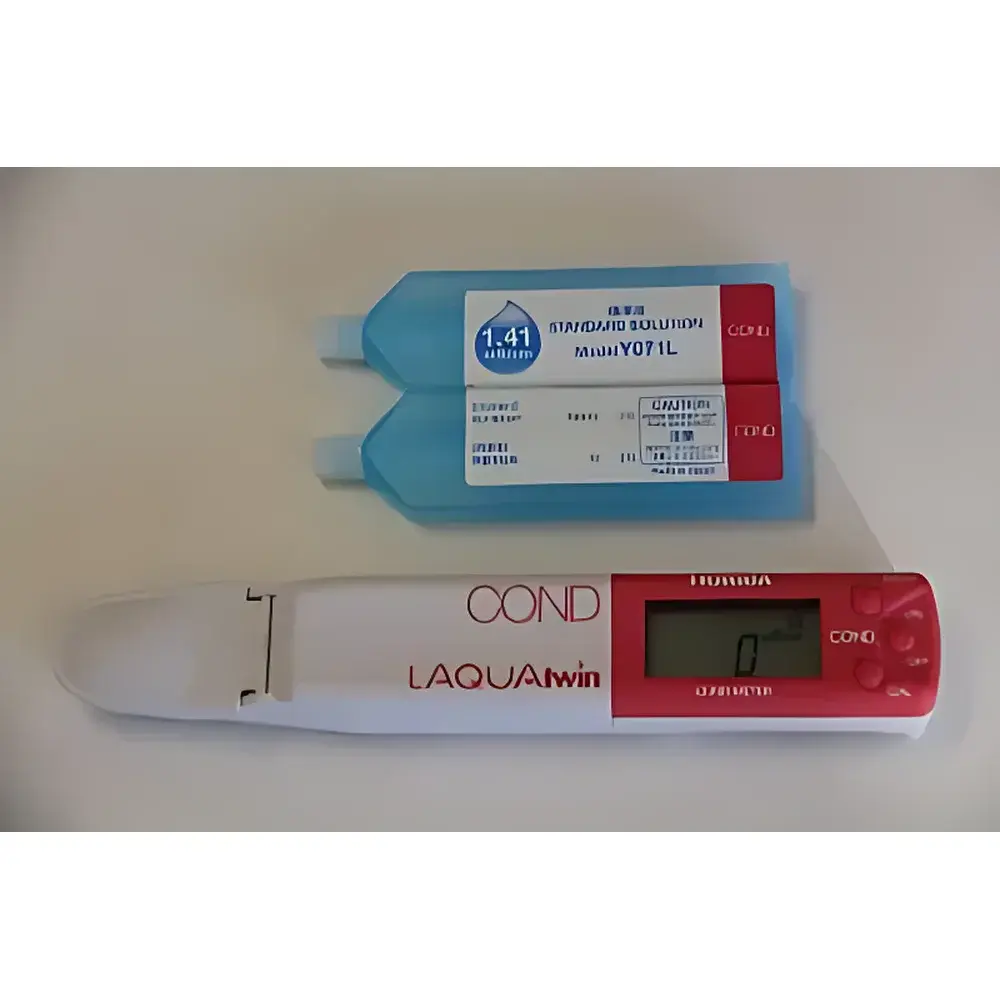
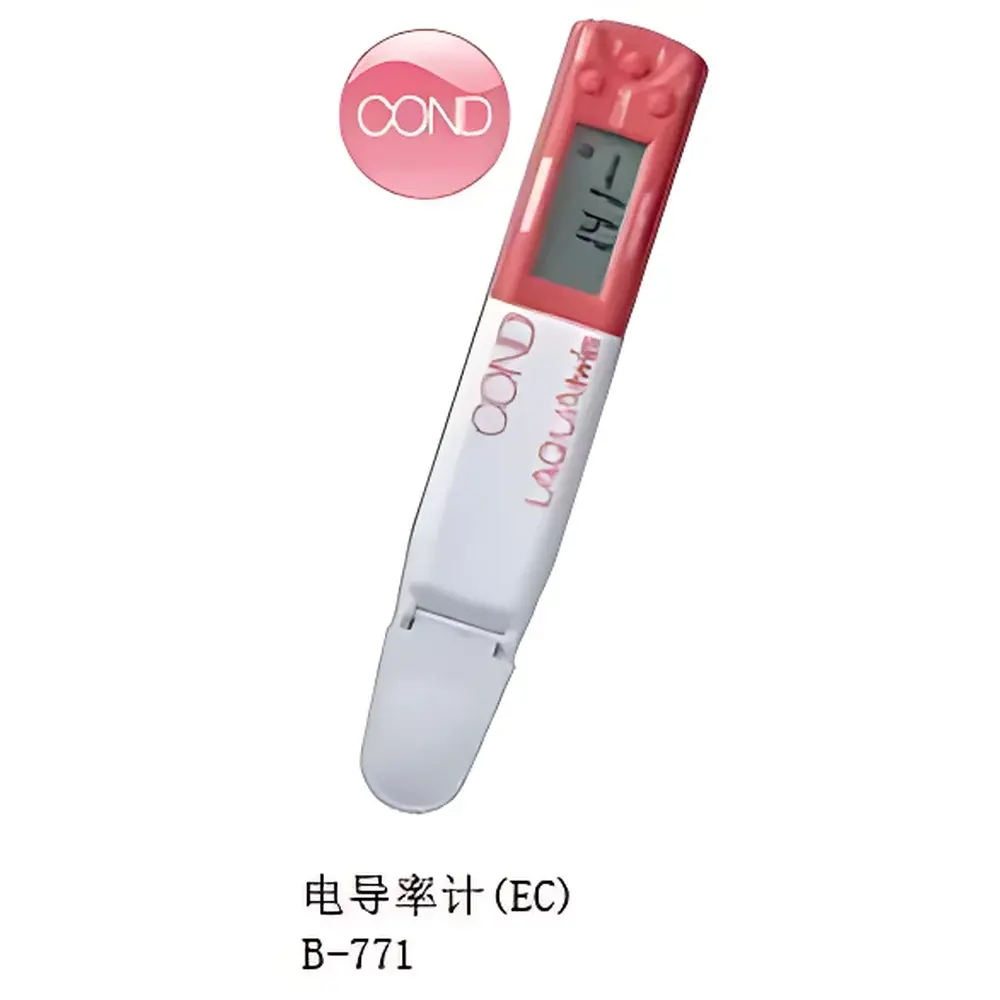
HORIBA B-771 Portable Pen-Type Conductivity Meter
| Brand | HORIBA |
|---|---|
| Origin | Japan |
| Model | B-771 |
| Measurement Principle | Two-Electrode AC Method |
| Conductivity Range | 0–19.9 mS/cm |
| TDS Range | 0–9900 ppm |
| Salinity Range | 0–1.1% (NaCl) |
| Resistivity Range | Not applicable |
| Temperature Range | 5–40 °C |
| Accuracy | ±2% FS ±1 digit (per range) |
| Resolution | 0.1 (for conductivity, TDS, salinity, temperature) |
| Temperature Compensation | Fixed 2%/°C |
| Calibration | Two-point calibration |
| Protection Rating | IP67 |
| Power Supply | Two CR2032 batteries |
| Dimensions | 164 × 29 × 20 mm (excl. protrusions) |
| Weight | Approx. 45 g (instrument only) |
Overview
The HORIBA B-771 is a compact, field-deployable pen-type conductivity meter engineered for rapid, reliable measurement of electrical conductivity (EC), total dissolved solids (TDS), and salinity in aqueous solutions. It operates on the two-electrode AC method — a robust electrochemical technique that minimizes polarization effects and ensures stable readings across variable sample conductivities. Designed for routine quality control, environmental monitoring, hydroponics, aquarium management, and educational laboratory use, the B-771 delivers traceable, reproducible results without requiring benchtop infrastructure. Its miniature form factor (164 mm × 29 mm × 20 mm) and ultra-lightweight construction (≈45 g, instrument-only) enable one-handed operation and extended field deployment. The device features automatic endpoint hold, fixed-temperature compensation (2%/°C), and full compliance with standard EC-to-TDS conversion algorithms (based on NaCl equivalence), making it suitable for applications where regulatory documentation is not required but technical consistency is essential.
Key Features
- Two-electrode AC measurement principle for reduced electrode polarization and improved long-term stability
- IP67-rated enclosure — fully dust-tight and submersible up to 1 m for 30 minutes, enabling use in humid, outdoor, or wash-down environments
- Auto-hold function freezes the stabilized reading on-screen, eliminating manual timing errors during spot checks
- Fixed temperature compensation (2%/°C) aligned with industry-standard NaCl-based EC/TDS correlation models
- Two-point calibration support using standard KCl solutions (e.g., 1413 µS/cm and 12.88 mS/cm) to maintain measurement fidelity across the full 0–19.9 mS/cm range
- Low power consumption powered by two replaceable CR2032 coin cells, supporting >10,000 measurements per battery set under typical usage
- Minimal sample requirement of ≥0.12 mL — compatible with micro-volume sampling in confined or resource-limited settings
Sample Compatibility & Compliance
The B-771 is optimized for aqueous samples with conductivity values between 0 and 19.9 mS/cm (equivalent to 0–1.99 S/m), covering common applications such as freshwater monitoring, nutrient solution analysis in controlled-environment agriculture, and process water screening. It reports TDS in ppm (NaCl-equivalent) and salinity as weight percent (% w/w NaCl), both derived from conductivity via built-in linear conversion. While not certified for GLP/GMP-regulated environments or compliant with FDA 21 CFR Part 11 due to its standalone, non-auditable data architecture, the instrument meets general-purpose metrological requirements defined in ISO 7888 (water quality — determination of electrical conductivity) and ASTM D1125 (standard test methods for electrical conductivity of water). It is not intended for high-ionic-strength brines (>20 mS/cm), organic solvents, or viscous suspensions.
Software & Data Management
The HORIBA B-771 operates as a self-contained, button-driven instrument with no onboard memory or digital interface. All measurements are displayed in real time on a high-contrast LCD screen; no data logging, Bluetooth connectivity, or PC synchronization is supported. Users must manually record readings in lab notebooks or external spreadsheets. This design prioritizes mechanical reliability, battery longevity, and immunity to firmware vulnerabilities — consistent with ISO/IEC 17025 Clause 5.5.2 requirements for equipment used in non-accredited testing workflows. For traceable data capture, integration with external barcode-scanned logbooks or validated LIMS templates is recommended.
Applications
- Routine verification of reverse osmosis (RO) and deionized (DI) water purity in laboratories and cleanrooms
- Hydroponic and aquaponic nutrient solution management — tracking EC drift to prevent over- or under-fertilization
- Field assessment of surface water, groundwater, and wastewater effluent conductivity for preliminary classification
- Educational demonstrations of ionic strength relationships and temperature dependence of electrolytic conduction
- Pre-screening of cleaning agent concentration in food processing rinse cycles
- Aquarium and marine tank maintenance — monitoring salinity stability in reef systems
FAQ
What calibration standards are recommended for the B-771?
Standard KCl solutions at 1413 µS/cm (0.01 M) and 12.88 mS/cm (0.1 M) are recommended for two-point calibration. Avoid using non-certified or aged standards.
Does the B-771 support user-selectable temperature compensation coefficients?
No — it applies a fixed 2%/°C compensation factor based on NaCl solution behavior, per ISO 7888 Annex A.
Can the B-771 measure resistivity directly?
No — resistivity is not calculated or displayed. The device outputs conductivity only; resistivity must be derived externally as the reciprocal (ρ = 1/σ).
Is the probe replaceable or serviceable?
The sensor is integrated and non-replaceable. If electrode performance degrades (e.g., coating, drift beyond ±2% FS), the unit is replaced as a complete assembly.
What is the minimum sample volume required for accurate measurement?
A minimum of 0.12 mL is required to ensure full immersion of the dual stainless-steel electrodes and eliminate air-gap artifacts.






