
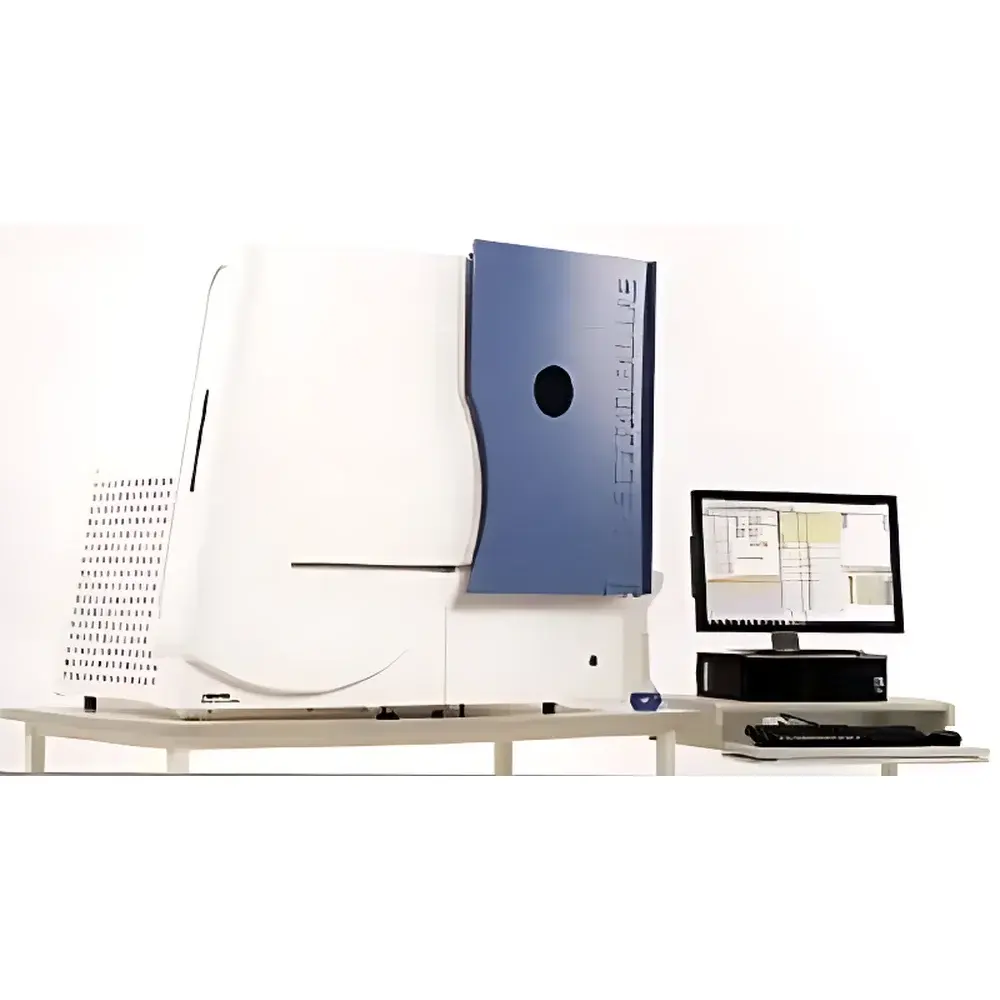
SPECTROBLUE ICP-OES Spectrometer
| Brand | SPECTRO |
|---|---|
| Origin | Germany |
| Model | SPECTROBLUE |
| Optical System | Paschen-Runge mount with 750 mm focal length |
| Detectors | 15 linear CCD arrays |
| Software | SPECTRO’s SMART ANALYSIS VISION |
| Compliance | Designed for ASTM D1976, ISO 11885, EPA Methods 200.7 & 200.8, EN 16173 |
Overview
The SPECTROBLUE is a high-performance inductively coupled plasma optical emission spectrometer (ICP-OES) engineered for routine multi-element analysis of liquid and digested solid samples in environmental, geochemical, agricultural, and industrial laboratories. Operating on the principle of atomic emission spectroscopy, the instrument atomizes and excites sample aerosols in a high-temperature argon plasma (~6,000–10,000 K), causing elements to emit characteristic wavelengths of light. These emissions are dispersed via a robust Paschen-Runge optical layout and resolved by 15 linear charge-coupled device (CCD) detectors—enabling simultaneous detection across a broad spectral range (typically 130–770 nm) with high photometric linearity and low background noise. Its compact monochromator design, combined with air-cooled RF generation and integrated UV-PLUS purge technology, eliminates reliance on external water chillers or high-purity nitrogen/argon purging for the vacuum ultraviolet (VUV) region—thereby reducing operational overhead while maintaining long-term spectral stability and detector quantum efficiency below 190 nm.
Key Features
- 750 mm focal length Paschen-Runge spectrometer with fixed grating geometry—ensuring mechanical rigidity, minimal wavelength drift, and high optical throughput.
- Fifteen linear CCD arrays positioned along the Rowland circle—delivering true simultaneous multi-element coverage without sequential scanning delays or sensitivity loss.
- UV-PLUS sealed optical chamber with internal gas recirculation and catalytic oxygen scrubbing—enabling stable transmission down to 130 nm without continuous high-purity gas consumption.
- High-efficiency air-cooled RF generator (up to 1.6 kW output) with ceramic plasma torch—designed for >10,000 hours of continuous operation and compatible with variable power modulation for matrix-adapted excitation.
- Integrated peristaltic pump, dual nebulizer system (standard + high-solids option), and cyclonic spray chamber—optimized for aqueous matrices including wastewater, soil extracts, plant digests, and feed slurries.
- Modular sample introduction architecture—supports autosamplers (e.g., SPECTRO ASR), micro-flow nebulization, and laser ablation interfaces for direct solid sampling when configured accordingly.
Sample Compatibility & Compliance
The SPECTROBLUE is validated for analysis of acid-digested environmental matrices per U.S. EPA Methods 200.7 (metals in drinking water) and 200.8 (metals in wastewater), as well as ISO 11885 (water quality — determination of selected elements by ICP-OES) and ASTM D1976 (trace metals in petroleum products). It meets EN 16173 requirements for heavy metal screening in soils and sludges. The system supports regulatory workflows under GLP and GMP environments through audit-trail-enabled software logging, user-access controls, electronic signatures (in compliance with FDA 21 CFR Part 11 when paired with validated VISION configuration), and full traceability of calibration history, QC checks, and raw spectral data archives.
Software & Data Management
SMART ANALYSIS VISION is SPECTRO’s proprietary, Windows-based instrument control and data reduction platform. It provides intuitive method setup wizards, automated background correction algorithms (including multi-point polynomial and peak-fit baselines), internal standard normalization, and matrix-matched calibration curve fitting with outlier rejection. All spectral acquisitions are stored in vendor-neutral .spc format with embedded metadata (instrument parameters, sample ID, operator, timestamp, integration time). The software supports LIMS integration via ASTM E1384-compliant export protocols and includes built-in reporting templates aligned with ISO/IEC 17025 documentation requirements. Raw spectrum viewing, spectral library matching, and interference correction tools (e.g., for Fe II lines overlapping As I at 193.696 nm) are accessible without add-on modules.
Applications
- Environmental monitoring: Quantification of regulated heavy metals (As, Cd, Cr, Cu, Ni, Pb, Zn, Hg, Se) in surface water, groundwater, leachates, and municipal biosolids.
- Agricultural testing: Multi-nutrient and contaminant profiling (Ca, Mg, K, P, B, Mn, Mo, Co, Al) in plant tissue, fertilizer solutions, and soil extracts.
- Industrial QA/QC: Rapid verification of alloy composition (Fe, Al, Cu, Ti, Ni base), catalyst residue analysis (Pt, Pd, Rh), and impurity screening in battery-grade Li, Co, and Ni salts.
- Food & feed safety: Screening for toxic elements (Cd, Pb, As) in animal feed, cereal grains, and infant formula digests per EU Commission Regulation (EU) No 2023/915.
- Geochemical exploration: High-throughput screening of rock powders and sediment cores for pathfinder elements (e.g., Au-associated Te, Sb, Bi) following HF-HNO₃ digestion.
FAQ
Does the SPECTROBLUE require external water cooling for the RF generator?
No—the system employs an advanced air-cooling architecture with thermally optimized heat sinks and forced convection, eliminating dependency on chiller units or deionized water loops.
Can the instrument analyze hydrofluoric acid (HF)-digested samples?
Yes, when equipped with a quartz or sapphire injector and corrosion-resistant sample introduction components; standard configurations support up to 3% HF concentration with appropriate wash protocols.
Is spectral interference correction automated in SMART ANALYSIS VISION?
Yes—interference correction models (e.g., for V 309.310 nm overlapping Fe 309.295 nm) are preloaded and configurable via user-defined correction coefficients or multivariate regression.
What sample introduction options are available beyond standard pneumatic nebulization?
Optional configurations include ultrasonic nebulizers (for enhanced sensitivity), desolvating systems (for organic solvent compatibility), and laser ablation modules (for direct solid sampling of metals, ceramics, and geological specimens).
How is data integrity ensured during regulatory audits?
VISION enforces role-based access control, full audit trails (including parameter changes and reprocessing events), electronic signature capture, and immutable storage of raw spectra and processed results—fully compliant with ALCOA+ principles and 21 CFR Part 11 when deployed in validated environments.






