
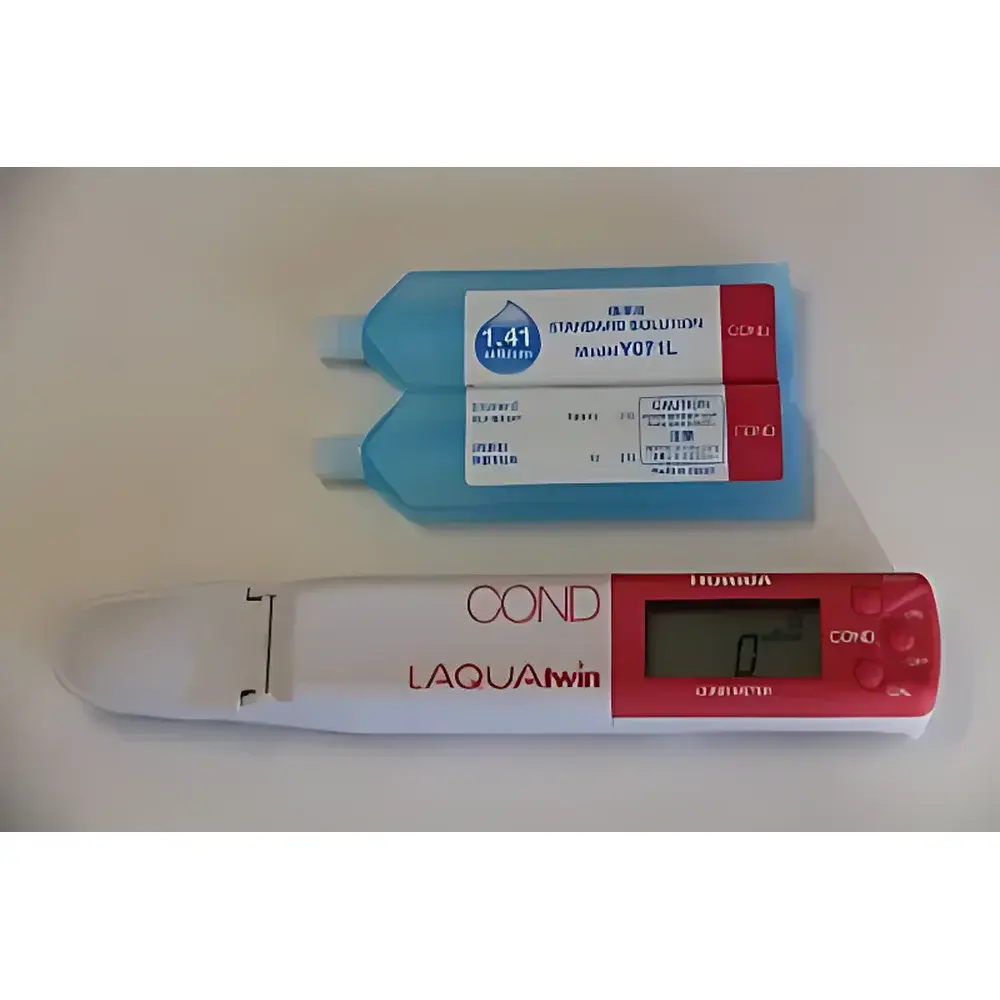
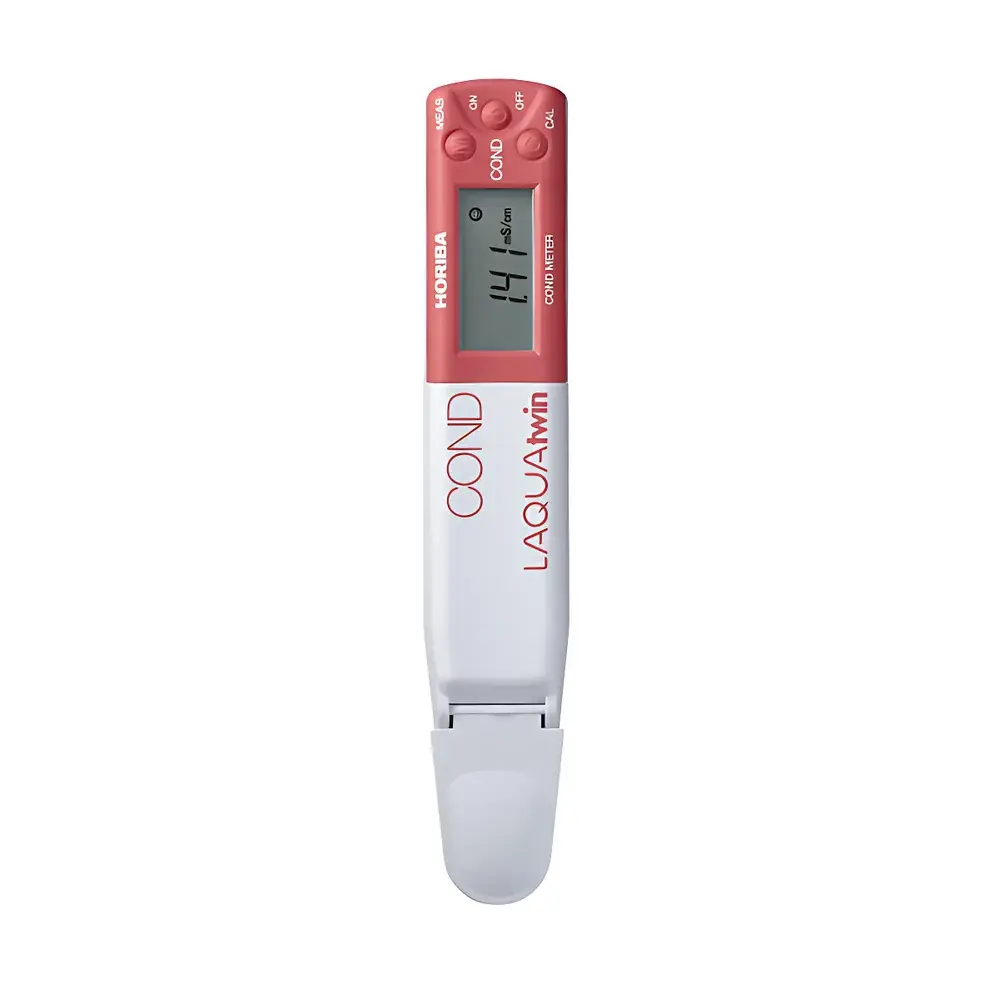
HORIBA B-771 Pocket Conductivity Meter
| Brand | HORIBA |
|---|---|
| Origin | Japan |
| Model | B-771 |
| Form Factor | Pen-type |
| Measurement Parameters | Conductivity (EC), TDS, Salinity, Temperature |
| Conductivity Range | 0–19.9 mS/cm |
| TDS Range | 0–9900 ppm |
| Salinity Range | 0–1.1 % (NaCl) |
| Temperature Range | 5–40 °C |
| Accuracy | ±2% F.S. (conductivity), ±0.1 °C (temperature) |
| Resolution | 0.1 mS/cm, 0.1 ppm (TDS), 0.01 % (salinity), 0.1 °C |
| Temperature Compensation | Automatic, fixed 2 %/°C coefficient |
| IP Rating | IP67 |
| Power | Two CR2032 batteries |
| Dimensions | 164 × 29 × 20 mm (excl. probe tip) |
| Weight | Approx. 45 g (instrument only) |
Overview
The HORIBA B-771 is a compact, pen-style conductivity meter engineered for field-deployable and routine laboratory use in water quality assessment, hydroponics, aquaculture, environmental monitoring, and educational applications. It operates on the principle of two-electrode AC conductometry—applying a low-frequency alternating current across a pair of stainless-steel electrodes to measure solution conductivity while minimizing polarization effects and electrode fouling. The instrument simultaneously computes and displays conductivity (EC), total dissolved solids (TDS), salinity (% NaCl), and temperature—each derived from a single measurement cycle with built-in temperature compensation per the standard 2 %/°C linear coefficient. Its rugged, sealed housing meets IP67 ingress protection standards, ensuring reliable operation in humid, dusty, or splash-prone environments without risk of internal contamination or electrical failure.
Key Features
- Pen-form factor with ergonomic grip and intuitive one-button interface for rapid deployment and single-handed operation
- Integrated dual-function sensor: stainless-steel electrodes calibrated for EC measurement and thermistor-based temperature sensing
- Automatic temperature compensation (ATC) using a fixed 2 %/°C coefficient—compliant with ISO 7888 and ASTM D1125 guidelines for conductivity reporting at 25 °C
- IP67-rated enclosure: fully dust-tight and submersible up to 1 m for 30 minutes—suitable for outdoor sampling, greenhouse use, and wastewater inspection
- Low-power design powered by two replaceable CR2032 coin-cell batteries (typical lifespan >1000 measurements)
- Auto-hold function freezes stable readings for documentation; no external data logger required for basic field recording
- Zero calibration capability and one-point conductivity calibration support via standard KCl solutions (e.g., 1413 µS/cm or 12.88 mS/cm)
Sample Compatibility & Compliance
The B-771 is optimized for aqueous samples with low to moderate ionic strength—including freshwater, nutrient solutions, brackish water, aquarium effluents, and municipal drinking water. It is not intended for highly viscous, suspended-solid-laden, or strongly oxidizing media (e.g., concentrated bleach or strong acids). The device complies with IEC 60529 (IP67), RoHS Directive 2011/65/EU, and electromagnetic compatibility requirements per EN 61326-1:2013. While not validated for GLP or GMP-regulated workflows, its measurement repeatability (±2% F.S.) and traceable calibration protocol support routine QC checks aligned with ISO/IEC 17025 preconditions for non-accredited laboratories.
Software & Data Management
The B-771 operates as a standalone instrument with no embedded Bluetooth, USB, or PC connectivity. All measurements are displayed in real time on a high-contrast LCD screen with dual-unit readout (e.g., mS/cm and ppm TDS). Data logging requires manual transcription. For traceability, users are advised to record instrument ID, calibration date, standard used, ambient temperature, and sample identification in bound logbooks or LIMS-integrated spreadsheets. Though lacking FDA 21 CFR Part 11-compliant audit trails, its simplicity ensures minimal user-induced error and facilitates SOP-driven workflows in teaching labs and field service teams.
Applications
- Hydroponic nutrient solution monitoring: verifying EC stability before irrigation cycles
- Aquaculture pond management: tracking salinity drift and osmotic stress indicators in shrimp or tilapia systems
- Environmental field surveys: rapid screening of stream conductivity as a proxy for anthropogenic ion loading (e.g., road salt, agricultural runoff)
- Drinking water safety checks: confirming TDS levels remain below WHO-recommended thresholds (≤500 ppm)
- Classroom instruction: demonstrating ionic dissociation, electrolyte behavior, and temperature dependence of conductivity
- Greenhouse quality control: validating rinse water purity post-sterilization and pre-irrigation
FAQ
What calibration standards are recommended for the B-771?
Use certified KCl reference solutions—commonly 1413 µS/cm (for low-range verification) or 12.88 mS/cm (for mid-range validation)—at 25 °C. Rinse the electrode thoroughly with deionized water between calibrations.
Can the B-771 measure resistivity?
No. The instrument calculates and displays conductivity, TDS, and salinity only. Resistivity is the reciprocal of conductivity but is not computed or shown on-screen.
Is temperature compensation adjustable?
No. The B-771 applies a fixed 2 %/°C temperature coefficient per ISO 7888, eliminating user configuration errors but limiting applicability to non-standard electrolytes requiring custom β values.
How often should the electrode be cleaned?
Clean after each use in dirty or organic-rich samples using mild detergent and soft brush; soak in 0.1 M HNO₃ for 5 minutes if scaling occurs. Avoid abrasive pads or solvents.
Does the B-771 meet EPA or APHA method requirements?
It supports Method 120.1 (APHA) and EPA 120.1 for conductivity measurement when operated within specification and calibrated with NIST-traceable standards—but is not a certified method-specific instrument.






