
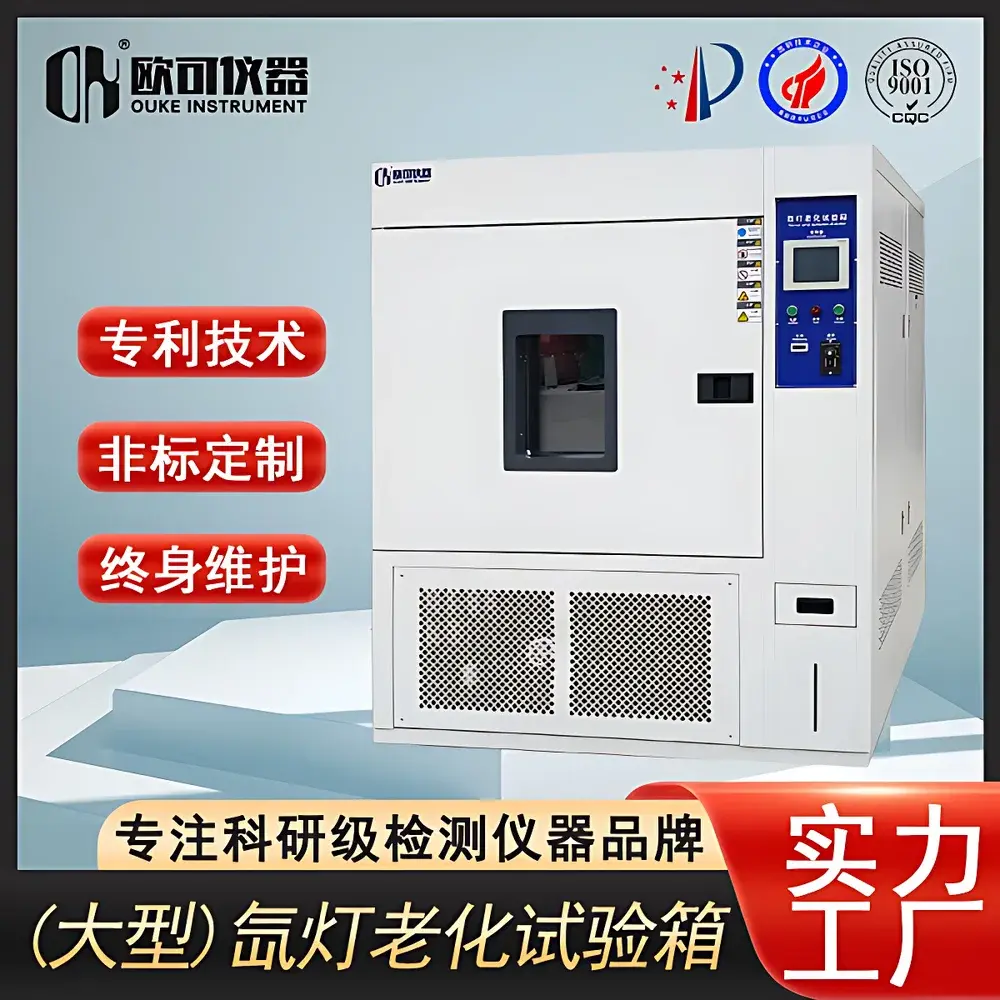
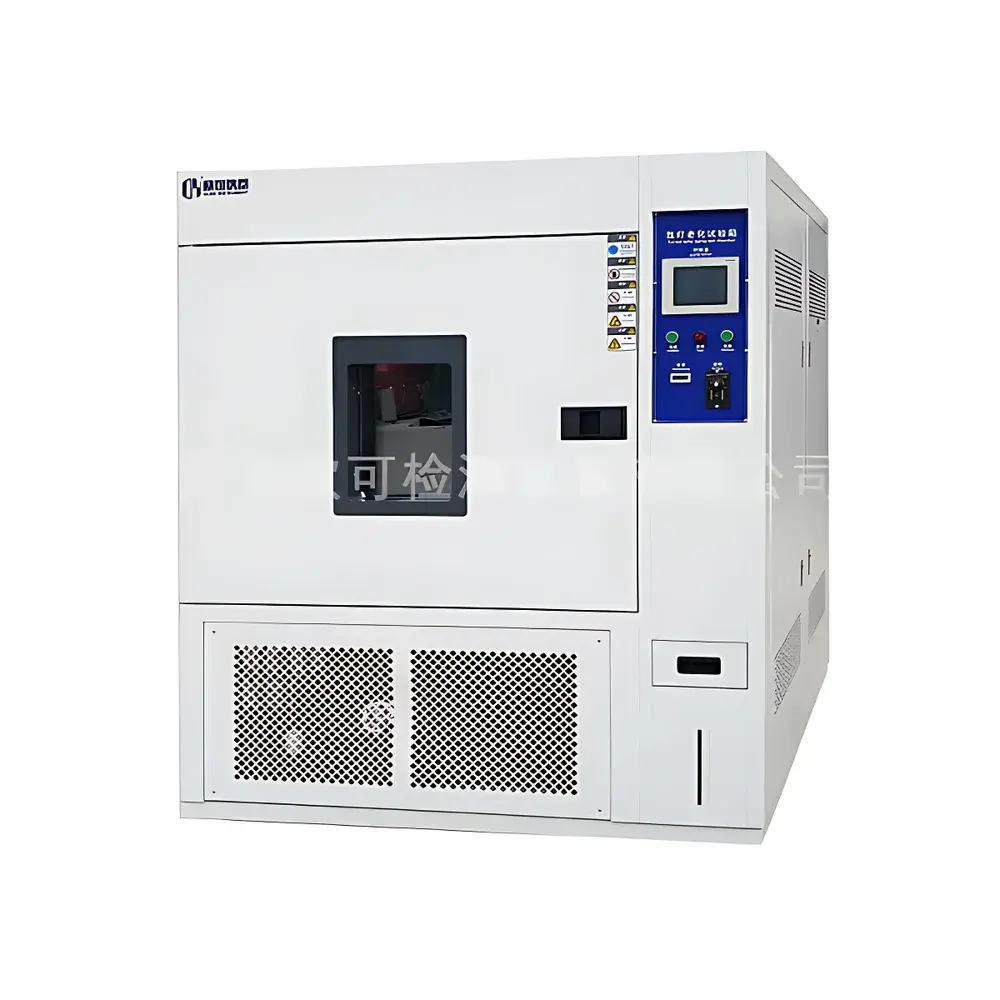
OK-XD-100 Xenon Arc Weathering Test Chamber
| Brand | OK Instruments |
|---|---|
| Origin | Guangdong, China |
| Manufacturer Type | Direct Manufacturer |
| Model | OK-XD-100 |
| Price | USD 5,300 (FOB) |
| Xenon Lamp Power Options | 1.8 kW / 2.5 kW / 6 kW |
| Radiant Flux Density | ≤1200 W/m² |
| Light Exposure Cycle Range | 1 s to 999 h (programmable in seconds, minutes, or hours) |
| Humidity Range (Light Cycle) | 20–75% RH |
| Temperature Range | –10°C to 80°C |
| Black Standard Temperature (BST) Control | 40–80°C |
| Irradiance Control | 0.3–1.0 W/m² @ 340 nm (manual adjustment) |
| Sample Rack | Rotating type (standard), optional fixed or custom large-format |
| Filter Options | Daylight (D65), Window Glass (W), UV-Enhanced |
| Compliance | ISO 4892-2, ASTM G155, SAE J2527, IEC 61215, GB/T 1865 |
Overview
The OK-XD-100 Xenon Arc Weathering Test Chamber is an engineered environmental simulation system designed to replicate the full-spectrum solar irradiance, thermal cycling, humidity variation, and moisture exposure conditions encountered in real-world outdoor service life. Unlike narrow-band UV chambers, this instrument employs a high-intensity xenon arc lamp whose spectral output—when paired with precision optical filters—closely matches natural sunlight across the ultraviolet (290–400 nm), visible (400–700 nm), and near-infrared (700–800 nm) regions. This broad spectral fidelity enables physicochemical degradation mechanisms—including photooxidation, thermal aging, hydrolytic cleavage, and photothermal stress—to be activated simultaneously and proportionally, yielding accelerated yet metrologically traceable aging data. The chamber integrates closed-loop control of black standard temperature (BST), relative humidity, irradiance at critical wavelengths (e.g., 340 nm), and programmable light/dark, spray/condensation cycles—making it suitable for compliance testing per ISO 4892-2, ASTM G155, SAE J2527, and IEC 61215.
Key Features
- Triple-configurable xenon lamp options: air-cooled (1.8 kW / 2.5 kW) for compact labs and cost-sensitive R&D; water-cooled (6 kW) for high-uniformity irradiation across large-area samples (up to 5 m²)
- Interchangeable optical filter system supporting three standardized spectral profiles: Daylight (D65), Window Glass (W), and UV-Enhanced—each certified to ISO 4892-2 spectral tolerances
- PID-controlled BST and chamber temperature (–10°C to 80°C) with ±1°C accuracy; humidity regulation (20–98% RH) with ±3% RH stability during light cycles
- Programmable multi-stage test sequences: independent timing control for irradiation, dark periods, spray duration (0.1–0.3 MPa), and condensation phases
- Rotating sample rack (standard) ensures irradiance uniformity ≤±5% across specimen surfaces—critical for inter-laboratory reproducibility
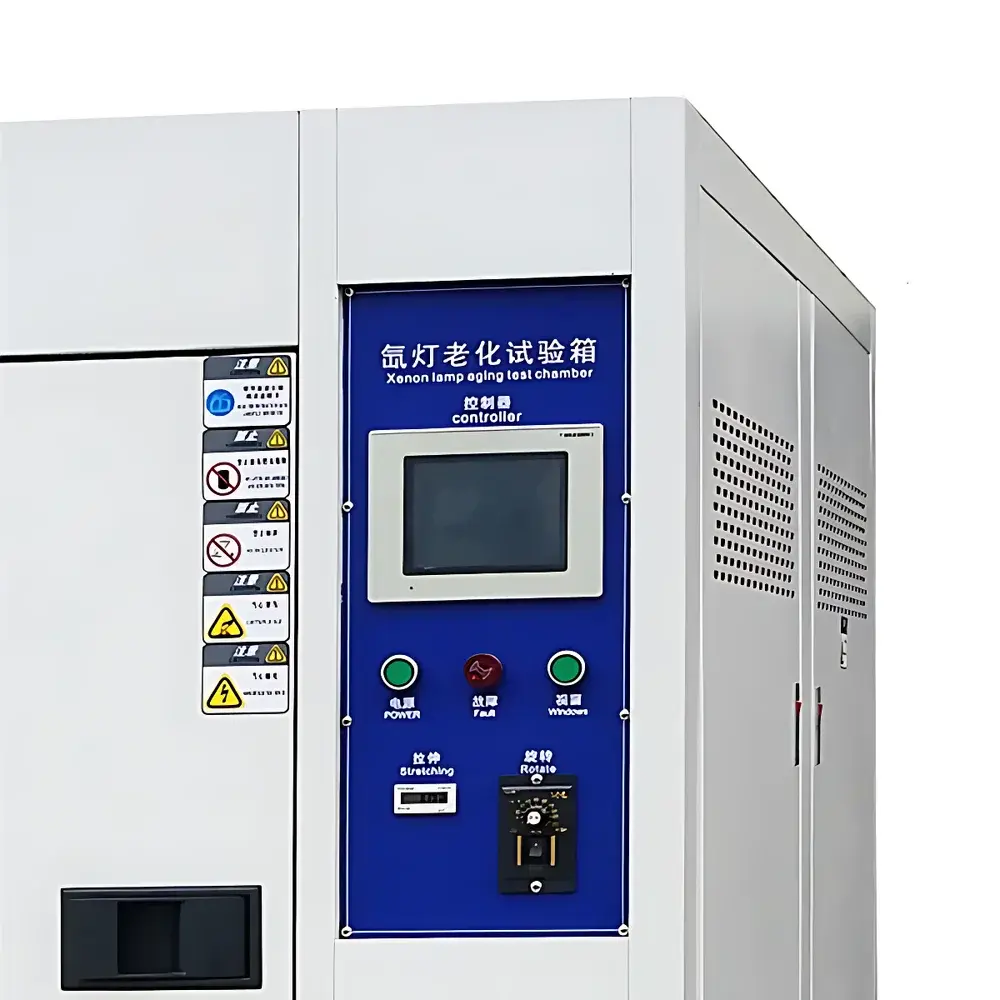
- PLC-based control interface with 10.1″ capacitive touchscreen, USB data export, real-time graphing, and password-protected user levels for GLP/GMP environments
Sample Compatibility & Compliance
The OK-XD-100 accommodates flat, curved, or irregular specimens up to 50 mm thick on its rotating or fixed rack configurations. It supports standard specimen holders per ISO 4892-2 (100 × 75 mm, 150 × 75 mm) and accepts custom fixtures for automotive trim, PV module coupons, or aerospace composite panels. All operational parameters—including irradiance setpoint, BST, RH, and cycle timing—are fully configurable to match test protocols defined in international standards. The system meets essential requirements for regulatory submission: irradiance monitoring traceable to NIST-calibrated sensors; audit-ready event logging (start/stop, lamp replacement, calibration); and hardware-enforced safety interlocks (door switch, overtemperature cutoff, low-water shutdown). Optional validation packages include IQ/OQ documentation aligned with ISO/IEC 17025 and FDA 21 CFR Part 11 readiness.
Software & Data Management
The embedded controller firmware supports up to 100 multi-step programs, each with independent ramp rates, dwell times, and conditional logic (e.g., “initiate spray after 4 h irradiation at 65°C BST”). Real-time data—including irradiance (W/m² @ 340 nm), BST, chamber RH, and lamp voltage—is logged at user-selectable intervals (1 s to 60 min) and stored internally (≥1 year capacity). Export formats include CSV and Excel-compatible .xls for integration with LIMS or statistical analysis platforms (e.g., JMP, Minitab). Optional Ethernet/WiFi connectivity enables remote monitoring via secure HTTPS interface and scheduled automatic report generation. For GLP-compliant labs, optional software modules provide electronic signatures, change history tracking, and 21 CFR Part 11–compliant audit trails—including operator ID, timestamp, parameter modifications, and sensor calibration records.
Applications
This chamber serves as a primary qualification tool in industries where long-term outdoor durability is mission-critical. In automotive engineering, it validates color stability, gloss retention, and crack resistance of interior trims (leather, PVC, TPO) and exterior coatings under SAE J2527 cyclic exposures. For coatings manufacturers, it quantifies chalking, blistering, and adhesion loss per ISO 11341 and ASTM D4587. Polymer compounders use it to optimize UV stabilizer packages in polyolefins, ABS, and PC—correlating yellowing index (Δb*) and tensile strength loss with field exposure. Photovoltaic material suppliers perform sequential qualification per IEC 61215—assessing EVA discoloration, backsheet delamination, and power degradation under UV + thermal + humidity stress. Aerospace and defense applications include evaluating thermal barrier coatings on turbine housings and UV resistance of radar-absorbing materials per MIL-STD-810H Method 505.5.
FAQ
What spectral range does the OK-XD-100 cover, and how is it validated against natural sunlight?
The xenon arc source emits from 290 nm to 800 nm. When combined with the D65 daylight filter, its spectral power distribution (SPD) conforms to CIE Publication No. 85 and ISO 4892-2 Annex A, with <±10% deviation from AM1.5G reference spectra between 300–800 nm.
Can the chamber operate without spray or condensation cycles?
Yes—each environmental stressor (irradiation, temperature, humidity, spray, condensation) is independently programmable. Users may define light-only, light+heat, or dark+humidity profiles as required by specific test methods.
Is irradiance calibration required before each test?
No—factory calibration is performed using NIST-traceable radiometers. However, users must verify irradiance output every 100 operating hours or after lamp replacement using the integrated broadband or narrowband (340 nm) sensor, per ISO 4892-2 Section 7.2.
Does the OK-XD-100 support automated data export to laboratory information management systems (LIMS)?
Yes—via USB mass storage mode or optional TCP/IP interface. Raw time-series logs include metadata headers (test ID, operator, start time, lamp hours) compatible with common LIMS ingestion protocols.
What maintenance intervals are recommended to ensure measurement integrity?
Xenon lamp replacement at 1000–1500 h (air-cooled) or 1500–2000 h (water-cooled); quarterly inspection of filter integrity and quarterly recalibration of RH/temperature sensors using traceable reference standards.



