
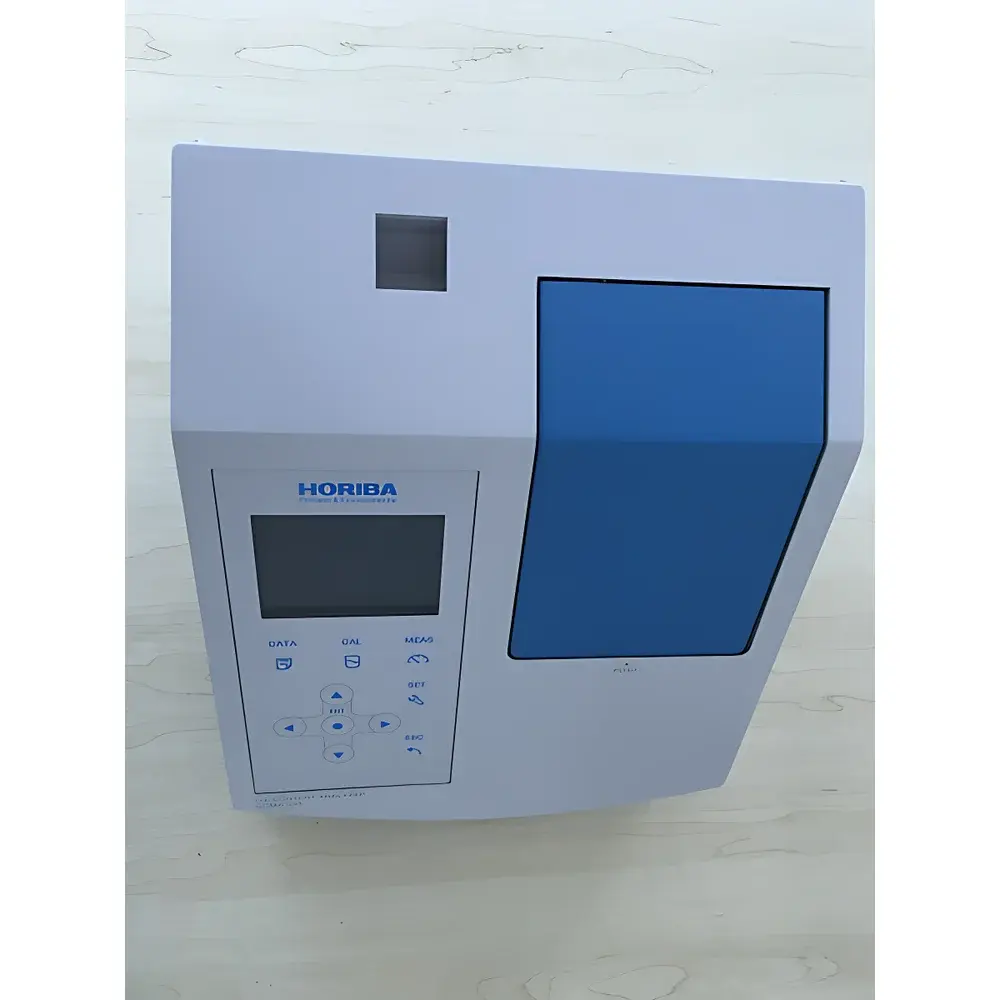
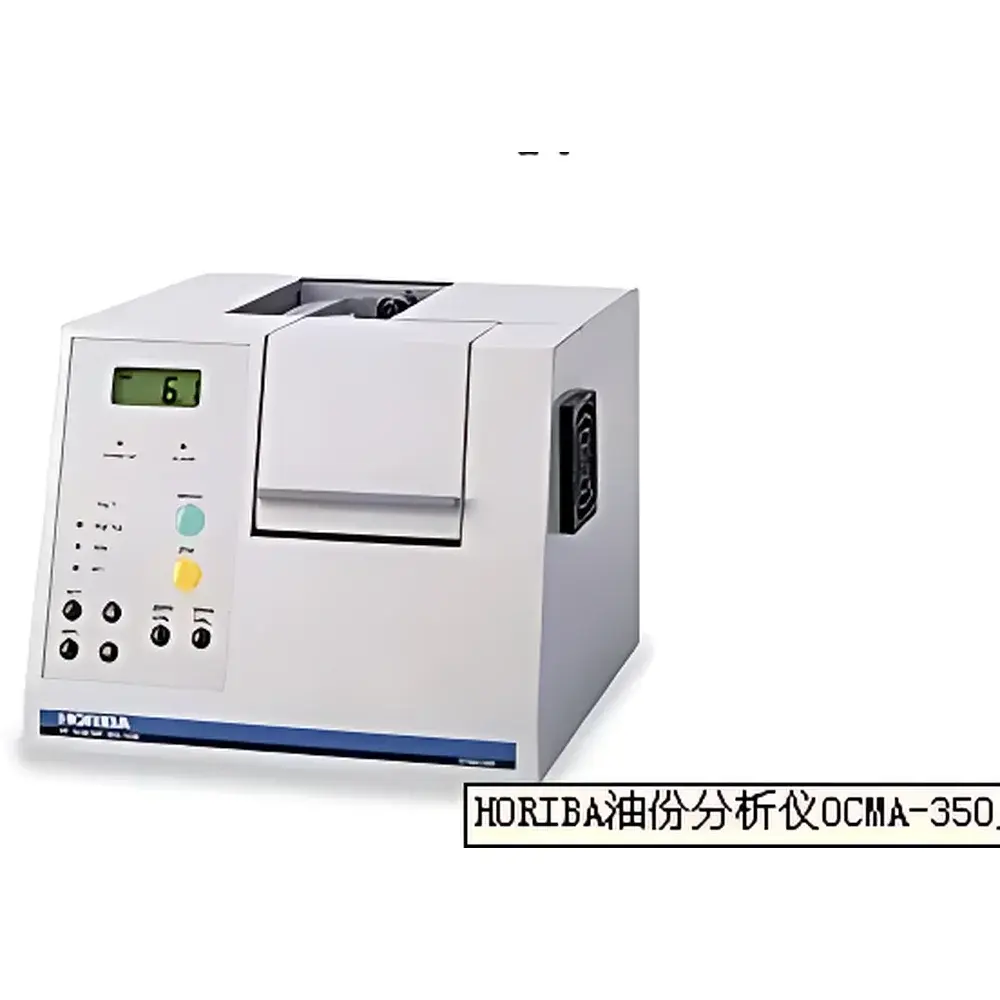
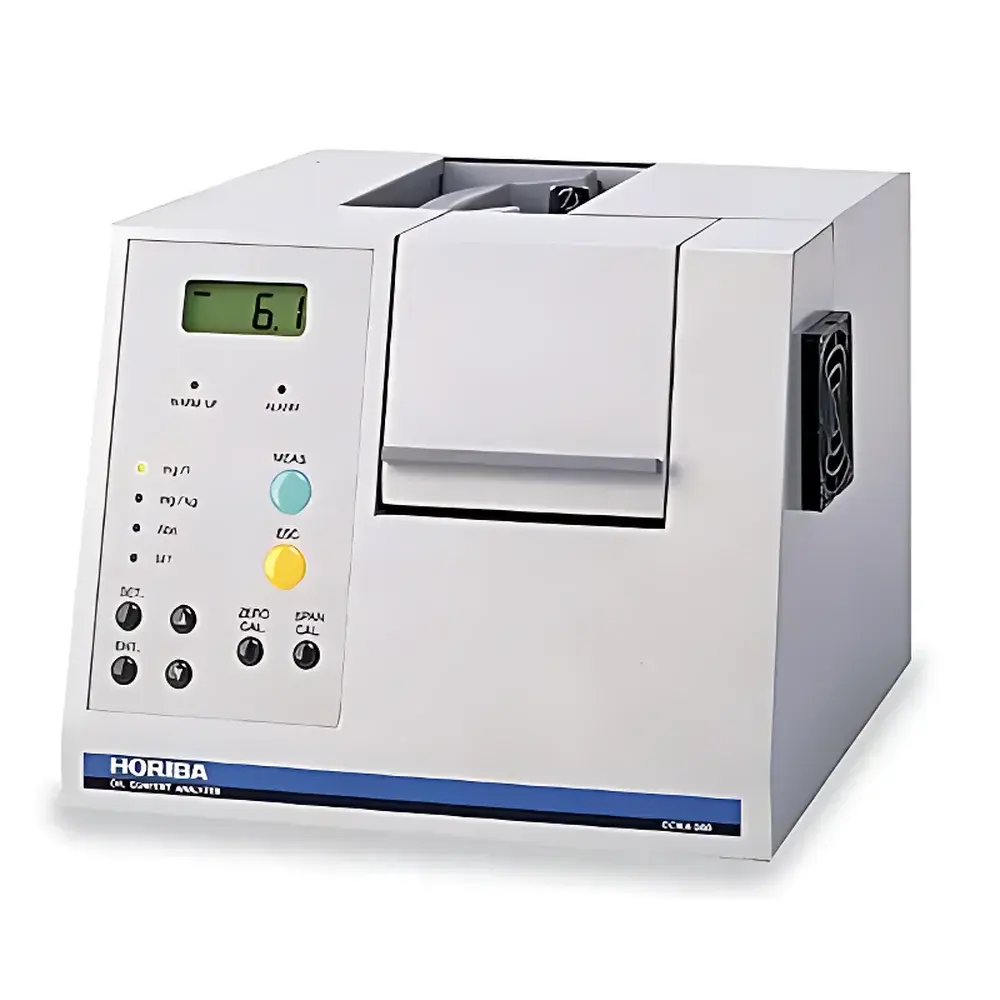
HORIBA OCMA-550 Portable Oil Content Analyzer
| Brand | HORIBA |
|---|---|
| Origin | Japan |
| Model | OCMA-550 |
| Instrument Principle | Non-Dispersive Infrared (NDIR) Absorption Spectrophotometry |
| Measurement Range | 0–200 mg/L, 0–1000 mg/kg, 0–1 Abs |
| Accuracy | ±1% of reading (at 1 mg/L level) |
| Resolution | 0.1 mg/L (for 0–99.9 mg/L range) |
| Detector Type | Thermoelectric Sensor |
| Optical Path | 20 mm Quartz Cuvette |
| Power Supply | 230 V AC, 50 Hz |
| Dimensions | 250 × 200 × 285 mm (W × H × D) |
| Display | Backlit LCD with timestamped data logging |
| Interface | RS-232C port and parallel printer port |
| Extractant Compatibility | S-316 solvent (non-absorbing at ~3.4 µm) |
Overview
The HORIBA OCMA-550 is a portable, field-deployable oil content analyzer engineered for precise quantification of hydrocarbon contaminants in aqueous and solid-phase environmental samples. It operates on the principle of non-dispersive infrared (NDIR) absorption spectrophotometry, targeting the characteristic C–H stretching vibration band near 3.4 µm — a spectral region where mineral oils, lubricants, and petroleum-based hydrocarbons exhibit strong, selective absorbance. Critically, the instrument is calibrated for use with S-316 solvent (1,1,2-trichloro-1,2,2-trifluoroethane), which exhibits negligible IR absorption at this wavelength, ensuring that only extracted oil components contribute to the measured signal. This methodology complies with foundational principles outlined in ASTM D7066 and ISO 9377-2 for hydrocarbon determination in water and soil matrices. The OCMA-550 is not a standalone extraction system but a dedicated photometric detector optimized for post-extraction analysis — requiring prior liquid–liquid or solid–liquid extraction using standardized protocols.
Key Features
- Triple-unit measurement capability: switch seamlessly between concentration units — mg/L (for water extracts), mg/kg (for soil/solid extracts), and absorbance (Abs) — directly on the instrument interface
- High-resolution thermoelectric detector with stable thermal response, enabling reproducible measurements across dynamic ranges without recalibration between runs
- Backlit LCD display with integrated real-time timestamping for GLP-compliant recordkeeping; no external software required for basic operation
- Dual data output: direct hardcopy via parallel printer port or digital export via RS-232C serial interface for integration into LIMS or QA/QC databases
- Compact, ruggedized chassis (250 × 200 × 285 mm) designed for mobile laboratory deployment, on-site remediation monitoring, and industrial process control environments
- Pre-configured calibration with certified reference standard (B-grade heavy oil) and dual-volume syringes (10 mL and 25 µL) for accurate sample introduction
Sample Compatibility & Compliance
The OCMA-550 accepts pre-extracted samples dissolved in S-316 solvent, making it compatible with standard EPA Method 1664A (revision B) and ISO 9377-2 workflows. It supports analysis of wastewater effluents, groundwater monitoring wells, sediment cores, metalworking fluid residues, textile mill rinse waters, and surface wipe samples from precision manufacturing lines. While the instrument itself does not perform extraction, its optical design ensures high specificity for aliphatic and aromatic hydrocarbons — excluding interference from chlorinated solvents, alcohols, or ketones when S-316 is used as the extractant. For regulatory reporting, users must validate method performance per US EPA requirements, including spike recovery (≥85–115%), reagent blank assessment, and ongoing calibration verification using NIST-traceable standards. The device meets CE marking requirements for electromagnetic compatibility (EN 61326-1) and safety (EN 61010-1).
Software & Data Management
The OCMA-550 operates autonomously without proprietary software; all measurement logic, unit conversion, and zero-point auto-calibration are embedded in firmware. Upon power-on, the system performs an internal dark-current correction and baseline stabilization routine. Measured absorbance values are converted in real time using stored calibration coefficients derived from the supplied B-grade oil standard. Timestamped results are retained in volatile memory until manually cleared or exported. When connected to a host computer via RS-232C, the instrument transmits ASCII-formatted data packets containing sample ID (user-entered), date/time stamp, selected unit, numeric result, and instrument status flags. This architecture facilitates audit-trail generation under FDA 21 CFR Part 11 when paired with validated third-party data acquisition software supporting electronic signatures and change control.
Applications
- Field screening of contaminated groundwater and surface water at brownfield sites and hazardous waste facilities
- Compliance monitoring of industrial discharge permits (e.g., NPDES) for petroleum hydrocarbons in wastewater streams
- Verification of cleaning efficacy in semiconductor wafer fabrication tools and precision mechanical component washing systems
- Residual oil quantification on machined parts, stamped metals, and textile substrates prior to coating or assembly
- Quality assurance testing of emulsified cutting fluids and spent grinding coolants in metalworking operations
- Supporting ISO 14001 environmental management system documentation through traceable, repeatable field measurements
FAQ
What extraction solvent is required for OCMA-550 operation?
S-316 (1,1,2-trichloro-1,2,2-trifluoroethane) is mandatory — its transparency at 3.4 µm ensures selective oil detection without solvent interference.
Can the OCMA-550 measure diesel, gasoline, or BTEX compounds independently?
No — it measures total hydrocarbon mass based on C–H bond density; compound-specific identification requires GC-MS or FTIR spectral deconvolution.
Is the OCMA-550 compliant with ISO/IEC 17025 requirements?
Yes, when operated within a documented quality system including periodic verification with certified reference materials and uncertainty budgeting per ISO/IEC 17025:2017 Clause 7.6.
Does the instrument support multi-point calibration?
No — it uses a single-point factory calibration traceable to HORIBA’s primary standard; users perform daily zero checks with solvent blanks.
What is the minimum detectable level under typical field conditions?
Based on stated resolution and accuracy, the practical limit of quantitation (LOQ) is 0.5 mg/L in water extracts, assuming optimal extraction efficiency and low particulate interference.
Related Products







