
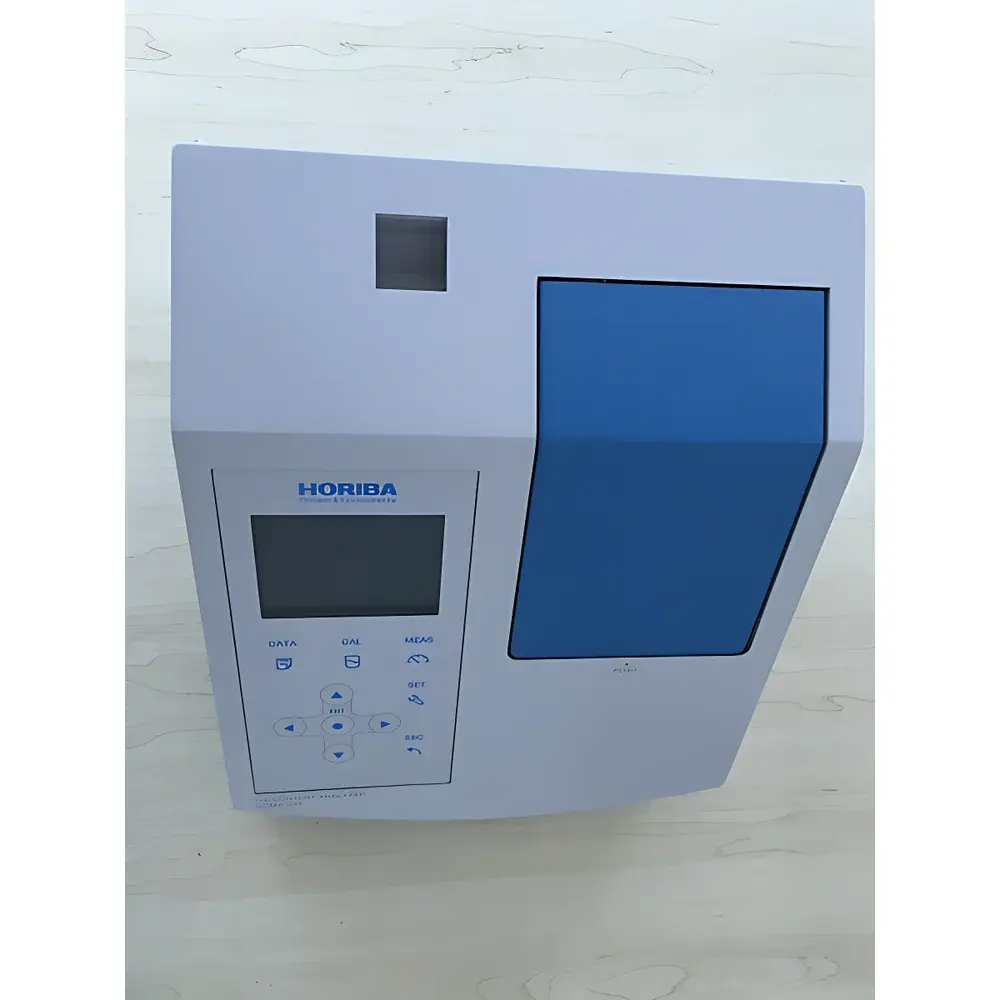
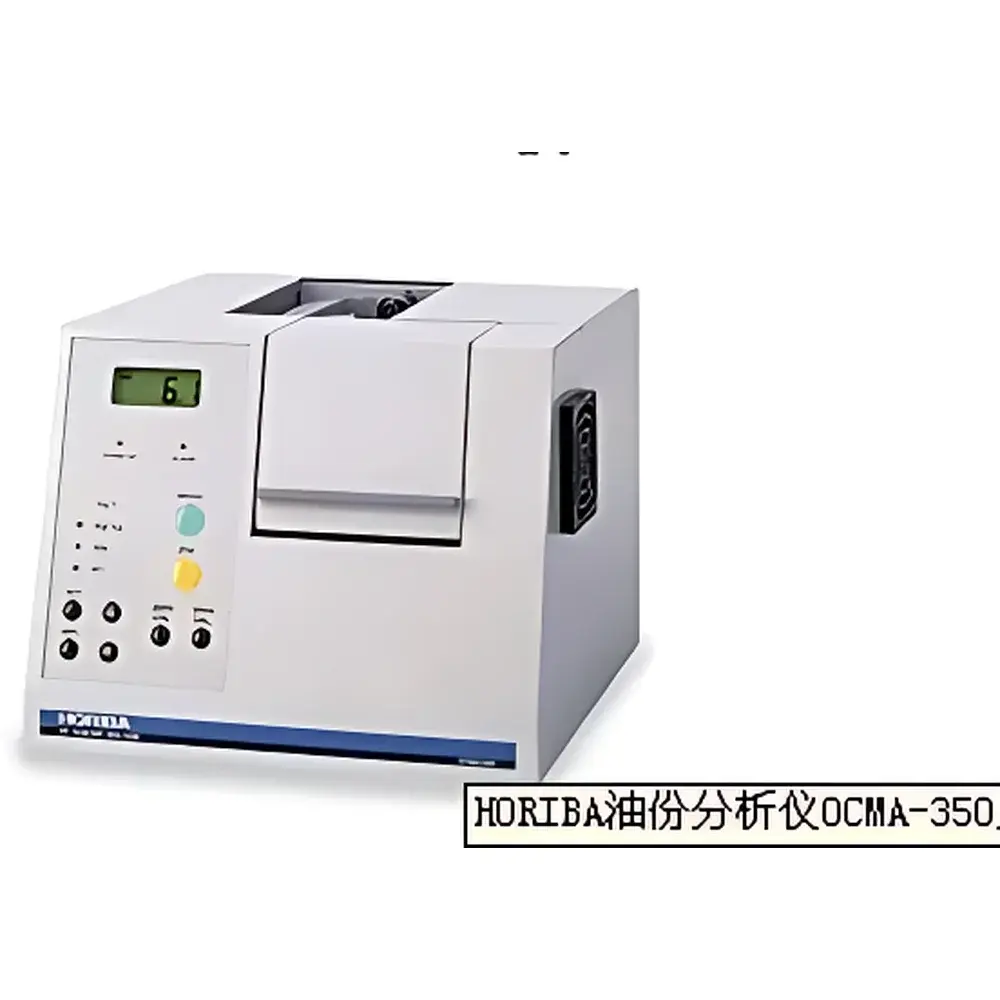
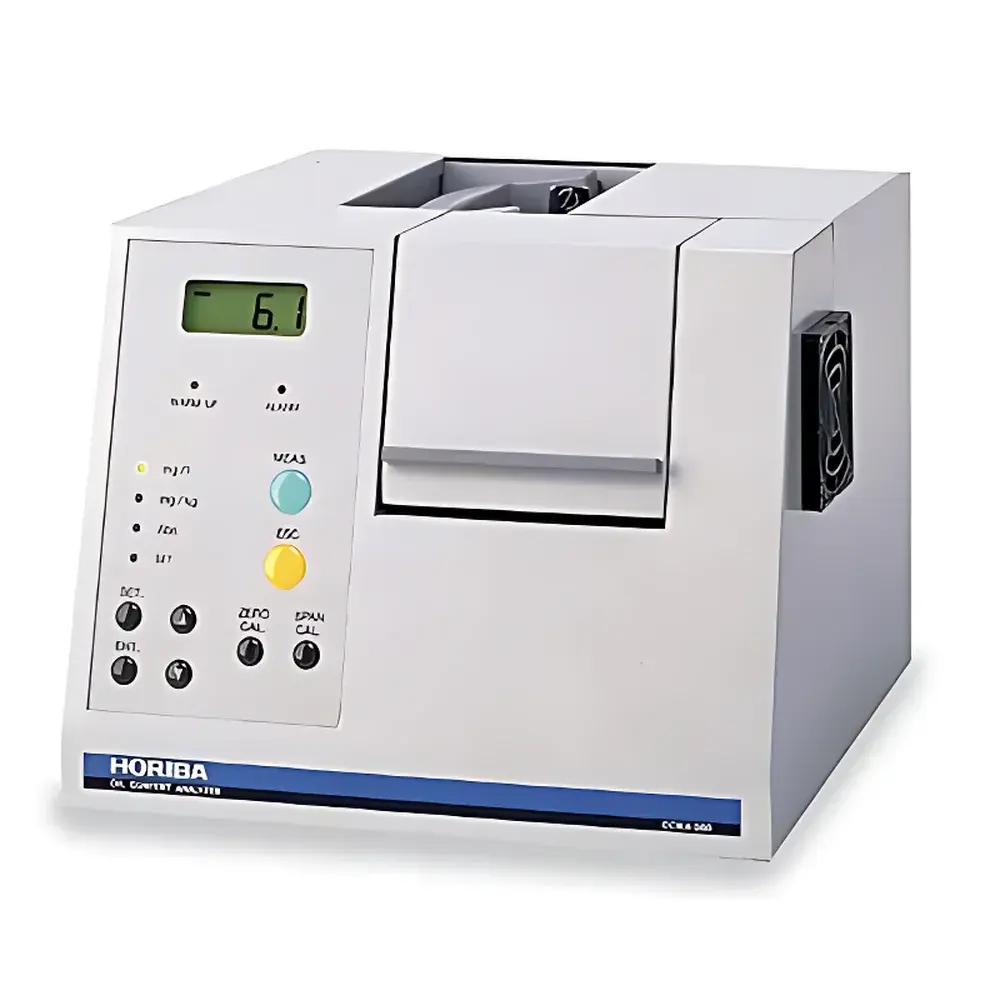
HORIBA OCMA-550 Portable Oil Content Analyzer
| Brand | HORIBA |
|---|---|
| Origin | Japan |
| Model | OCMA-550 |
| Instrument Type | Portable |
| Measurement Principle | Non-Dispersive Infrared (NDIR) Absorption with S-316 Solvent Extraction |
| Detection Range | 0–200 mg/L (water), 0–1000 mg/kg (soil), 0–1 Abs |
| Repeatability | ±0.4 mg/L (0–9.9 mg/L), ±2.0 mg/L (10.0–99.9 mg/L), ±4 mg/L (100–200 mg/L), ±1% F.S. (0–1 Abs) |
| Sensitivity | 1% of full scale |
| Optical Path | Quartz Cuvette (200 mm path length) |
| Detector | Thermoelectric Sensor |
| Display | Backlit LCD with Timestamp |
| Interface | RS-232C, Parallel Printer Port |
| Power Supply | 230 V AC, 50 Hz |
| Dimensions | 250 × 200 × 285 mm (W × H × D) |
| Standard Accessories | Covered quartz cuvette, power cord, heavy oil standard (B-grade), 2 A fuse, 10 mL & 25 µL syringes |
Overview
The HORIBA OCMA-550 Portable Oil Content Analyzer is an engineered solution for trace-level hydrocarbon quantification in aqueous and solid-phase environmental and industrial samples. It operates on the principle of non-dispersive infrared (NDIR) absorption spectroscopy at the characteristic C–H stretching band near 3.4 µm — a region where hydrocarbons exhibit strong, selective absorbance while the extraction solvent S-316 remains optically transparent. This spectral specificity ensures high selectivity for aliphatic and aromatic hydrocarbons (e.g., mineral oils, lubricants, diesel, and cutting fluids) without interference from water, salts, or common suspended solids. Designed for field-deployable and laboratory-based compliance monitoring, the OCMA-550 delivers quantitative results directly traceable to gravimetric and reference-standard calibration protocols aligned with ISO 9377-2 (petroleum hydrocarbons in water) and ASTM D7066 (oil-in-water analysis by IR). Its architecture supports rapid turnaround — from solvent-assisted liquid–liquid extraction (using S-316) to single-button measurement — making it suitable for on-site wastewater screening, soil contamination assessment, and post-cleaning validation in precision manufacturing.
Key Features
- Triple-unit display capability: switch seamlessly between concentration units — mg/L (for water extracts), mg/kg (for soil extracts), and absorbance (Abs) — enabling direct comparison across sample matrices without manual conversion.
- Integrated timestamp functionality: each measurement is automatically annotated with date and time, satisfying GLP documentation requirements for audit-ready data integrity.
- Thermoelectric detector with stable thermal compensation: minimizes drift during extended operation and ensures reproducibility across ambient temperature fluctuations (10–35 °C).
- Backlit LCD interface with intuitive icon-driven navigation: eliminates need for external PCs during routine field use; supports real-time viewing of absorbance spectra overlays when connected to optional software.
- RS-232C and parallel printer port: enables direct export of raw absorbance values, concentration results, and calibration metadata to LIMS or spreadsheet environments.
- Modular solvent handling compatibility: designed for integration with the optional SR-305 solvent regeneration system — featuring dual-layer activated carbon and activated alumina columns — to extend S-316 service life and reduce hazardous waste generation per ASTM D7084 guidelines.
Sample Compatibility & Compliance
The OCMA-550 accepts pre-extracted samples prepared via standardized S-316 solvent extraction (OCMA-550 method) or H-997 solvent (OCMA-555 variant). It accommodates heterogeneous matrices including industrial effluents with suspended solids (SS), emulsified oils, textile rinse waters, metalworking coolant residues, and soil leachates. Its 200 mm quartz cuvette provides enhanced sensitivity for low-concentration detection down to 0.1 ppm (as total petroleum hydrocarbons, TPH), validated against NIST-traceable reference oils. The instrument conforms to key regulatory frameworks: EPA Method 1664 (revision B) for oil and grease, ISO 9377-2 Annex A (infrared determination), and JIS K 0102 (Japanese Industrial Standard for water quality testing). All firmware and calibration routines comply with FDA 21 CFR Part 11 requirements for electronic records and signatures when used in GMP-regulated environments.
Software & Data Management
While the OCMA-550 operates autonomously, its RS-232C interface supports bidirectional communication with HORIBA’s OCMA Data Manager software (v3.2+), enabling automated calibration curve generation, multi-point standardization, batch reporting, and statistical process control (SPC) charting. Software logs include full audit trails: operator ID, calibration history, cuvette cleaning cycles, and outlier flagging based on ICH Q2(R2)-aligned precision thresholds. Data exports are compliant with CSV and XML formats for seamless ingestion into enterprise LIMS platforms. Firmware updates preserve historical calibration coefficients and maintain metrological continuity across instrument lifecycles.
Applications
- Environmental site assessment: rapid quantification of petroleum hydrocarbons in groundwater, surface water, and excavated soils at brownfield sites.
- Industrial pretreatment monitoring: real-time verification of oil removal efficiency in API separators, coalescers, and membrane filtration systems.
- Manufacturing process control: validation of degreasing efficacy for semiconductor wafers, aerospace components, and medical device substrates.
- Regulatory discharge compliance: routine testing of treated wastewater prior to release under local environmental permits (e.g., EU WFD, US Clean Water Act).
- Research & development: method development for alternative solvents, emulsion stability studies, and biodegradation kinetics of hydrocarbon contaminants.
FAQ
What extraction solvent is required for the OCMA-550?
S-316 (1,1,2-trichloro-1,2,2-trifluoroethane) is the specified solvent for OCMA-550 operation. It provides optimal spectral transparency at 3.4 µm and high extraction efficiency for C10–C40 hydrocarbons.
Can the OCMA-550 measure emulsified oil without phase separation?
No — the method requires complete solvent extraction followed by phase separation. Emulsions must be broken using centrifugation or chemical demulsifiers prior to S-316 extraction.
Is the instrument suitable for seawater analysis?
Yes, provided salinity does not exceed 35 g/L and samples undergo appropriate blank correction using matrix-matched standards.
How often must the instrument be calibrated?
Initial calibration is performed using certified B-grade heavy oil standard. Field recalibration is recommended before each analytical session or after every 20 measurements, per ISO/IEC 17025 internal quality control protocols.
Does the OCMA-550 support remote diagnostics or firmware updates?
Firmware updates require local connection via RS-232C and HORIBA’s authorized configuration utility. Remote diagnostics are not supported; however, error codes and sensor health status are displayed in real time on the LCD.
Related Products







