
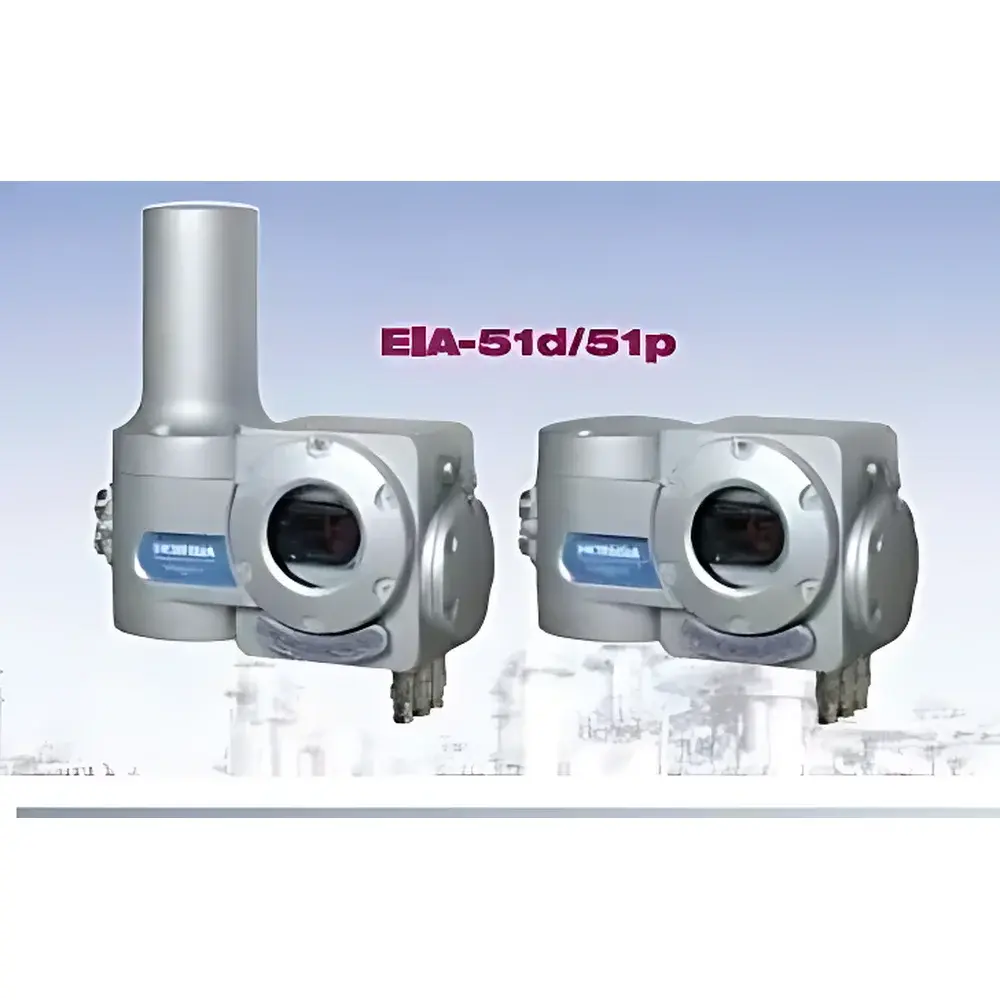
HORIBA EIA-51d/EIA-51p Intrinsically Safe and Explosion-Proof NDIR Gas Analyzer
| Brand | HORIBA |
|---|---|
| Origin | Japan |
| Model | EIA-51d / EIA-51p |
| Explosion Protection | Ex d IIB+H2 T4 (EIA-51d) / Ex p II T4X (EIA-51p) |
| Measurement Principle | Non-Dispersive Infrared (NDIR) with Interference Compensation |
| Detectable Gases | CO, CO₂, CH₄ (configurable per application) |
| Range | 0–0.11 vol% to 0–100 vol% (gas-dependent) / 0–50 ppm to 0–2000 ppm |
| Repeatability | ±0.5% F.S. (standard range) |
| Linearity | ±1.0% F.S. |
| Zero/Full-Scale Drift | ±2.0% F.S./week |
| Response Time (T90) | ≤20 s (standard), ≤40 s (extended range) |
| Sample Flow Rate | 500 mL/min |
| Operating Ambient | –5 to +40 °C, RH <90%, vibration <0.3 m/s² @ 100 Hz |
| Analog Output | Isolated 4–20 mA (DC), optional 0–10 V / 1–5 V |
| Communication | RS-485, Modbus RTU (selectable baud rates: 1200–19200 bps) |
| Sample Contact Materials | SUS304, SUS316, FKM, CaF₂, Au |
| Purge Gas | N₂, 196–690 kPa, 0.5–10 L/min |
Overview
The HORIBA EIA-51d and EIA-51p are certified explosion-proof non-dispersive infrared (NDIR) gas analyzers engineered for continuous, high-integrity measurement of combustible gases—including carbon monoxide (CO), carbon dioxide (CO₂), and methane (CH₄)—in hazardous industrial environments. Designed in compliance with IEC 60079 series standards, the EIA-51d implements flameproof (Ex d) protection rated for Group IIB+H₂ atmospheres with temperature class T4 (max surface temperature ≤135 °C), while the EIA-51p utilizes pressurized enclosure (Ex p) protection for Group II applications under T4X conditions. Both models employ interference-compensated NDIR detection—a dual-detector optical architecture wherein a primary measurement detector and a reference compensation detector operate within the same optical path. This configuration actively mitigates spectral interference from co-existing gases, mechanical vibration, and long-term drift induced by source aging or cell contamination—enabling stable, trace-level quantification without frequent recalibration.
Key Features
- Explosion-proof certification to IEC 60079-1 (Ex d IIB+H₂ T4) and IEC 60079-2 (Ex p II T4X), suitable for Zone 1 and Zone 2 classified areas in petrochemical, refining, biogas, and chemical manufacturing facilities.
- Interference-compensated NDIR optics delivering enhanced selectivity and measurement robustness in complex gas matrices containing water vapor, hydrocarbons, or other IR-active interferents.
- Wide dynamic range capability: configurable spans from 0–50 ppm to 0–100 vol%, supporting both trace monitoring and high-concentration process control applications.
- High metrological stability: repeatability of ±0.5% F.S. and linearity of ±1.0% F.S. on standard ranges; zero and span drift limited to ±2.0% F.S./week under controlled ambient conditions.
- Fast response performance: T90 ≤20 seconds for standard measurement ranges, ensuring timely detection of rapid gas concentration changes during safety-critical events.
- Modular analog and digital interfaces: isolated 4–20 mA output with programmable alarm thresholds (–10% to +110% of full scale); optional RS-485 port supporting Modbus RTU protocol at selectable baud rates (1200–19200 bps).
- Chemically resistant wetted materials—including SUS304/SUS316 stainless steel, fluorocarbon elastomers (FKM), calcium fluoride (CaF₂) windows, and gold-coated optical surfaces—for extended service life in corrosive or particulate-laden sample streams.
Sample Compatibility & Compliance
The EIA-51d and EIA-51p are validated for use with dry, dust-free sample gases containing ≤21% oxygen. They are not intended for direct measurement in inerted or oxygen-enriched atmospheres beyond specified limits. Sample pressure must exceed 1.98 kPa (absolute), with nominal flow maintained at 500 mL/min via external sampling system. For optimal accuracy and longevity, inlet gas must be free of condensable vapors, aerosols, and particulates; optional heated sample lines or particulate filters may be integrated upstream. The analyzers comply with international hazardous area directives and support audit-ready operation in regulated environments: their hardware design, calibration traceability, and firmware architecture align with principles of GLP and GMP documentation frameworks. While not inherently 21 CFR Part 11 compliant, the optional Modbus-enabled data logging interface allows integration into validated SCADA or DCS platforms that implement electronic signature and audit trail functionality.
Software & Data Management
Operation is managed via an intuitive front-panel interface with tactile keypad and high-contrast LCD display—designed for glove-compatible interaction in industrial settings. All critical parameters—including span/gas selection, alarm setpoints, output scaling, and communication settings—are configurable without software tools. Manual zero/span calibration is standard; optional auto-calibration modules support scheduled or event-triggered verification using certified span gases. Raw concentration values, status flags (e.g., sensor fault, low flow, over-range), and diagnostic logs are accessible via Modbus registers. When connected to a central historian or MES system, time-stamped measurement data—including analog output values and discrete alarm states—can be archived with millisecond-resolution timestamps. Firmware updates are performed via secure serial upload following documented change control procedures, preserving calibration coefficients and user configurations.
Applications
These analyzers serve mission-critical roles across multiple sectors requiring reliable gas monitoring in explosive atmospheres. Typical deployments include: continuous CO monitoring in syngas purification units and hydrogen production facilities; CO₂ concentration tracking in fermentation off-gas streams and landfill biogas upgrading systems; CH₄ leak detection and flare gas composition analysis in upstream oil & gas infrastructure; and combustion efficiency optimization in industrial boilers operating under hazardous classification. Their dual-certification variants also enable redundant or cross-validated installation strategies—e.g., deploying EIA-51d in primary flameproof enclosures and EIA-51p in pressurized instrument cabinets—supporting SIL 2-rated safety instrumented functions (SIFs) when integrated with appropriate logic solvers.
FAQ
What explosion protection certifications does the EIA-51d hold?
The EIA-51d is certified Ex d IIB+H₂ T4 per IEC 60079-1, permitting use in Zone 1 areas where flammable gas-air mixtures equivalent to IIB group (e.g., ethylene) or hydrogen-containing atmospheres may occur.
Can the EIA-51p measure hydrogen (H₂) directly?
No—the EIA-51p uses NDIR technology, which is insensitive to diatomic gases like H₂. HORIBA offers complementary thermal conductivity or electrochemical-based analyzers for H₂ detection in pressurized enclosures.
Is automatic calibration available as a factory-installed option?
Yes—optional automated zero/span calibration modules are available, supporting timed or demand-initiated calibration sequences using external solenoid valves and certified reference gases.
What sample conditioning is required upstream of the analyzer?
A dedicated sample probe, particulate filter, moisture trap, and pressure regulator are recommended. For wet or corrosive streams, heated sample lines and acid-scrubbing pre-treatment may be necessary to preserve optical integrity and sensor longevity.
Does the device support HART communication?
No—only RS-485 Modbus RTU is supported. HART compatibility is not implemented; integration with HART-based control systems requires a protocol converter.
Related Products







